
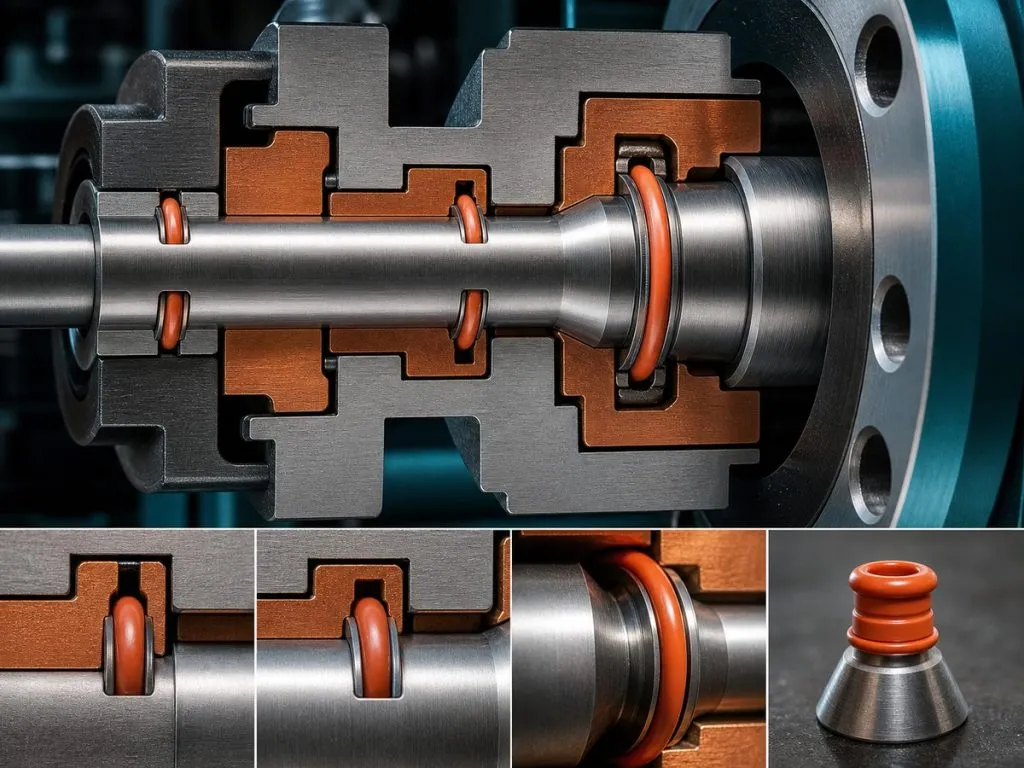
Why does groove design determine the reliability of an O-Ring?
The O-ring itself is just the elastomer that really makes it seal:
- compression volumeContact stress from
- Groove to O-RingPositioning and Limiting
- Gap control has a significant impact oncrowding-out riskinhibition
Therefore, the essence of many "even if you change the material does not work" problems is that the groove does not match the assembly conditions.
Common Trench Types (by most common application in engineering)
1) Face seal (axial seal) groove
Features: The O-ring is sandwiched between two end faces.
- Advantages: intuitive structure, easy assembly
- Focus: end face flatness, surface roughness, compression uniformity
2) Radial sealing grooves (I.D./O.D. sealing)
Characteristics: O-rings are pressurized in the circumferential direction.
- Advantages: suitable for cylinders, housings, joints
- Focus: Concentricity, Clearance, Extrusion & Edge Bite
3) Dynamic sealing grooves (with relative motion)
Characteristics: Need to balance sealing and friction.
- Focus: Frictional heat generation, lubrication, abrasion, material wear resistance
Essentials of Design and Assembly (Practical Edition)
1) Give the O-Ring a "safe compression space".
Too little compression: easy to leak
Excessive compression: assembly difficulties, reduced life, increased permanent deformation in compression
2) Groove chamfer/import angle is the key to preventing scratches
The most common failure during assembly is: the O-ring is damaged by a sharp corner.gashmaybefrizz.
3) Control of extrusion risk: clearance + hardness + pressure
When the pressure increases and the gap is too large, the elastomer is extruded.
- Options: reduce clearance, increase hardness, increase support structure (depending on working conditions)
4) Surface roughness and cleanliness
- Surfaces too coarse can form microchannels
- Surface burrs can damage O-rings
5) Assembly recommendations
- Use compatible lubricants when needed
- Avoid torsion (torsion leads to localized stress concentrations)
- For batch assembly, it is recommended to stabilize the assembly method with a jig.
Don't just look at "O-Ring Size", always consider "Groove + Assembly + Media/Temperature".
Frequently Asked Questions (FAQ)
Q: Why does the same O-ring behave differently in different housings?
Usually caused by groove depth, clearance, end face flatness, or assembly scratches.
Q: What is the first thing to change when the assembly is leaking?
It is recommended to check first:
1) Are there any scratches
2) Whether the compression is sufficient
3) Whether the end face/groove has burrs or deformation
Suggested information for you
In order to give a quicker suggestion of landable grooves, it is best to provide:Groove cross-section size, material hardness, working pressure/waterproofing target, dynamic movement or not, assembly method.