What information do you have to prepare? (You can do this 10 minutes before you start customizing.)
Before looking for a silicone products factory, organize the following information first, communication will be much faster:
- Product Use: Sealing, waterproofing, dustproofing, cushioning, keying, overmolding, etc.
- working environment: Temperature range, exposure to oil/alcohol/solvents/acids/alkalis, prolonged outdoor use.
- Structural information: 2D drawings (PDF/DWG) or 3D (STEP/IGES), critical dimensions and tolerances.
- Target performance: Hardness (Shore A), tensile, resilience, abrasion resistance, flame retardant, etc.
- Appearance requirements: Color, surface texture, whether printing/oil spraying/laser engraving is required.
- Annual usage and delivery time: Determine the mold solution and unit price range.
The more complete the information, the faster the proofing; but even without drawings, it is possible to work backwards from samples or sketches.
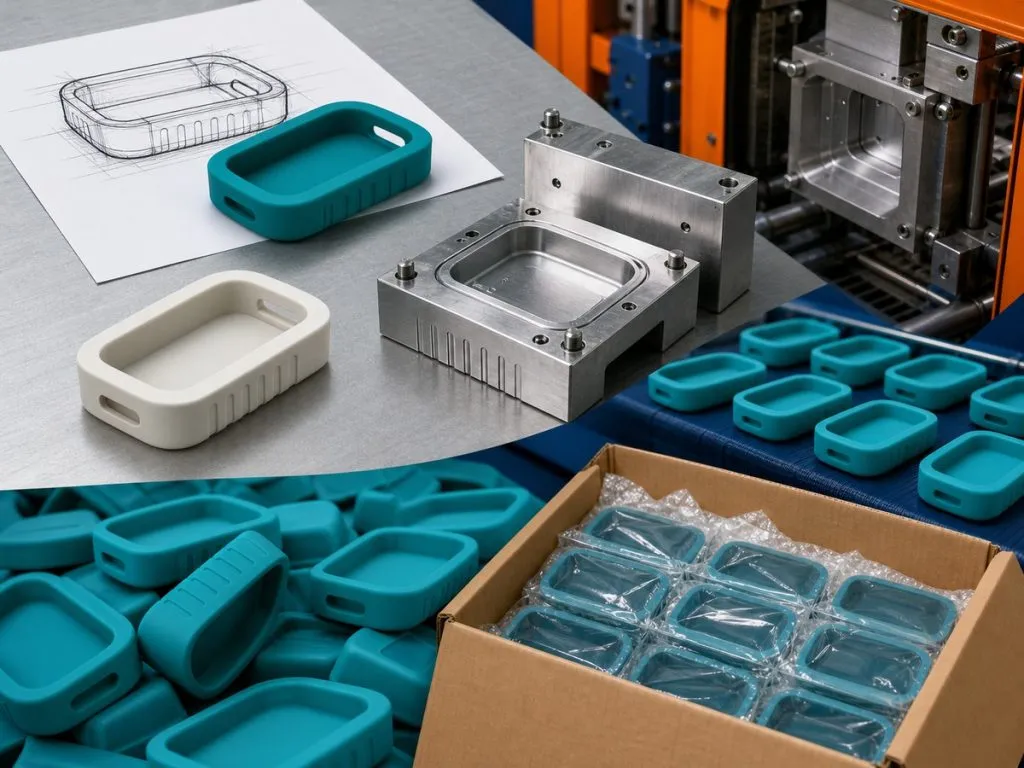
Standard customization process: from drawing to mass production (it is recommended to advance in this order)
1) Requirements Identification and Manufacturability Review (DFM)
The factory will focus on looking at it:
- is or isn'tThin edges, sharp corners, deep cavitiesand other locations that make mold release difficult.
- Whether the sealing parts meet thecompression ratiotogether withgroove fit.
- Are the tolerances reasonable: too tight can lead to higher costs, too loose can affect assembly and consistency.
(2) Material and formula selection
Common Choice Ideas:
- General Silicone: Temperature and weather resistant, suitable for most consumer electronics and appliance parts.
- High tear/high resilience silicone: Suitable for structures with frequent assembly or high forces.
- Oil/chemical resistant materials(e.g. FKM, etc.): Suitable for oil, fuel and solvent environments.
3) Mold program determination (the most critical step before opening the mold)
It will be decided:
- Number of cavities, gate locations, venting solutions
- Mold Steel and Life Expectancy
- Whether secondary processes are required (gluing, oiling, printing, etc.)
4) Proofing (T0/T1) and size confirmation
Proofing common output:
- sample
- Dimensional measurement report (critical dimensions)
- Material/Color Confirmation
5) Pilot production and process validation (small batch)
The goal is not to "do more" but to validate:
- Yield and Appearance Stability
- Assembly and sealing performance
- Reproducibility of key process parameters
6) Mass production and quality inspection
Commonly used control points in the mass production phase:
- Incoming Material Inspection (Adhesives/Accessories)
- First article confirmation, inspection
- Shipment inspection (size/appearance/functionality/packaging)
6 Factors Affecting Delivery Time and Cost
- Whether the drawings are clear and key dimensions are labeled
- Whether special materials or certified documents are required
- Mold complexity and number of cavities
- Appearance process (oil spraying, printing, hand oiling, etc.)
- Number of test items and standards
- Packaging and Shipping Requirements
Frequently Asked Questions (FAQ)
Q1: Can I do it with only samples and no drawings?
Yes. Usually a mapping modeling is done first, and then a proof is made to confirm.
Q2: How long does it take to proof?
Related to the complexity of the mold. Well-documented projects with simple structures are usually faster.
Q3:How to avoid "sample is OK, but mass production is unstable"?
It is recommended to do a small batch trial production after confirming the samples to fix the key parameters, inspection points and assembly methods.
Related Custom Products and Inquiries
Please provide drawings, key dimensions, material specifications, operating conditions, and estimated quantities so we can discuss feasible prototyping and production plans.