
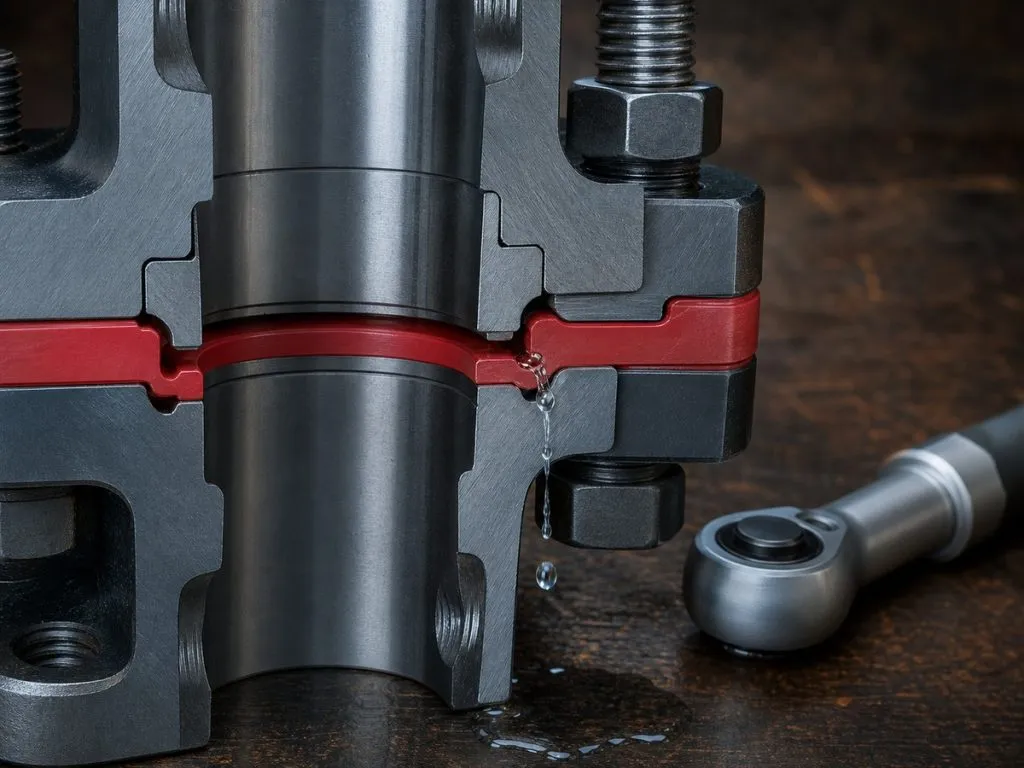
When a seal is leaking, a comprehensive investigation of the materials, structure, tolerances, and assembly conditions is required. This article outlines general troubleshooting approaches; specific causes should be determined based on project testing.
1. First identify: at what stage of the leakage occurs
- Leaks on test fit: mostly size/groove/assembly issues
- No leakage at the beginning, but leakage after aging: mostly CS, thermal aging, preload decay due to temperature cycling.
- Intermittent leakage: mostly assembly deviation, sealing surface contamination, structural deformation
2. 10 high-frequency clearance directions (in order of priority)
- Whether the compression is within the design window (compression after actual assembly)
- Whether the groove depth/width tolerance is superimposed over the tolerance
- Does chamfering/rounding result in seal cuts
- Whether the roughness of the sealing surface is too large (formation of microchannels)
- Insufficient flatness/coaxiality of parts
- Consistency of screw torque and distribution (insufficient localized preload)
- Whether the seal is twisted, turned or overstretched
- Is the lubricant incompatible (causing swelling/slip)
- Whether the material hardness is too high or too low (insufficient assembly force and contact stress)
- Excessive CS after aging (preload decay)
3. Rapid validation methodology (not equivalent to a final determination)
- Colored water/negative pressure method to locate leakage channels
- Localized pressurization vs. zoned blocking to determine which section of the seal line failed
- After disassembly, check the seal cut, indentation uniformity and contamination
4. Common ideas for rectification
- Structural priority: adjusting grooves, adding chamfers, optimizing compression
- Assembly sequence: tooling positioning, torque control, assembly sequence
- Material final: optimization of hardness and low CS after confirmation of structure and assembly
5. Delivering the recommendations: putting "manufacturability" into the drawings
- Key dimension marking and inspection methods
- Appearance standard: Sealing surface area burrs and notch limitation
- CPK requirements and process control points
FAQ
1. will changing to a softer material fix it?
Possible short-term improvement, but may also lead to extrusion, wear, or longevity issues. It is recommended that compression and groove tolerances be checked first.
2. Why do some of the same batches leak and some do not?
Usually caused by assembly deviations superimposed on tolerances. It is recommended to do a tolerance chain analysis and include assembly robustness verification.
Related Custom Products and Inquiries
Please provide drawings, key dimensions, material specifications, operating conditions, and estimated quantities so we can discuss feasible prototyping and production plans.