
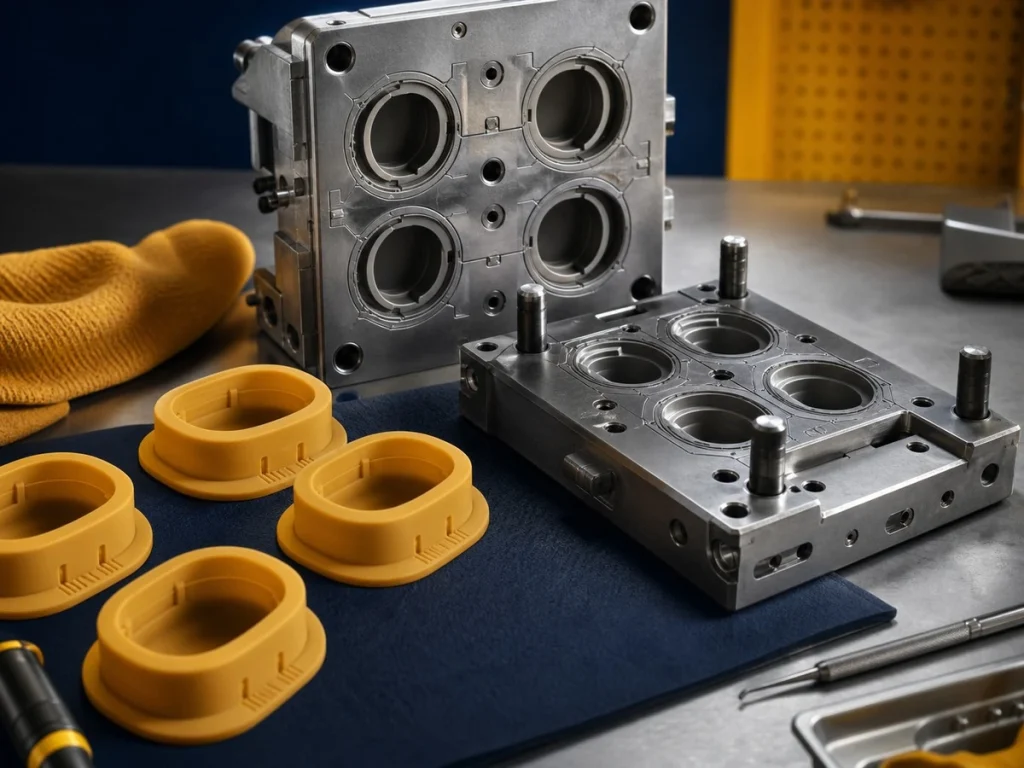
The acceptance of a silicone mold is not about confirming that a sample can be produced, but rather about confirming that it can be used for continuous production under stable process conditions. Dimensions, venting, demolding, flash, and ease of maintenance should all be included in the initial acceptance inspection.
1. Review the design documents before producing the first piece
If the mold does not conform to the drawings, templates, materials, and process requirements, it will be difficult to trace the source of subsequent problems.
- Confirm the part number, key dimensions, and parting line locations
- Confirm the number of cavities, gates, venting, and positioning method
- Specify the number of acceptance samples and the acceptance criteria
2. Focus on evaluating product performance
The first unit should be inspected for appearance, dimensions, weight, and assembly functionality, rather than simply selecting the best one.
- Measuring Key Dimensions and Multi-Cavity Consistency
- Check for air bubbles, missing material, flash, and demolding marks
- Conduct functional testing on sealing and push-button products simultaneously
3. Observe the process window
If a product meets specifications only within an extremely narrow range of parameters, the risks associated with mass production are typically high.
- Record temperature, pressure, vulcanization time, and demolding cycle time
- Try varying the parameters within a reasonable range
- Observe dimensional drift and resin buildup after continuous production
4. Delivery and Maintenance Documentation
Maintainable molds can reduce subsequent downtime and communication costs.
- Provide mold numbers, maintenance requirements, and information on wear parts
- Save the first-piece report and trial mold parameters
- Define the procedures for mold storage, maintenance, and modification
FAQ
1. Does a first-piece pass mean the mold has been accepted?
Not necessarily. It is also important to verify continuous production stability, consistency across multiple cavities, and ease of maintenance.
2. How many pieces are required for mold acceptance?
This should be determined based on the product’s complexity and risk; for critical seals, it is recommended to cover multiple cycles and multiple cavities.