Scope and common interpretation errors
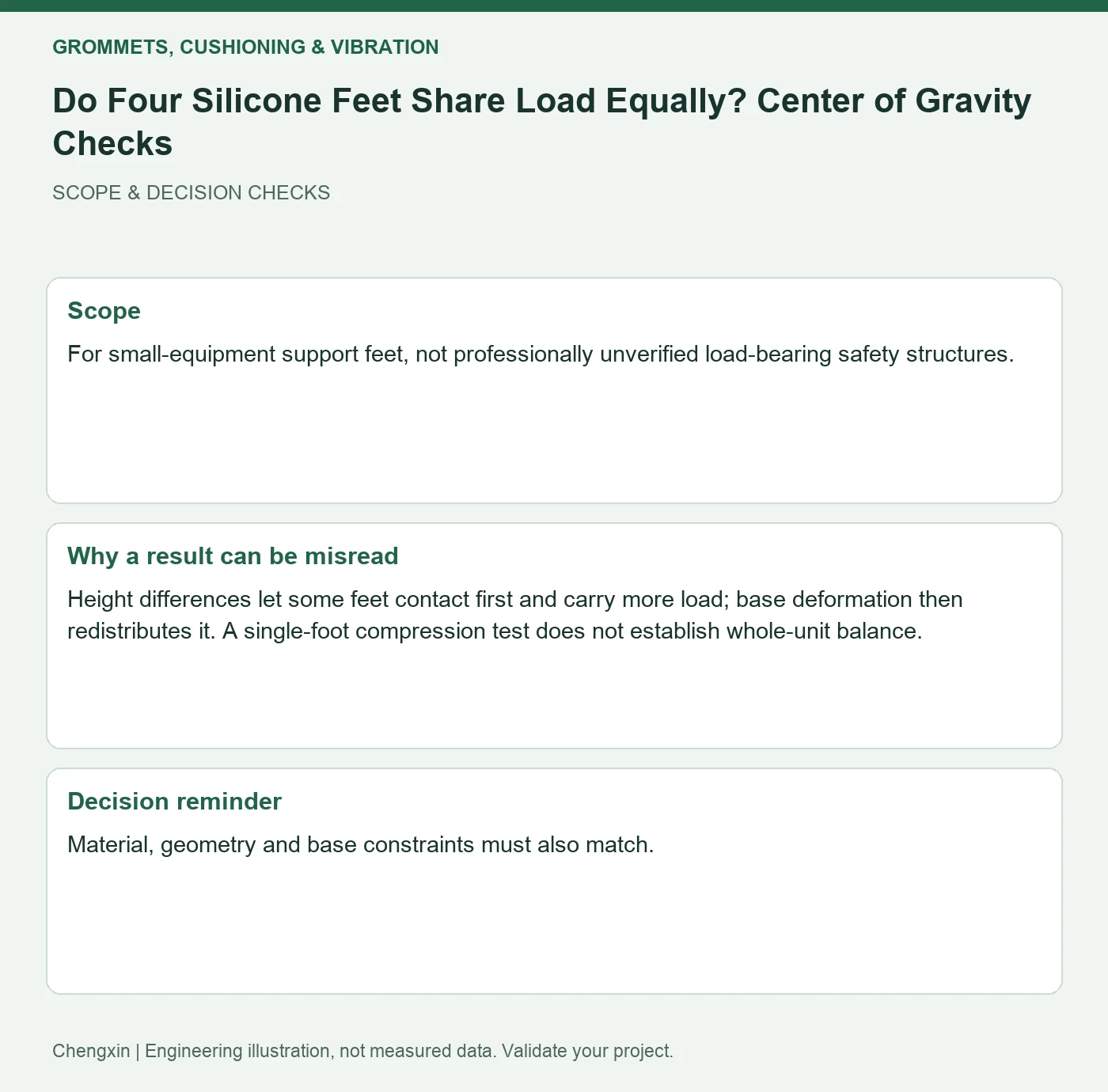
For small-equipment support feet, not professionally unverified load-bearing safety structures.
Height differences let some feet contact first and carry more load; base deformation then redistributes it. A single-foot compression test does not establish whole-unit balance.
Turn the review into recorded checks
| Step | Action and evidence |
|---|---|
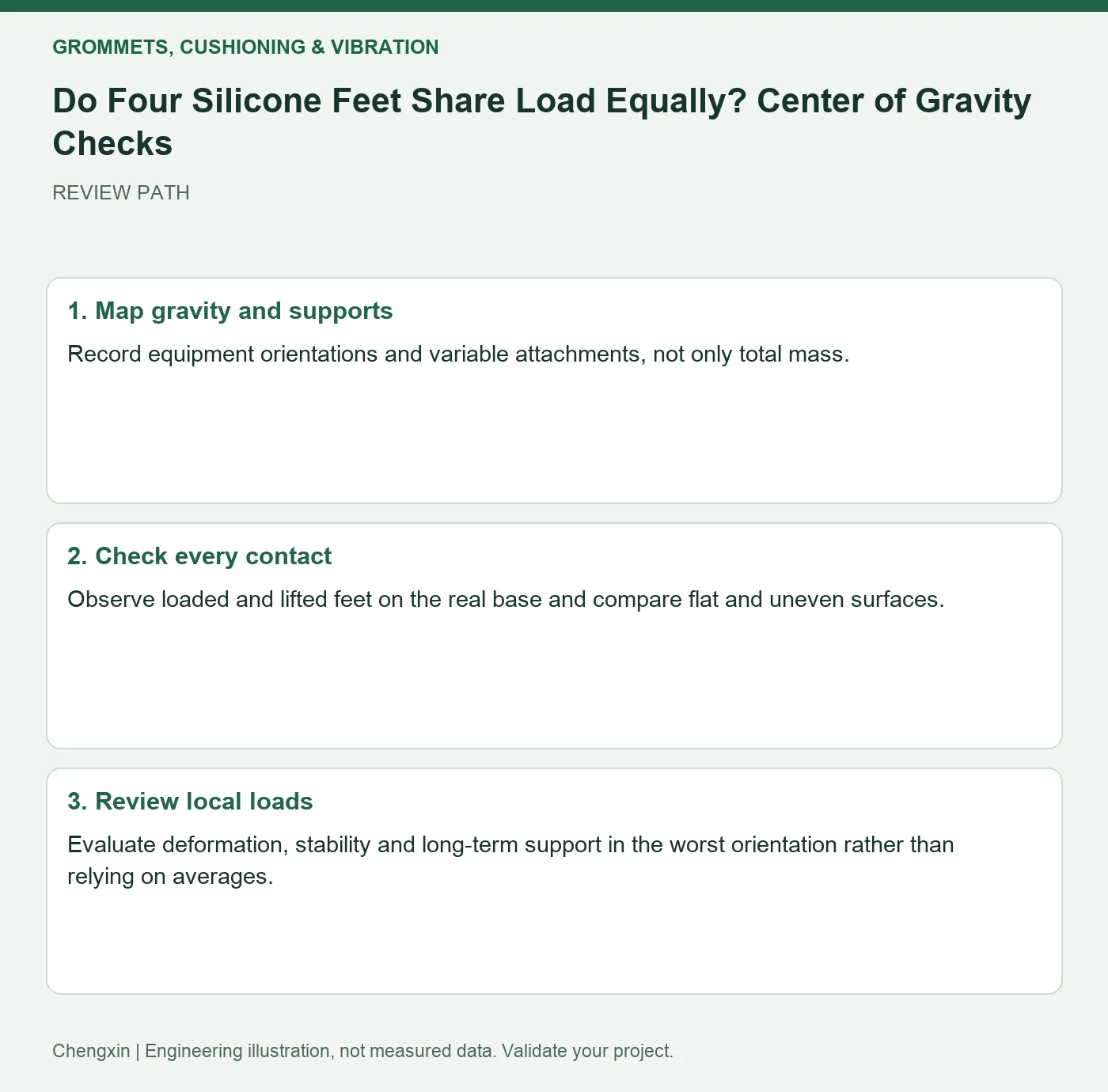
| 1 · Map gravity and supports | Record equipment orientations and variable attachments, not only total mass. |
| 2 · Check every contact | Observe loaded and lifted feet on the real base and compare flat and uneven surfaces. |
| 3 · Review local loads | Evaluate deformation, stability and long-term support in the worst orientation rather than relying on averages. |
A comparison to avoid misinterpretation
A power supply or motor on one side may produce unequal marks in identical feet. Check distribution before softening all feet.
Frequently asked question
Does equal compression mean equal load?
Material, geometry and base constraints must also match.
Background and further reading
This note addresses one specific question. For broader concepts, see the related background guide.
Related question: Silicone Isolators in Compression and Shear: Direction Matters.
External references support the relevant concepts. The review steps and scenarios are independent engineering discussion guidance, not quotations from a standard or external organization. Use agreed methods, applicable document revisions and complete conditions.
Apply this to your custom part
Compare the structure with Silicone Vibration-Isolation Feet for Small Equipment. Describe the application, geometry, operating conditions, quantity and problem to solve. Submit a custom-parts inquiry, or see how to send drawings and sample photographs by business email. Confirm material, dimensions, costs, testing and delivery requirements for the project.