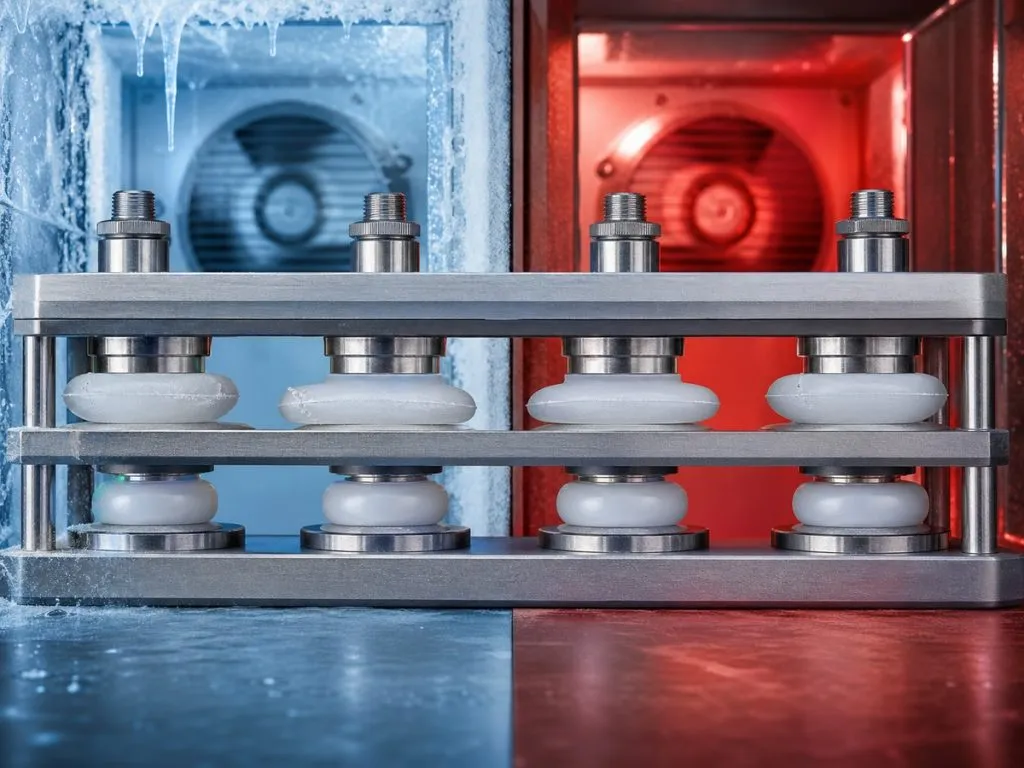
In rubber sealing systems, Compression Set (CS) is commonly used to assess the ability of a material to retain its springback after long-term compression.CS data not only affects material selection, but also has a direct bearing on seal life, preload decay and long-term reliability. In this paper, the practical significance of CS is systematically explained from test conditions, data judgment to engineering applications.
1. What is CS really measuring?
- CS Reflects how much thickness a material can recover after being compressed at a certain temperature and time.
- The smaller the CS, the better the long-term rebound retention (but still need to be looked at in conjunction with hardness, structural window)
2. Three elements of test conditions
- Temperature: It is recommended to cover the operating temperature and to set up a tightening condition.
- Time: Commonly 24h/72h/168h etc., life items can be longer.
- Compression rate: corresponds to the actual assembly compression (do not arbitrarily apply default values)
3. Test piece vs. actual part: differences must be recognized
- Parts may have differences in parting lines, surface treatments, and secondary vulcanization.
- Recommendation: Use test pieces for material screening, use actual parts or equivalent samples for final judgment.
4. How to apply CS to project decision-making
- Combined with a leak test: CS is only a material indicator, a good seal depends on the system results.
- Perform CS/leakage retests after high and low temperature cycling to assess "preload decay".
- Write CS goals into specification and tie in lot sampling
5. Common misconceptions
- Only CS without hardness: may cause mismatch in assembly window
- Inconsistent conditions but side-by-side comparisons: different temperatures/times/compression rates, unreliable conclusions
FAQ
- CS How much is a pass?
There is no uniform answer. Suggest setting targets by operating conditions vs. competitor/historical project data, then verifying closed loop with leakage vs. life.
- Do I have to do thermal aging after CS?
Recommended. Heat aging is concerned with overall performance changes (hardness, strength, risk of cracking) and is complementary to CS.