
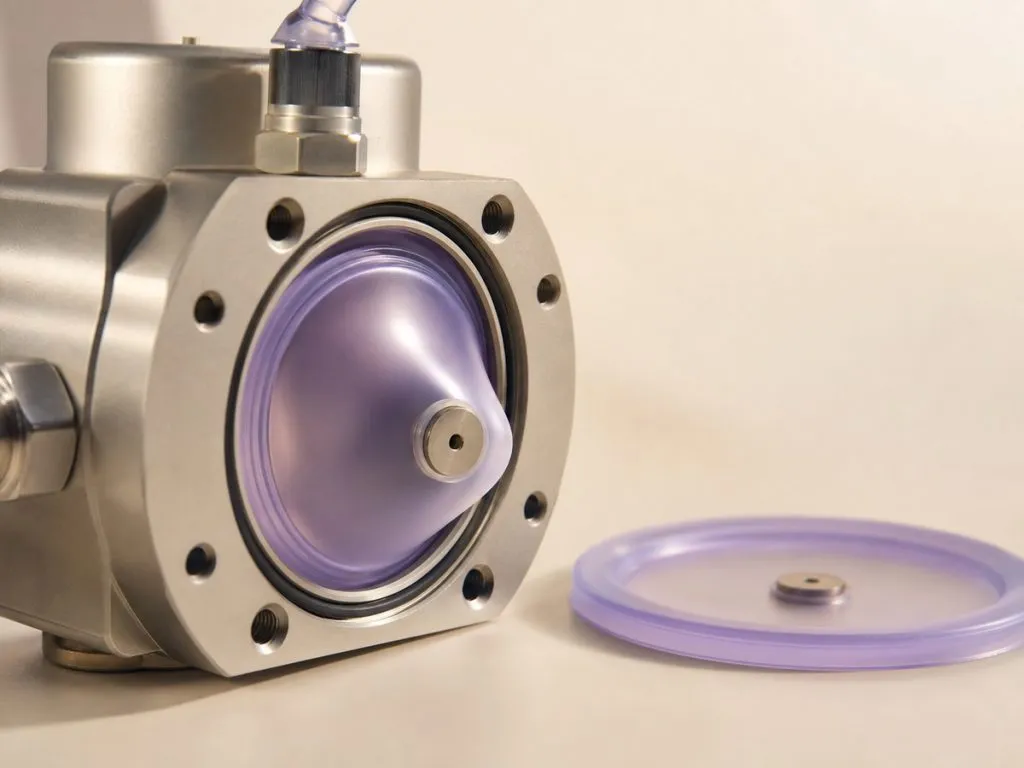
Silicone diaphragms are commonly used in valves, pump bodies, and pneumatic control systems. Their reliability depends on thickness uniformity, pressure differential, stroke, clamping structure, and the material’s long-term recovery performance.
1. Clarify the functions performed by the diaphragm
Diaphragms may be used to isolate media, provide unidirectional shut-off, or transmit pressure; different functions require different design priorities.
- For isolation-type designs, the focus is on media resistance and edge-clamping seals.
- For valve disc types, focus on opening pressure, stroke, and fatigue life.
- For sensors, the key factors to consider are sensitivity, hysteresis, and repeatability.
2. Thickness and hardness must be coordinated
Increasing hardness or reducing thickness on its own may alter the pressure response; this should be verified using the test specimen curve.
- Avoid sharp corners in thin-walled areas to reduce stress concentration
- The clamping edges should be of sufficient width and have a uniform clamping surface.
- Assess the risk of expansion, inversion, or tearing based on the pressure differential range
3. Tooling and Manufacturing Control
Mold cavity venting, parting line location, and curing uniformity affect the consistency of the diaphragms.
- Set "critical thickness" as a priority measurement item
- The parting line should avoid dynamic bending areas and sealing areas.
- Control burrs to prevent them from affecting gripping and movement
4. Verification Items
We recommend combining material testing with functional testing of the entire unit, rather than focusing solely on the appearance of individual components.
- Measure opening pressure, flow rate, or displacement curves
- Conduct cyclic testing and immersion testing
- Check for rebound and seal integrity after prolonged compression
FAQ
1. Does a thinner diaphragm result in a more sensitive response?
They are generally more prone to deformation, but are also more susceptible to fluctuations in pressure differentials, fatigue, and manufacturing tolerances.
2. Can we simply replicate it based on the old sample?
This can serve as a starting point, but you should verify whether the medium, pressure, and service life requirements remain the same when used as-is.