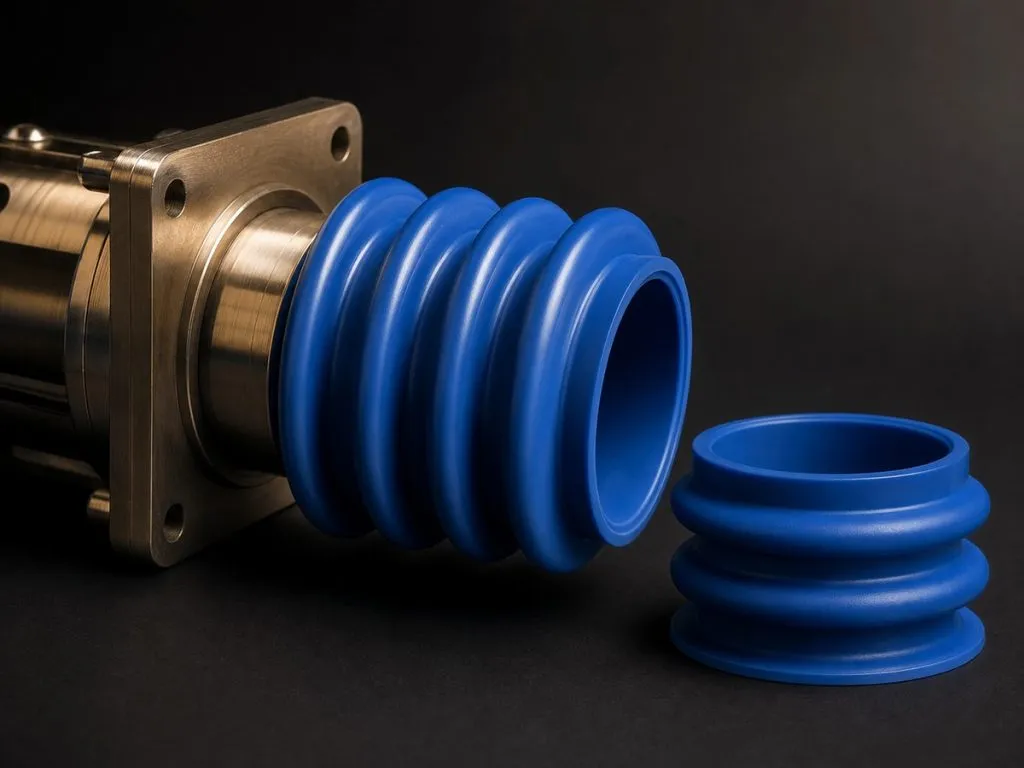
When using silicone bellows for dust and water protection, guidance, and cushioning, the most critical factor is the stress distribution during dynamic stroke. The design process should begin with the installed length, compression ratio, extension, and the structure of the connection ends.
1. First, quantify the motion conditions
The free length, minimum length, maximum length, and operating frequency of a bellows determine the number of waves and the waveform.
- Determine whether compression, tension, and deflection occur simultaneously
- Record the maximum and minimum installation distances and the frequency of movement
- Avoid prolonged operation near the travel limits
2. The profile and wall thickness determine service life
If the transitions between troughs and peaks are too sharp or if the material is too thin in certain areas, this will accelerate fatigue cracking.
- Smooth, rounded transitions are used to reduce stress concentration.
- Maintain uniform wall thickness and closely monitor the trough areas
- Choose the appropriate wave number based on the route, rather than simply aiming for the shortest length.
3. Connection Structure at Both Ends
Clamp, groove, flange, or bonded connections must balance clamping force and sealing performance.
- Allow for sufficient clamping length at the end
- Avoid placing the sealing edge in areas subject to dynamic bending.
- For metal or plastic interfaces, verify the fillet radius and surface roughness.
4. Sample Verification
Moving parts must be designed based on dynamic data analysis; it is not advisable to rely solely on their static appearance.
- Perform compression, tension, and deflection cycles
- Inspect for Cracks, Permanent Deformation, and Dust Seals
- Retesting Travel and Rebound After High- and Low-Temperature Cycles
FAQ
1. Does a higher wave number mean a longer lifespan?
Not necessarily. Increasing the wave number improves stroke distribution, but it also affects spatial, mold, and local stability.
2. Can silicone corrugated tubing be used outdoors?
Silicone rubber has good weather resistance, but it still needs to be tested for resistance to UV radiation, ozone, temperature, and installation conditions.