Confirm the cure system
WACKER's SilGel 616 A/B information identifies sulfur-, amine- and organotin-containing substances among potential inhibitors and recommends compatibility trials. This guides investigation; it does not imply identical sensitivity across all grades or justify applying that gel's ratio to another LSR.
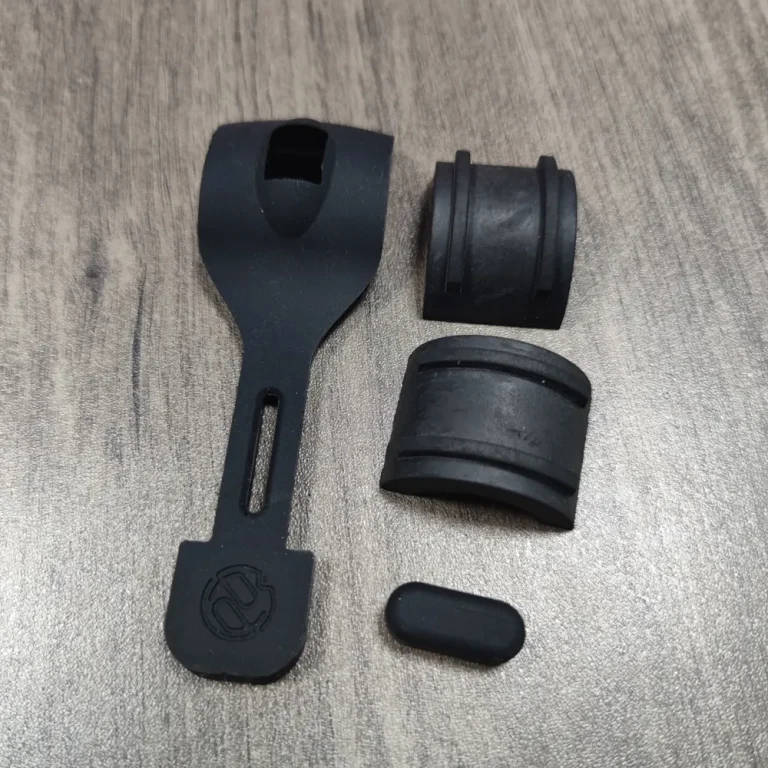
Use a blank to isolate contact effects
Divide one correctly mixed batch between a validated clean container, the original substrate and an approved-cleaned substrate. Keep thickness and cure conditions constant. Record surface, interface or full-section effects and change one contact factor at a time, retaining photographs and lot identity.
Trace the whole contact chain
Review containers, stirrers, release agents, packaging film, machining oil and upstream residue. An abnormal blank calls for raw-material shelf-life, A/B metering and actual material-temperature checks. Validate that cleaning neither damages the substrate nor introduces unknown residue.
Project review checklist
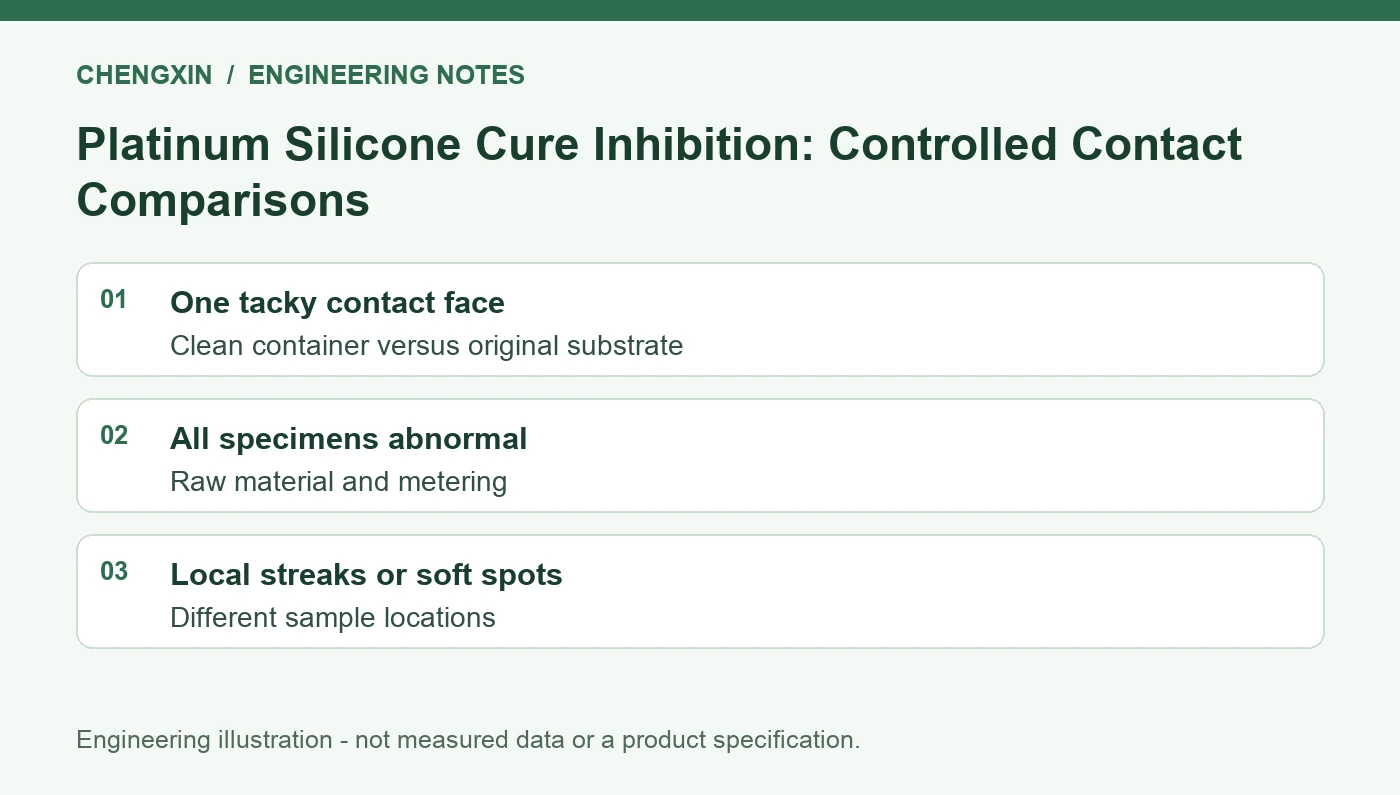
| Observation | Priority comparison | Next step |
|---|---|---|
| One tacky contact face | Clean container versus original substrate | Investigate contact materials |
| All specimens abnormal | Raw material and metering | Check ratio and cure conditions |
| Local streaks or soft spots | Different sample locations | Check mixing uniformity |
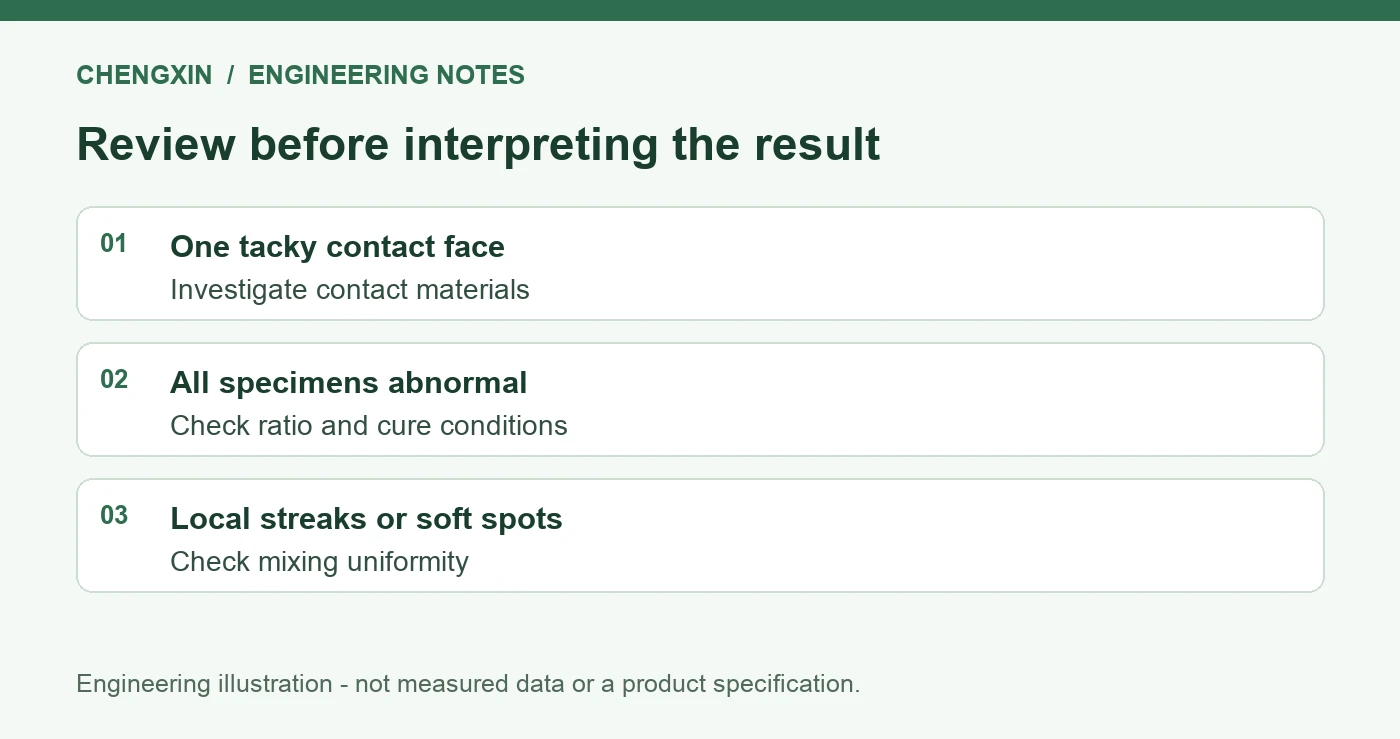
Illustrative project example
An abnormal substrate specimen with a sound blank identifies contact as a priority, not a completed root-cause proof. Replace or isolate suspect factors and retest. One successful cleaning does not establish permanent source removal.
Frequently asked questions
Does surface tack always mean cure inhibition?
No. Distinguish uncured material, exudation, sticky coating and release residue; seek supplier analysis when needed.
Will a stronger primer solve it?
Do not change primers without compatibility testing. Primer chemistry and drying state may affect the interface too.
Technical references
References explain methods and terminology. They do not establish certification, acceptance limits or measured performance for a Chengxin product. Confirm the applicable edition and project-specific method with the responsible laboratory.
Related product and project inquiry
Custom Shaped Silicone Parts · Mold Release Before Silicone Bonding: Residue and Process Separation
For a custom part review, send the drawing, application, material or performance needs, key dimensions, quantity and target test conditions. Material, tooling and acceptance requirements are confirmed for each project.