Scope and common interpretation errors
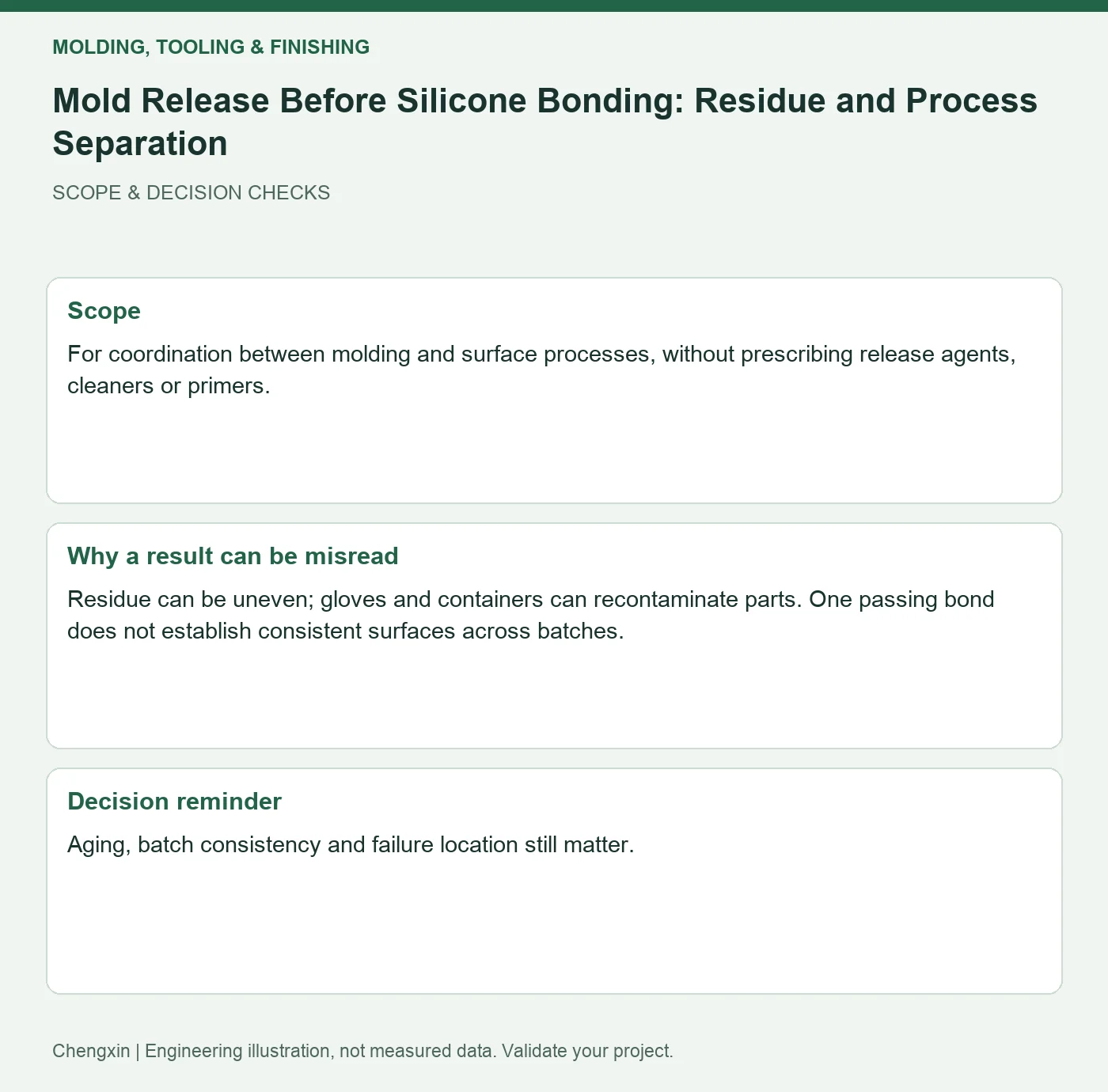
For coordination between molding and surface processes, without prescribing release agents, cleaners or primers.
Residue can be uneven; gloves and containers can recontaminate parts. One passing bond does not establish consistent surfaces across batches.
Turn the review into recorded checks
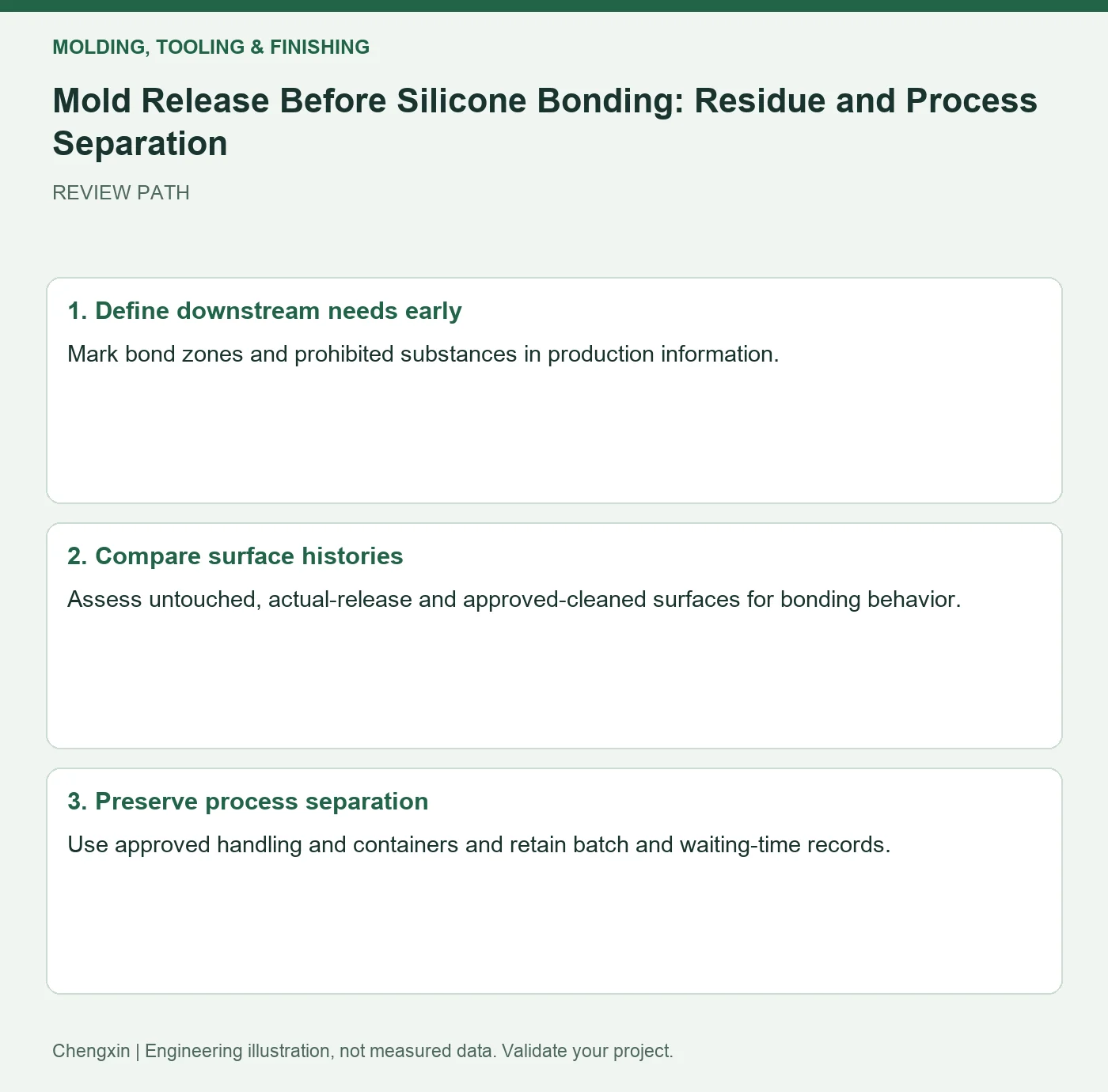
| Step | Action and evidence |
|---|---|
| 1 · Define downstream needs early | Mark bond zones and prohibited substances in production information. |
| 2 · Compare surface histories | Assess untouched, actual-release and approved-cleaned surfaces for bonding behavior. |
| 3 · Preserve process separation | Use approved handling and containers and retain batch and waiting-time records. |
A comparison to avoid misinterpretation
A failure after changing release methods warrants controlled reproduction rather than simply increasing primer to conceal a surface change.
Frequently asked question
Does one passing peel test remove residue controls?
Aging, batch consistency and failure location still matter.
Background and further reading
This note addresses one specific question. For broader concepts, see the related background guide.
Related question: Silicone Thin Sections Not Filling: Flow Path and Section Transitions.
External references support the relevant concepts. The review steps and scenarios are independent engineering discussion guidance, not quotations from a standard or external organization. Use agreed methods, applicable document revisions and complete conditions.
Apply this to your custom part
Compare the structure with Custom Shaped Silicone Parts. Describe the application, geometry, operating conditions, quantity and problem to solve. Submit a custom-parts inquiry, or see how to send drawings and sample photographs by business email. Confirm material, dimensions, costs, testing and delivery requirements for the project.