Specify a reproducible medium
ASTM D471 addresses liquid exposure effects on rubber. Labels such as oil, cleaner or coolant are insufficient. Record product or composition, concentration, water quality, renewal and service contamination. Pure-component results do not automatically cover mixtures.

Separate uptake from extraction
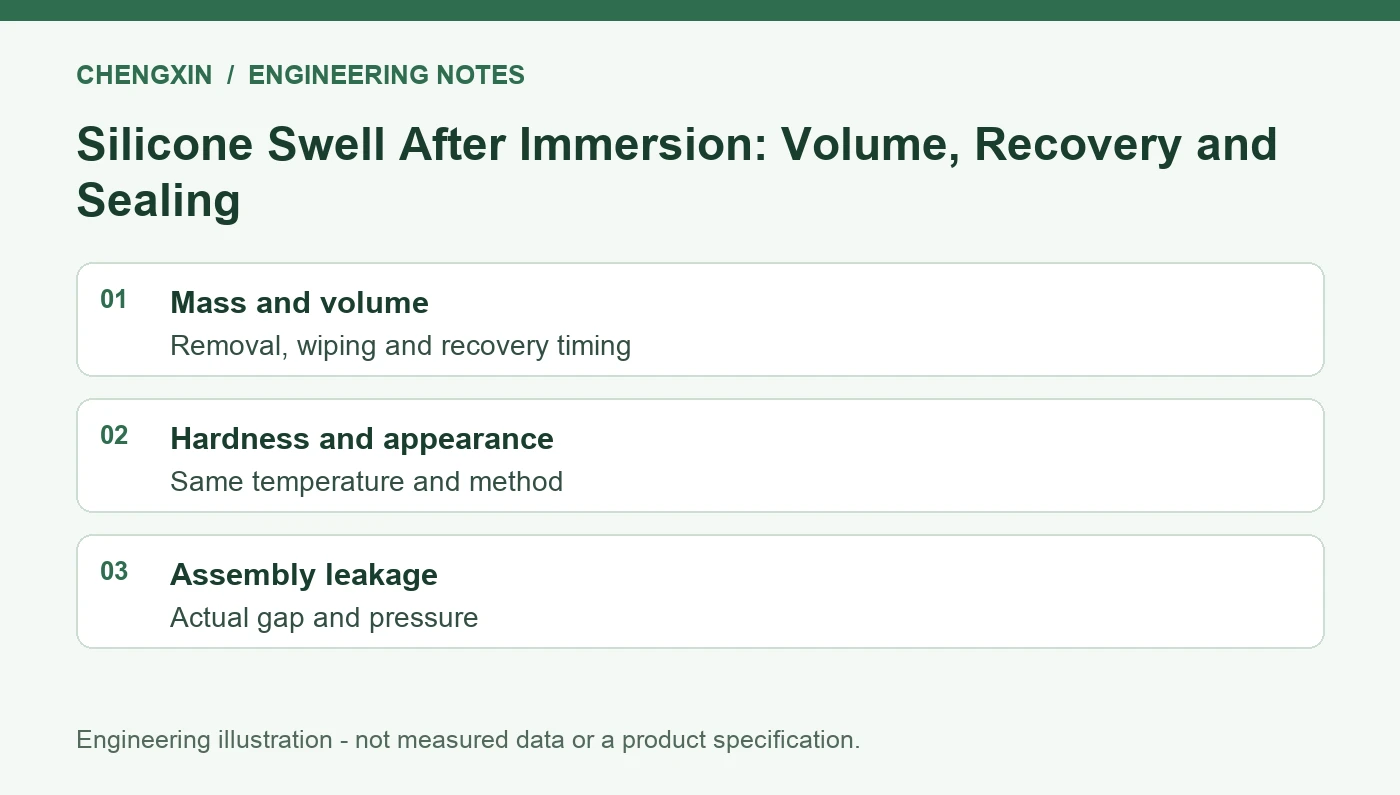
A specimen may absorb liquid while losing extractable components. Track identified specimens before exposure, immediately afterward and after recovery. Standardize surface-liquid removal and transfer-to-measurement timing. Use the chosen volume method; percentage outside-diameter growth is not volumetric change.
Evaluate the installed gland
Changes acceptable in a free specimen may be unsuitable in a constrained seal. Swell can consume gland space, while recovery shrinkage changes squeeze. For cyclic contact, compare alternating wet/dry states. A single immersion pass does not establish full-life performance.
Project review checklist
| Data | Conditions to retain | Purpose |
|---|---|---|
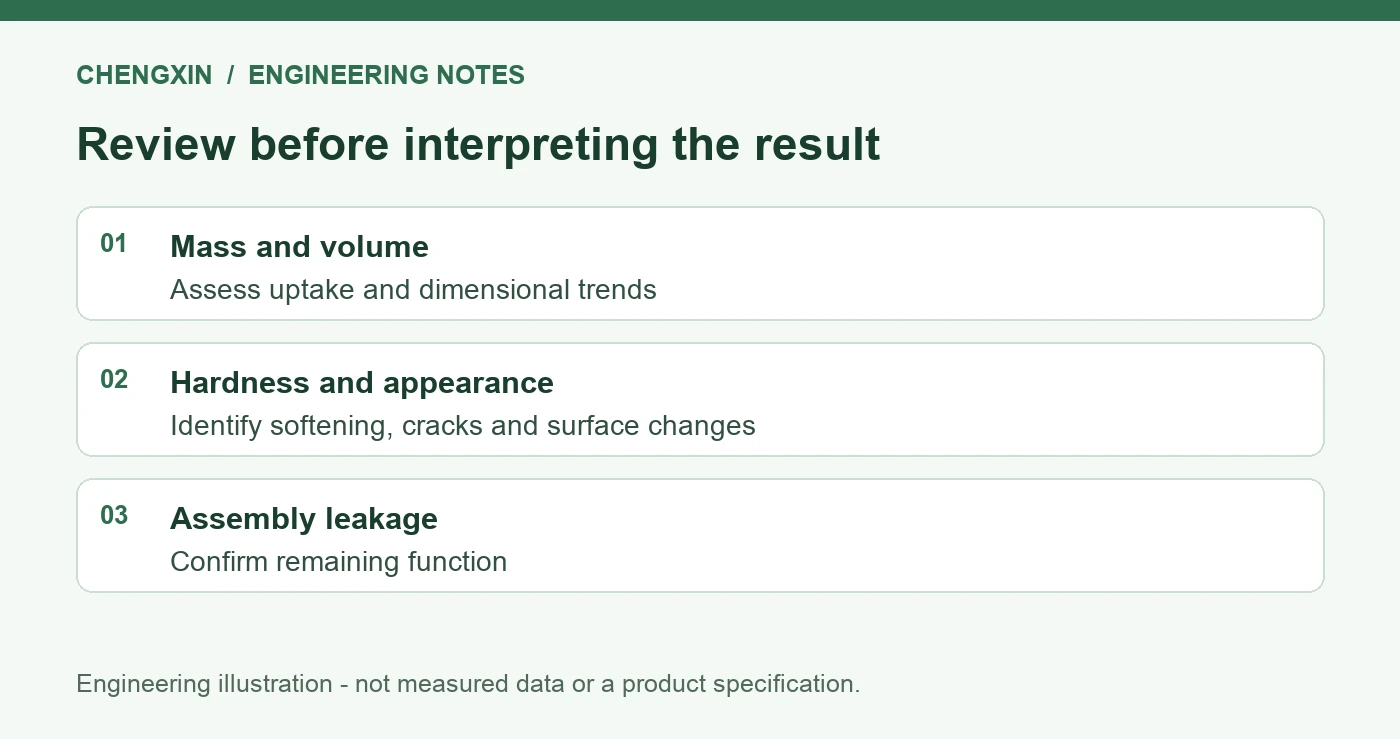
| Mass and volume | Removal, wiping and recovery timing | Assess uptake and dimensional trends |
| Hardness and appearance | Same temperature and method | Identify softening, cracks and surface changes |
| Assembly leakage | Actual gap and pressure | Confirm remaining function |
Illustrative project example
A swollen part returning near initial dimensions still needs hardness and sealing checks. A report containing only recovered dimensions cannot prove acceptable operation while immersed.
Frequently asked questions
Is smaller volume change always better?
Mechanical changes, surface condition and function also matter; no single metric fully establishes compatibility.
Can higher temperature rapidly replace actual exposure?
First establish that acceleration preserves the relevant failure mechanism; otherwise it is screening, not a direct service-time conversion.
Technical references
References explain methods and terminology. They do not establish certification, acceptance limits or measured performance for a Chengxin product. Confirm the applicable edition and project-specific method with the responsible laboratory.
Related product and project inquiry
Precision Silicone O-Rings for Watches · Silicone O-Ring Gland Fill: Allowing for Expansion and Swell
For a custom part review, send the drawing, application, material or performance needs, key dimensions, quantity and target test conditions. Material, tooling and acceptance requirements are confirmed for each project.