Scope and common interpretation errors
For hot-water equipment accessories, without assuming all silicone grades suit high temperatures or steam.
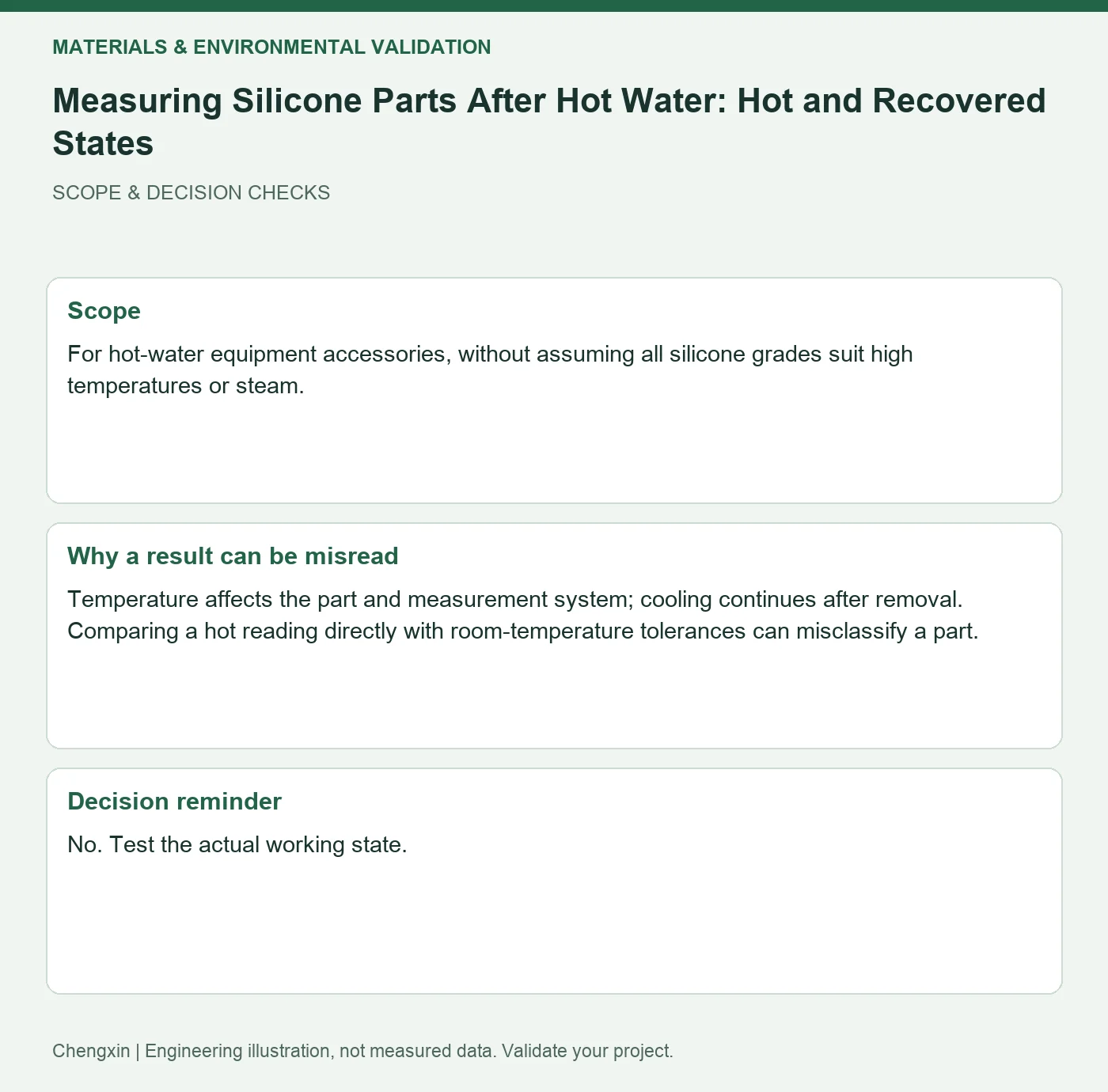
Temperature affects the part and measurement system; cooling continues after removal. Comparing a hot reading directly with room-temperature tolerances can misclassify a part.
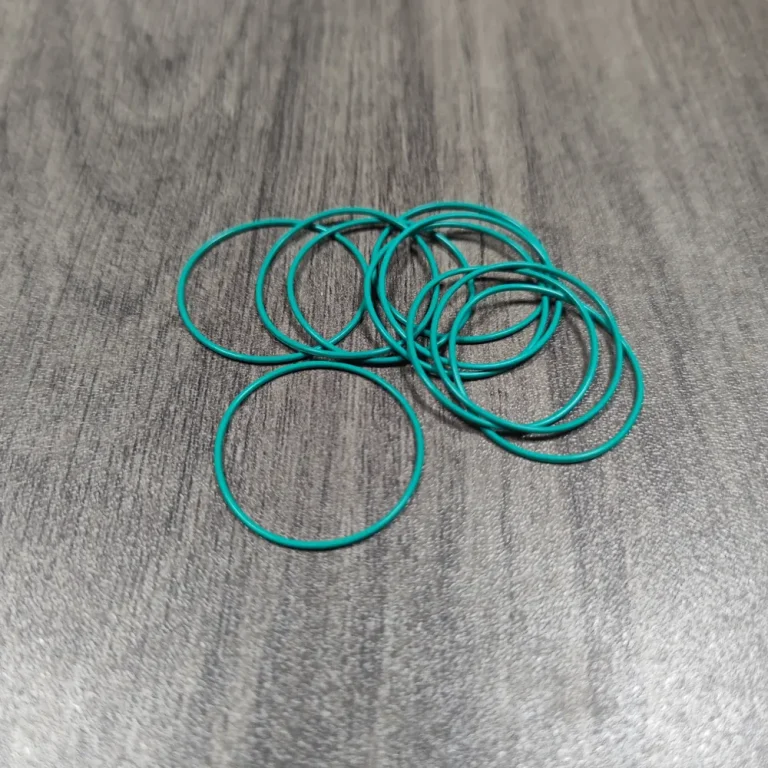
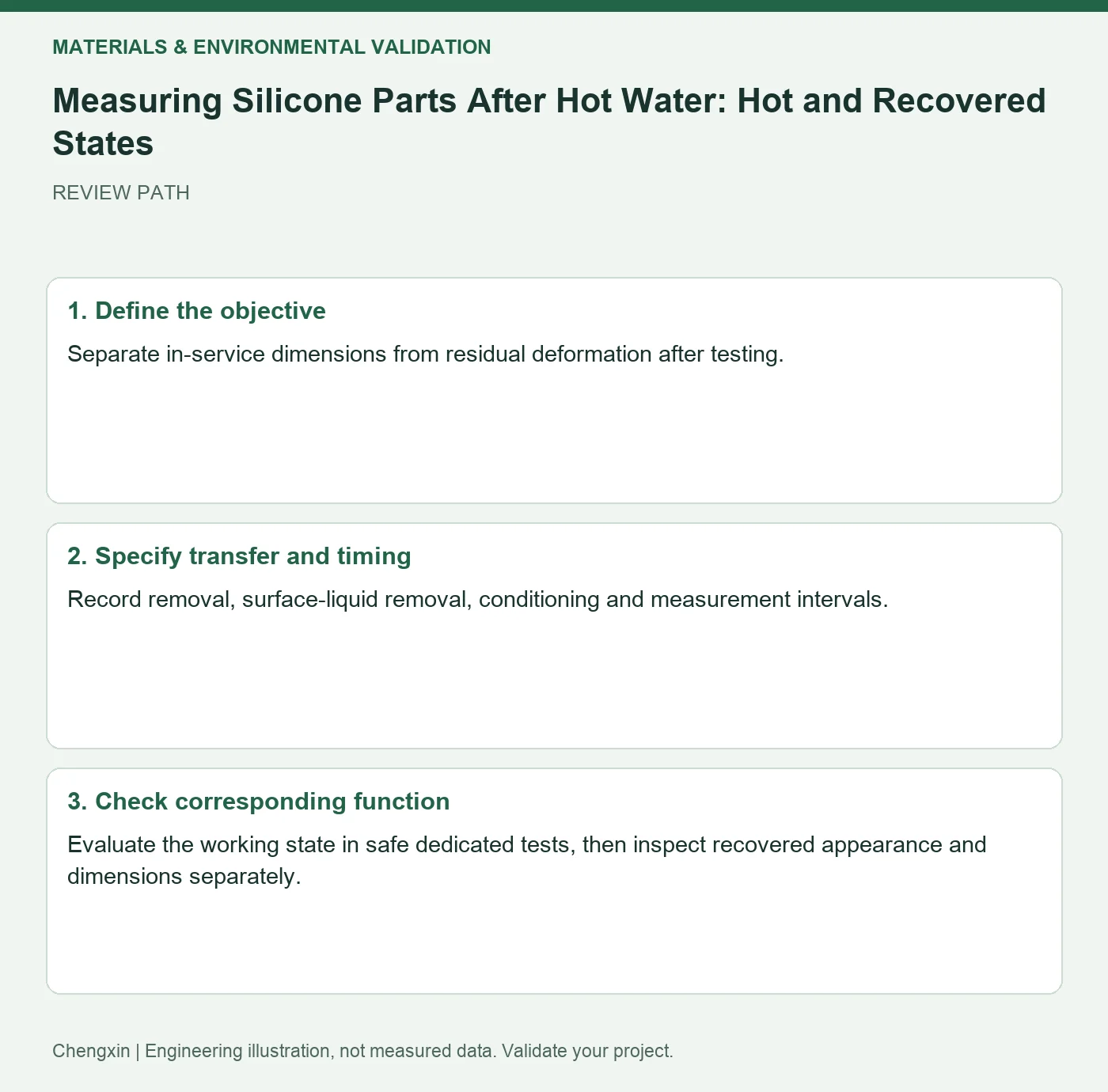
Turn the review into recorded checks
| Step | Action and evidence |
|---|---|
| 1 · Define the objective | Separate in-service dimensions from residual deformation after testing. |
| 2 · Specify transfer and timing | Record removal, surface-liquid removal, conditioning and measurement intervals. |
| 3 · Check corresponding function | Evaluate the working state in safe dedicated tests, then inspect recovered appearance and dimensions separately. |
A comparison to avoid misinterpretation
A seal may fit tightly when hot and recover its dimensions after cooling. Discuss operating clearance rather than only obtaining a passing room-temperature report.
Frequently asked question
Does a dimensional pass after cooling prove no hot-water leakage?
No. Test the actual working state.
Background and further reading
This note addresses one specific question. For broader concepts, see the related background guide.
Related question: Retained Odor in Silicone Parts: Packaging and Cleaning Comparisons.
External references support the relevant concepts. The review steps and scenarios are independent engineering discussion guidance, not quotations from a standard or external organization. Use agreed methods, applicable document revisions and complete conditions.
Apply this to your custom part
Compare the structure with Rubber O-Rings for Cleaning-Equipment Water Circuits. Describe the application, geometry, operating conditions, quantity and problem to solve. Submit a custom-parts inquiry, or see how to send drawings and sample photographs by business email. Confirm material, dimensions, costs, testing and delivery requirements for the project.