Scope and common interpretation errors
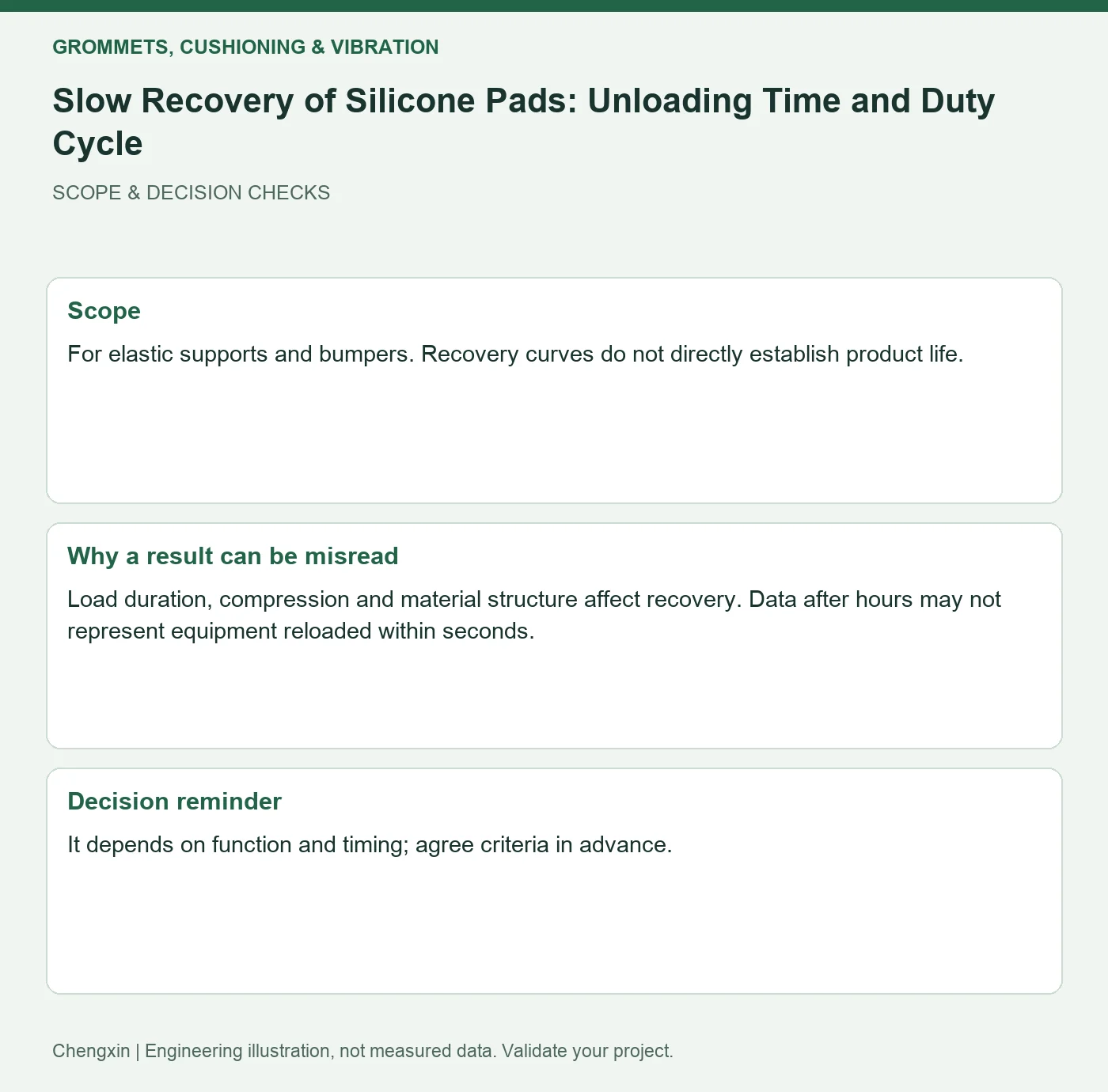
For elastic supports and bumpers. Recovery curves do not directly establish product life.
Load duration, compression and material structure affect recovery. Data after hours may not represent equipment reloaded within seconds.
Turn the review into recorded checks
| Step | Action and evidence |
|---|---|
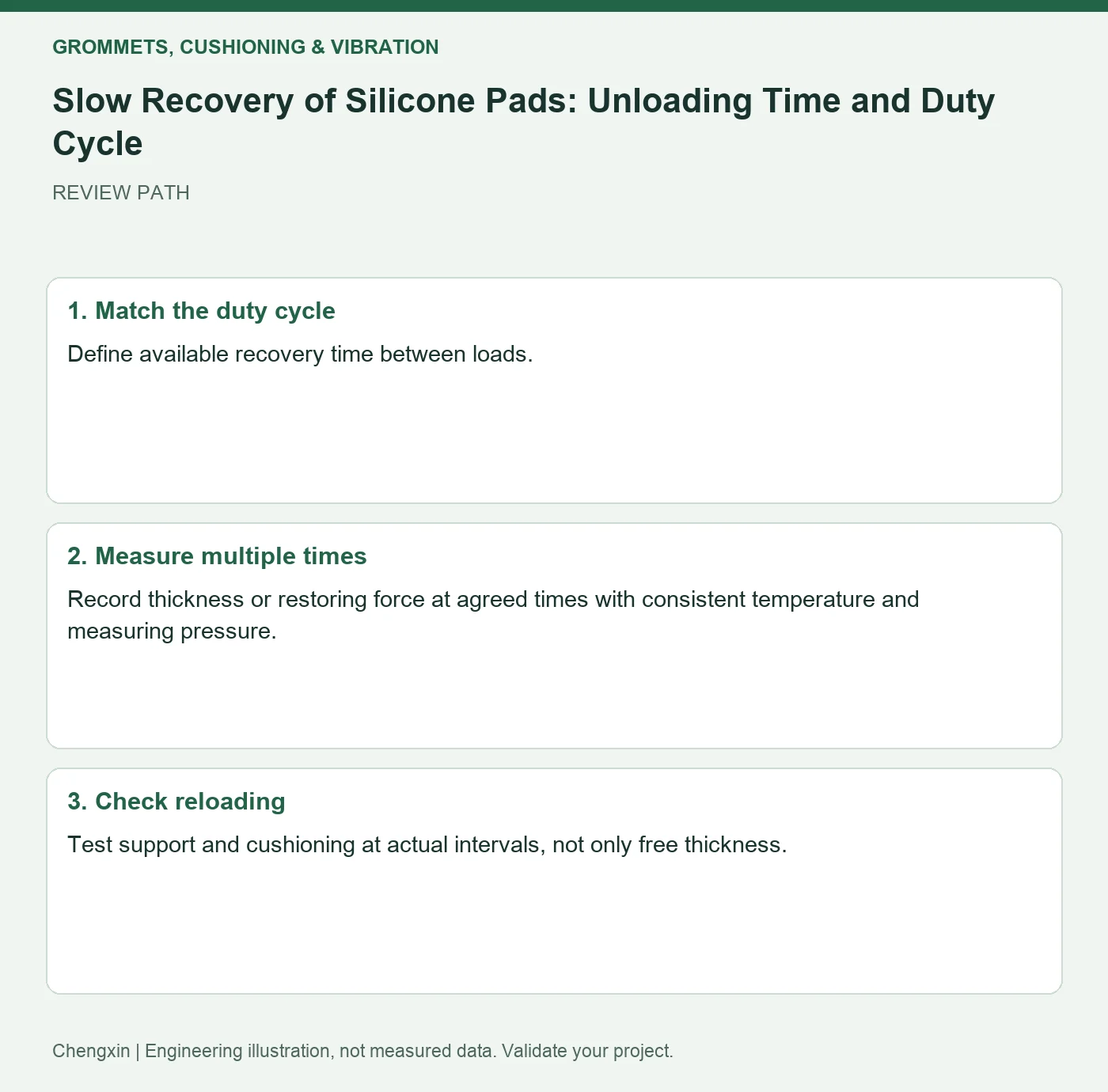
| 1 · Match the duty cycle | Define available recovery time between loads. |
| 2 · Measure multiple times | Record thickness or restoring force at agreed times with consistent temperature and measuring pressure. |
| 3 · Check reloading | Test support and cushioning at actual intervals, not only free thickness. |
A comparison to avoid misinterpretation
A pad that eventually recovers but remains thin before the next action requires short-interval cycling as a key condition, rather than reporting only final thickness.
Frequently asked question
Is slow recovery automatically a failure?
It depends on function and timing; agree criteria in advance.
Background and further reading
This note addresses one specific question. For broader concepts, see the related background guide.
Related question: Do Four Silicone Feet Share Load Equally? Center of Gravity Checks.
External references support the relevant concepts. The review steps and scenarios are independent engineering discussion guidance, not quotations from a standard or external organization. Use agreed methods, applicable document revisions and complete conditions.
Apply this to your custom part
Compare the structure with Silicone Vibration-Isolation Feet for Small Equipment. Describe the application, geometry, operating conditions, quantity and problem to solve. Submit a custom-parts inquiry, or see how to send drawings and sample photographs by business email. Confirm material, dimensions, costs, testing and delivery requirements for the project.