Scope and common interpretation errors
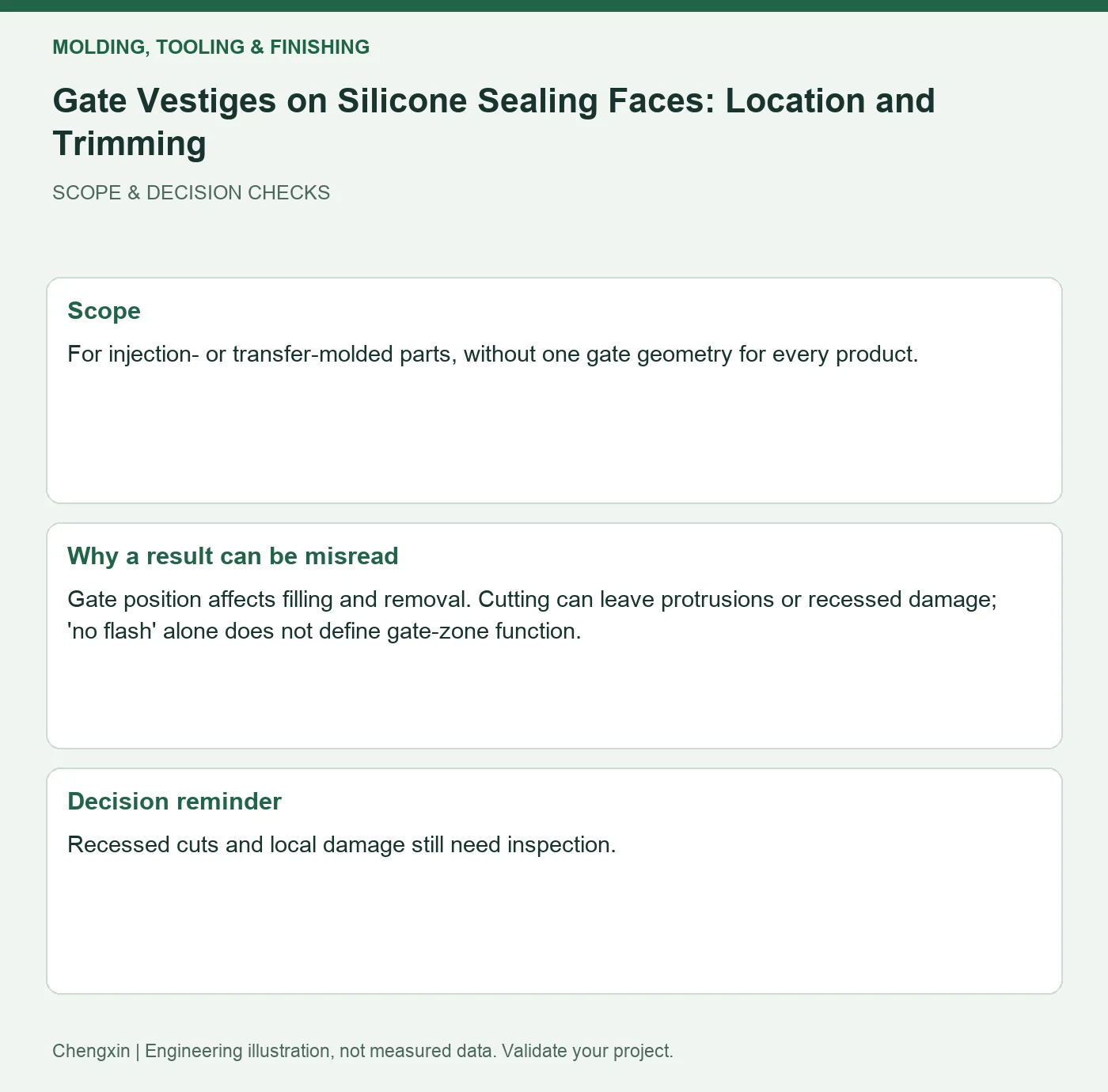
For injection- or transfer-molded parts, without one gate geometry for every product.
Gate position affects filling and removal. Cutting can leave protrusions or recessed damage; 'no flash' alone does not define gate-zone function.
Turn the review into recorded checks
| Step | Action and evidence |
|---|---|
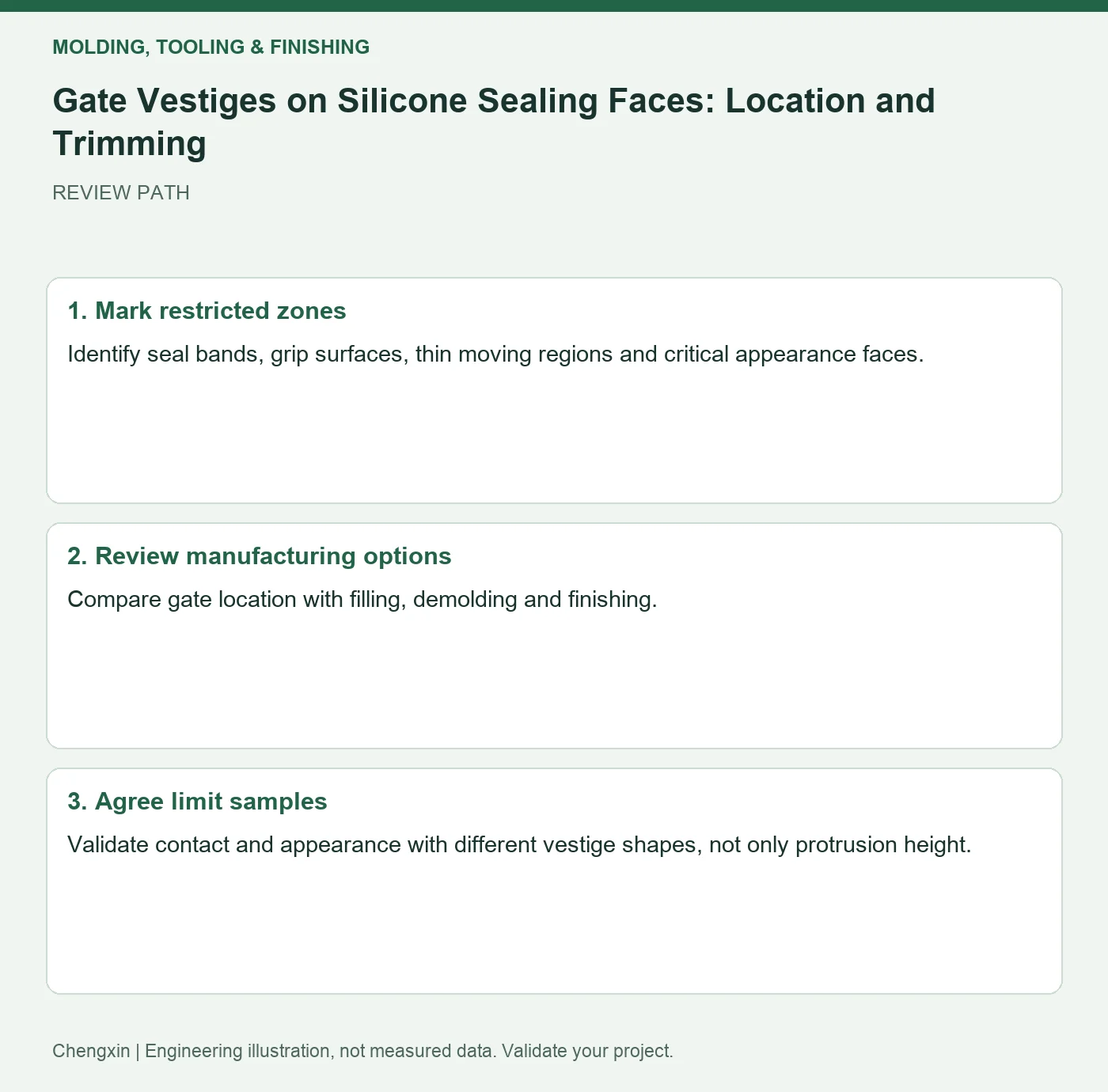
| 1 · Mark restricted zones | Identify seal bands, grip surfaces, thin moving regions and critical appearance faces. |
| 2 · Review manufacturing options | Compare gate location with filling, demolding and finishing. |
| 3 · Agree limit samples | Validate contact and appearance with different vestige shapes, not only protrusion height. |
A comparison to avoid misinterpretation
Moving a gate away from a seal may create incomplete fill elsewhere. Balance the filling design rather than treating position in isolation.
Frequently asked question
Does cutting flush remove every risk?
Recessed cuts and local damage still need inspection.
Background and further reading
This note addresses one specific question. For broader concepts, see the related background guide.
Related question: Uneven Walls Around Silicone Holes: Core Shift or Measurement?.
External references support the relevant concepts. The review steps and scenarios are independent engineering discussion guidance, not quotations from a standard or external organization. Use agreed methods, applicable document revisions and complete conditions.
Apply this to your custom part
Compare the structure with Shaped Silicone Housing Gaskets for Wearable Devices. Describe the application, geometry, operating conditions, quantity and problem to solve. Submit a custom-parts inquiry, or see how to send drawings and sample photographs by business email. Confirm material, dimensions, costs, testing and delivery requirements for the project.