Scope and common interpretation errors
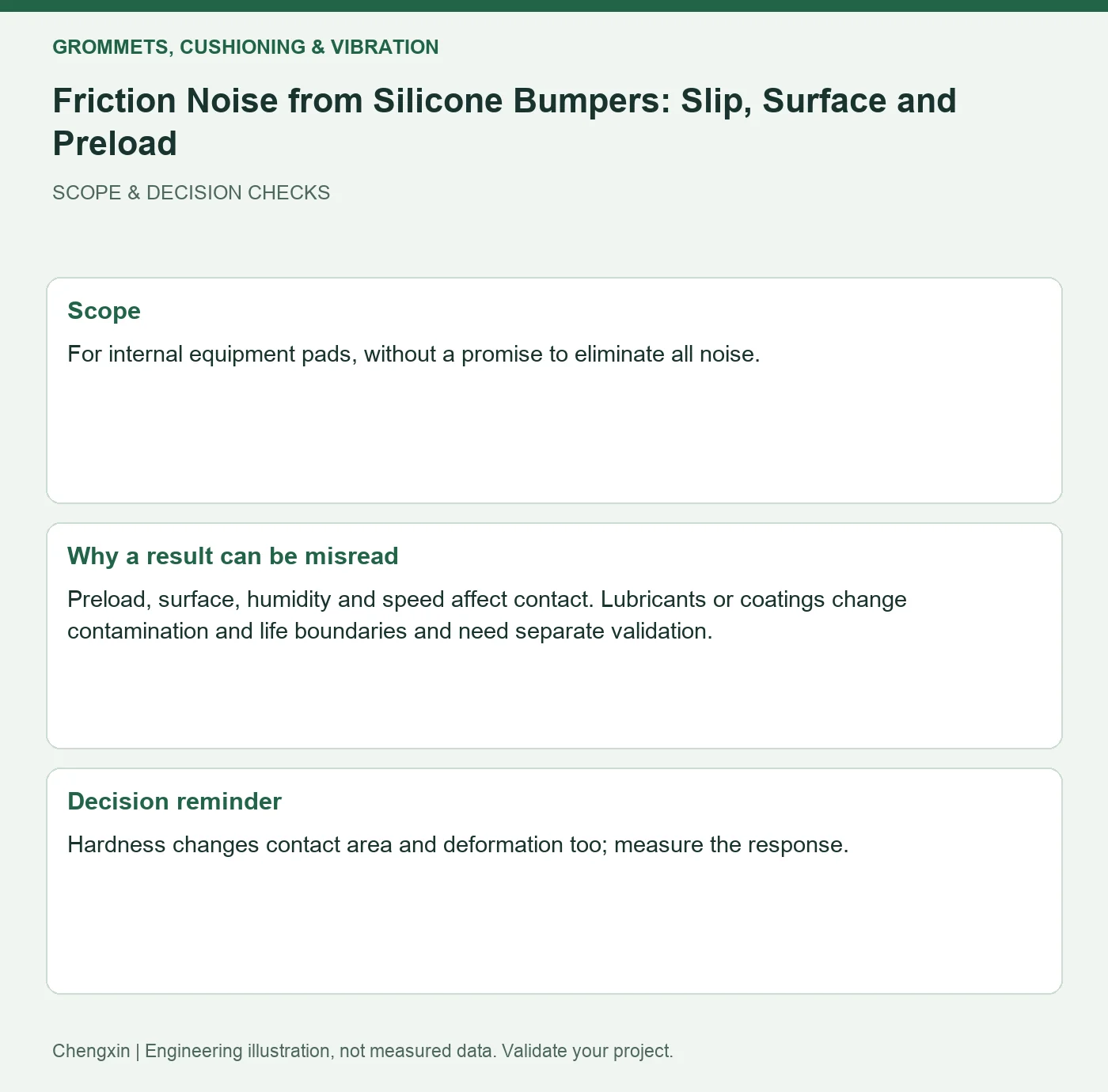
For internal equipment pads, without a promise to eliminate all noise.
Preload, surface, humidity and speed affect contact. Lubricants or coatings change contamination and life boundaries and need separate validation.
Turn the review into recorded checks
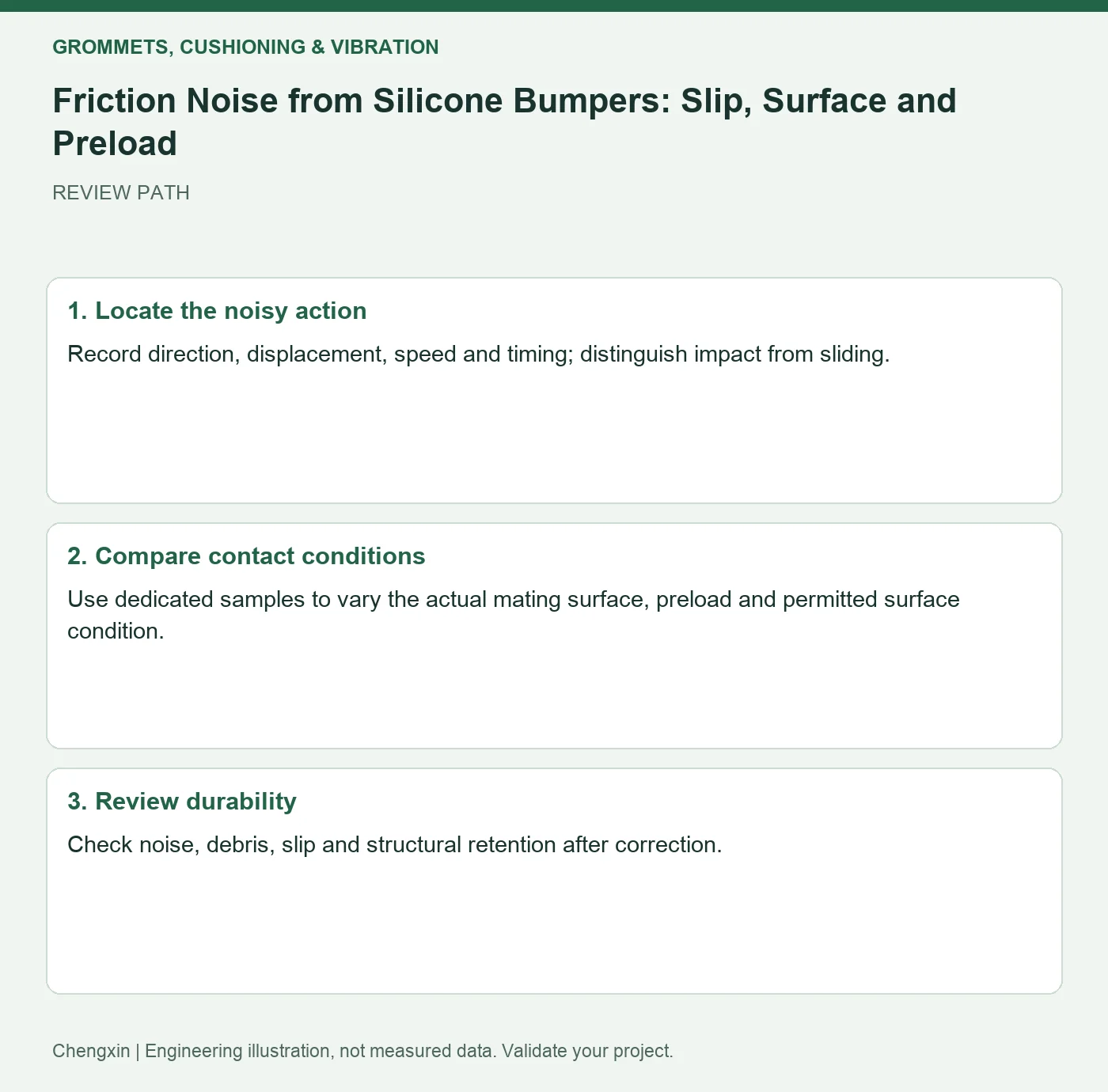
| Step | Action and evidence |
|---|---|
| 1 · Locate the noisy action | Record direction, displacement, speed and timing; distinguish impact from sliding. |
| 2 · Compare contact conditions | Use dedicated samples to vary the actual mating surface, preload and permitted surface condition. |
| 3 · Review durability | Check noise, debris, slip and structural retention after correction. |
A comparison to avoid misinterpretation
Noise disappearing at lower displacement suggests investigating relative motion. One quiet lubricated trial does not establish an approved lubrication process.
Frequently asked question
Is softer rubber always quieter?
Hardness changes contact area and deformation too; measure the response.
Background and further reading
This note addresses one specific question. For broader concepts, see the related background guide.
Related question: Slow Recovery of Silicone Pads: Unloading Time and Duty Cycle.
External references support the relevant concepts. The review steps and scenarios are independent engineering discussion guidance, not quotations from a standard or external organization. Use agreed methods, applicable document revisions and complete conditions.
Apply this to your custom part
Compare the structure with Silicone Vibration-Isolation Feet for Small Equipment. Describe the application, geometry, operating conditions, quantity and problem to solve. Submit a custom-parts inquiry, or see how to send drawings and sample photographs by business email. Confirm material, dimensions, costs, testing and delivery requirements for the project.