Scope and common interpretation errors
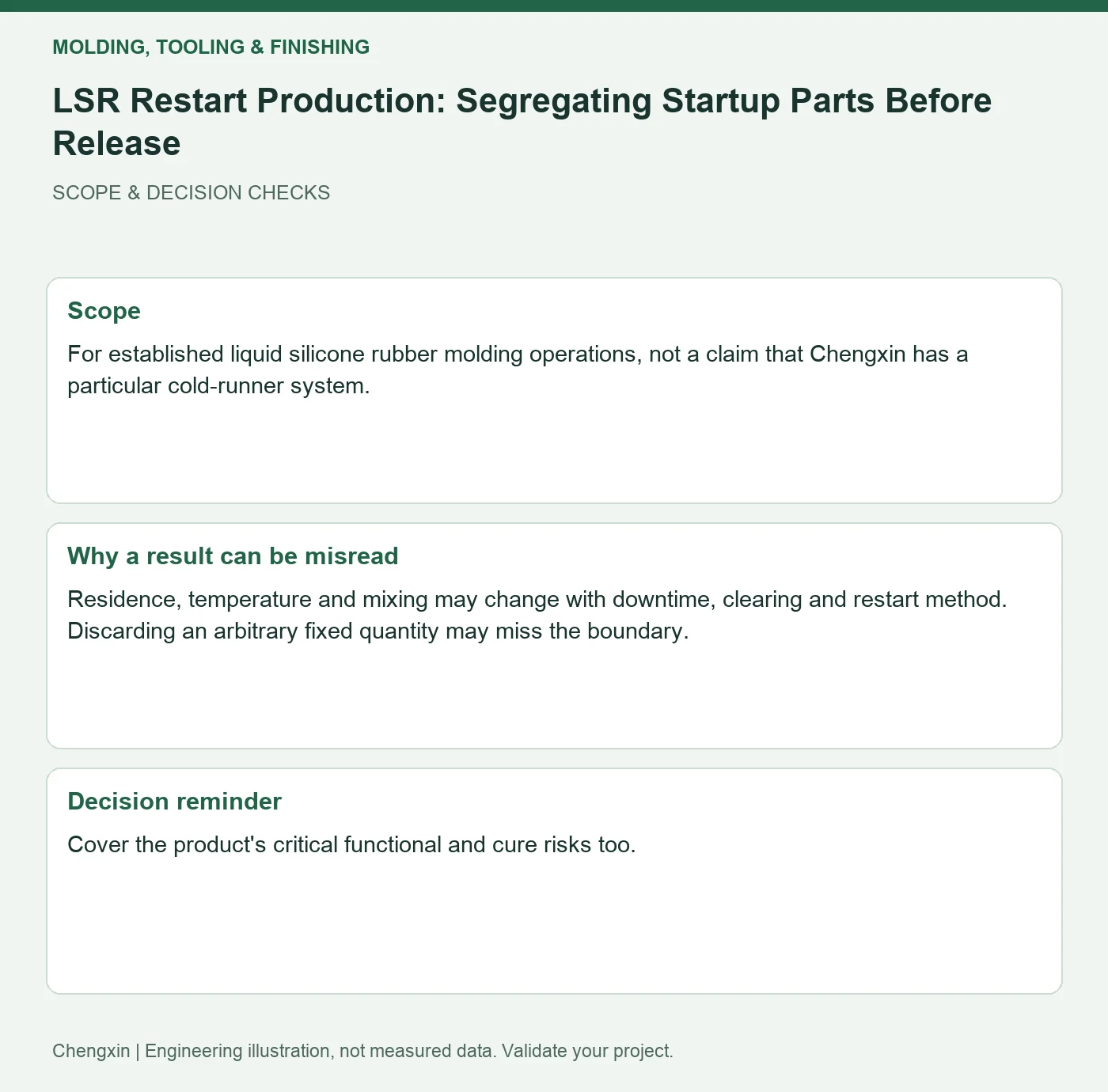
For established liquid silicone rubber molding operations, not a claim that Chengxin has a particular cold-runner system.
Residence, temperature and mixing may change with downtime, clearing and restart method. Discarding an arbitrary fixed quantity may miss the boundary.
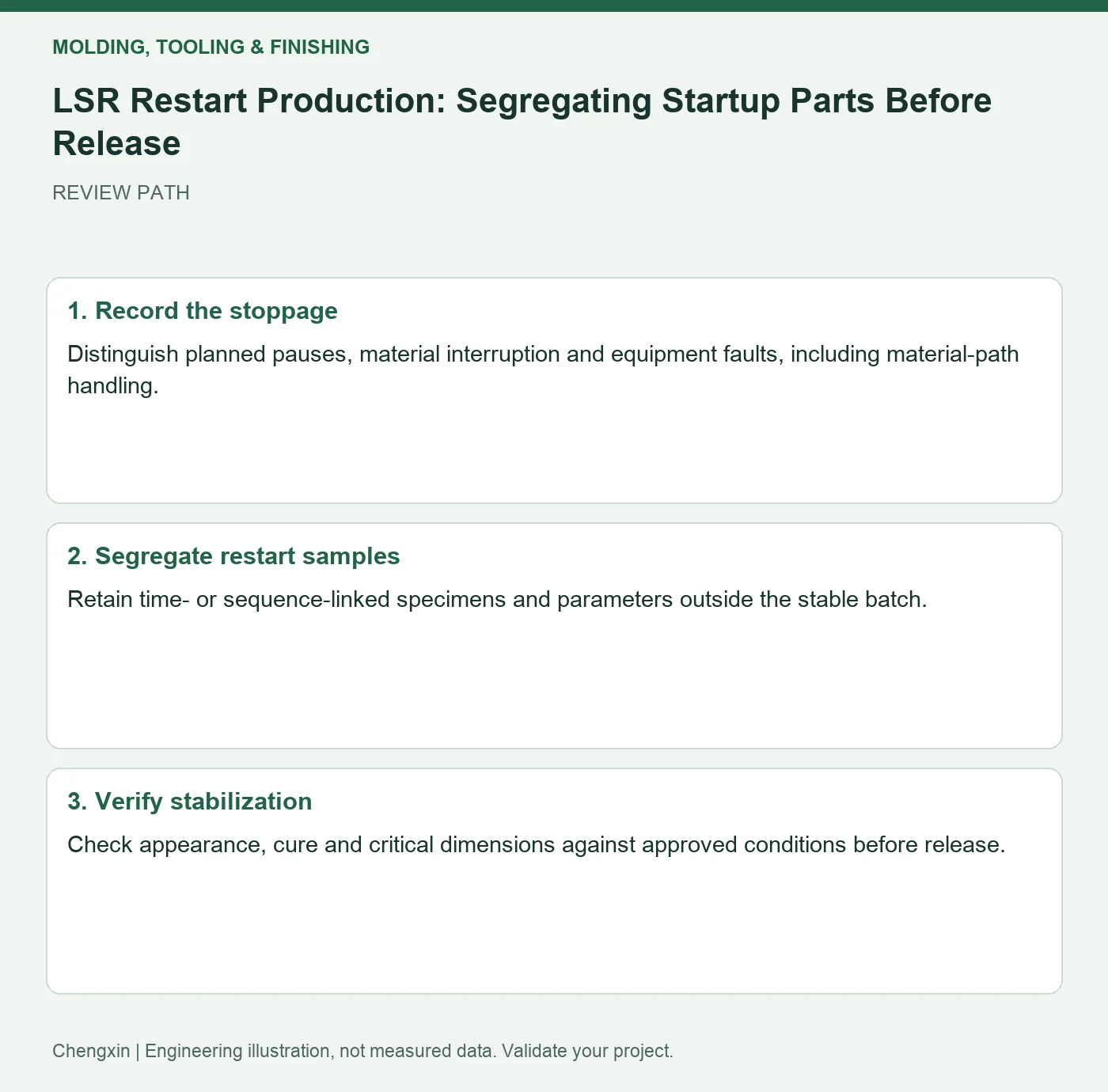
Turn the review into recorded checks
| Step | Action and evidence |
|---|---|
| 1 · Record the stoppage | Distinguish planned pauses, material interruption and equipment faults, including material-path handling. |
| 2 · Segregate restart samples | Retain time- or sequence-linked specimens and parameters outside the stable batch. |
| 3 · Verify stabilization | Check appearance, cure and critical dimensions against approved conditions before release. |
A comparison to avoid misinterpretation
Gradual stabilization over successive restart samples should remain visible in the record; deleting early abnormal data does not establish a stable whole batch.
Frequently asked question
Can normal appearance end segregation?
Cover the product's critical functional and cure risks too.
Background and further reading
This note addresses one specific question. For broader concepts, see the related background guide.
Related question: Nicks After Silicone Trimming: Residual Flash Versus Overcut.
External references support the relevant concepts. The review steps and scenarios are independent engineering discussion guidance, not quotations from a standard or external organization. Use agreed methods, applicable document revisions and complete conditions.
Apply this to your custom part
Compare the structure with Custom Shaped Silicone Parts. Describe the application, geometry, operating conditions, quantity and problem to solve. Submit a custom-parts inquiry, or see how to send drawings and sample photographs by business email. Confirm material, dimensions, costs, testing and delivery requirements for the project.