Scope and common interpretation errors
For dimensional and related first article documentation, without implying customer-system certification.
Reporting only easy dimensions misses material, appearance or assembly requirements. Revised balloon numbers can lead to incorrect reuse of old data.
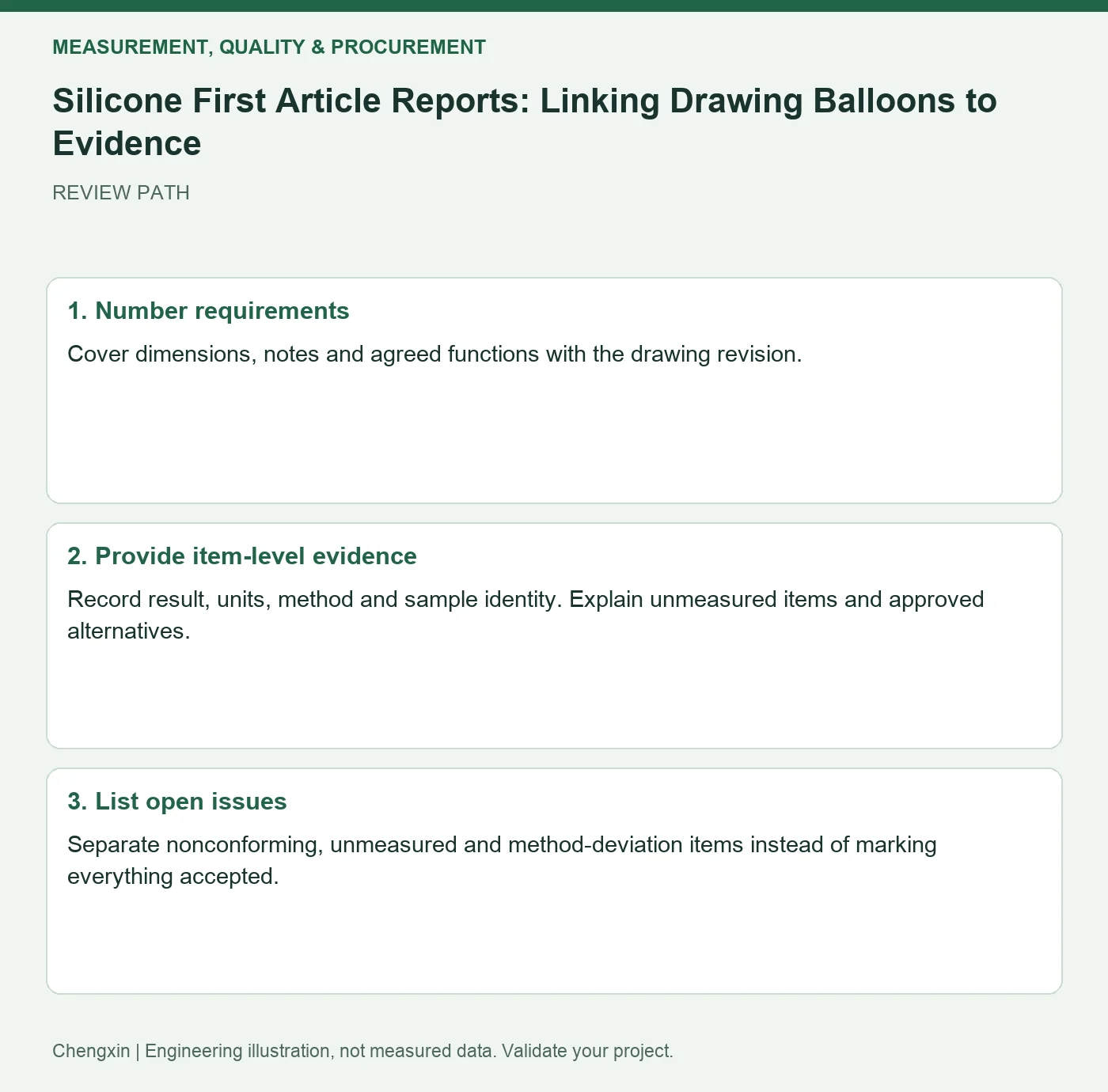
Turn the review into recorded checks
| Step | Action and evidence |
|---|---|
| 1 · Number requirements | Cover dimensions, notes and agreed functions with the drawing revision. |
| 2 · Provide item-level evidence | Record result, units, method and sample identity. Explain unmeasured items and approved alternatives. |
| 3 · List open issues | Separate nonconforming, unmeasured and method-deviation items instead of marking everything accepted. |
A comparison to avoid misinterpretation
A flexible profile judged with a dedicated fixture should state that functional-gauge method at its balloon number, not contain an invented numerical dimension.
Frequently asked question
Does an all-pass first article prove stable production?
First article approval and ongoing process control provide different evidence.
Background and further reading
This note addresses one specific question. For broader concepts, see the related background guide.
Related question: One Box of Abnormal Silicone Parts: Defining Containment Boundaries.
External references support the relevant concepts. The review steps and scenarios are independent engineering discussion guidance, not quotations from a standard or external organization. Use agreed methods, applicable document revisions and complete conditions.
Apply this to your custom part
Compare the structure with Custom Shaped Silicone Parts. Describe the application, geometry, operating conditions, quantity and problem to solve. Submit a custom-parts inquiry, or see how to send drawings and sample photographs by business email. Confirm material, dimensions, costs, testing and delivery requirements for the project.