Scope and common interpretation errors
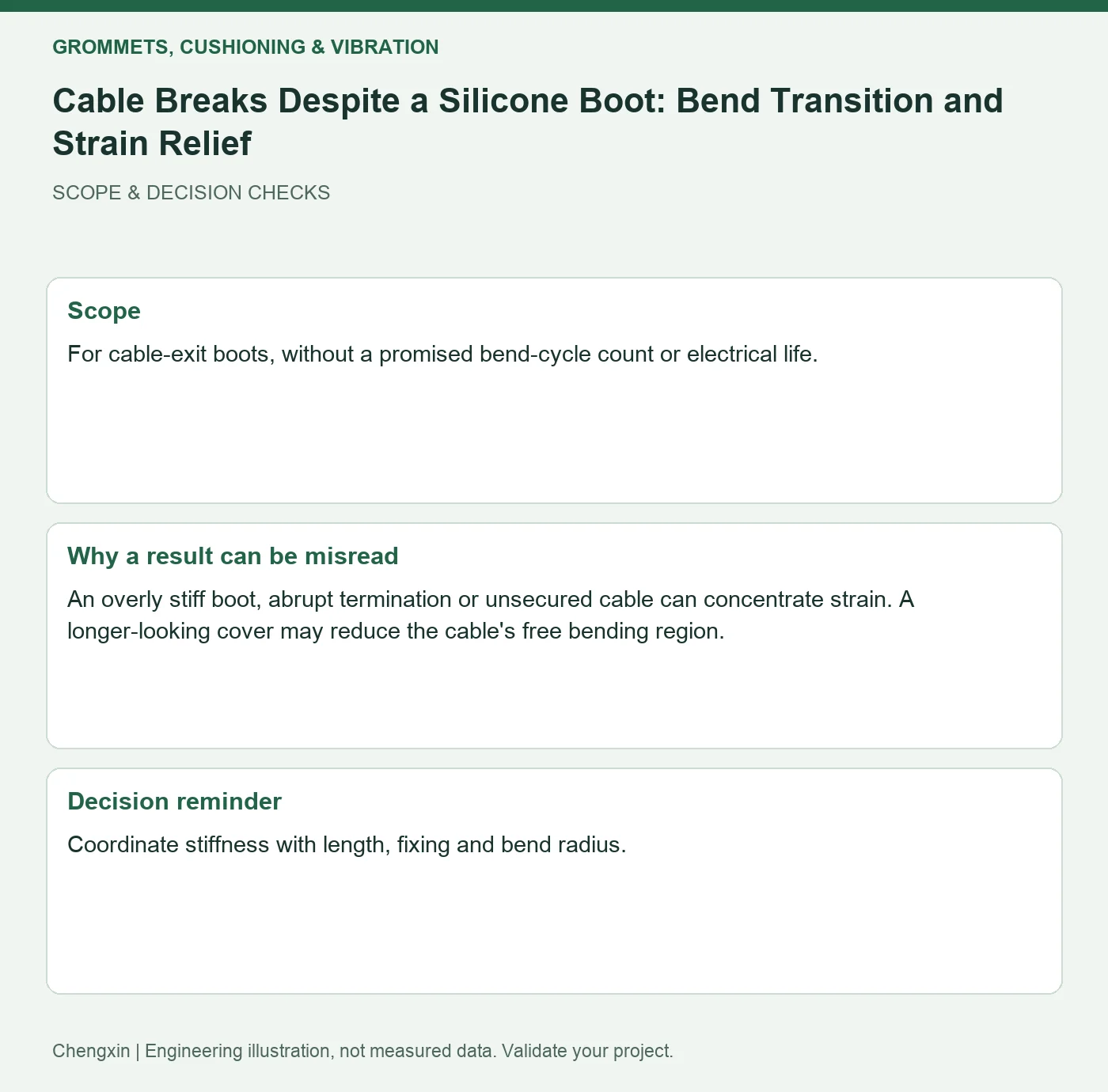
For cable-exit boots, without a promised bend-cycle count or electrical life.
An overly stiff boot, abrupt termination or unsecured cable can concentrate strain. A longer-looking cover may reduce the cable's free bending region.
Turn the review into recorded checks
| Step | Action and evidence |
|---|---|
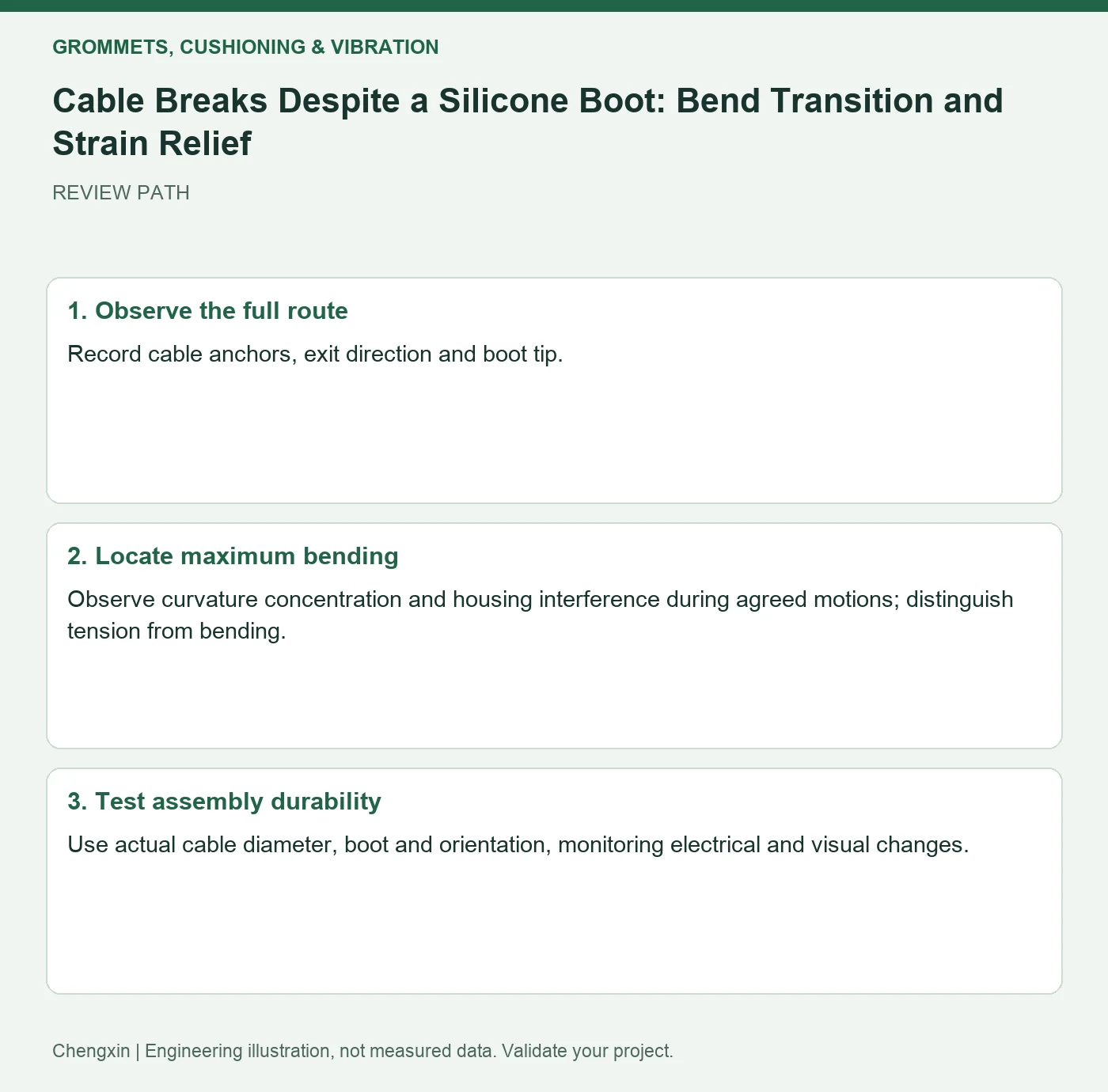
| 1 · Observe the full route | Record cable anchors, exit direction and boot tip. |
| 2 · Locate maximum bending | Observe curvature concentration and housing interference during agreed motions; distinguish tension from bending. |
| 3 · Test assembly durability | Use actual cable diameter, boot and orientation, monitoring electrical and visual changes. |
A comparison to avoid misinterpretation
If breakage moves from the housing exit to the boot tip, reassess the transition and motion range rather than merely extending the boot.
Frequently asked question
Is a softer boot always more protective?
Coordinate stiffness with length, fixing and bend radius.
Background and further reading
This note addresses one specific question. For broader concepts, see the related background guide.
Related question: Split Silicone Grommets: Cable Protection Versus Water Sealing.
External references support the relevant concepts. The review steps and scenarios are independent engineering discussion guidance, not quotations from a standard or external organization. Use agreed methods, applicable document revisions and complete conditions.
Apply this to your custom part
Compare the structure with Custom Shaped Silicone Parts. Describe the application, geometry, operating conditions, quantity and problem to solve. Submit a custom-parts inquiry, or see how to send drawings and sample photographs by business email. Confirm material, dimensions, costs, testing and delivery requirements for the project.