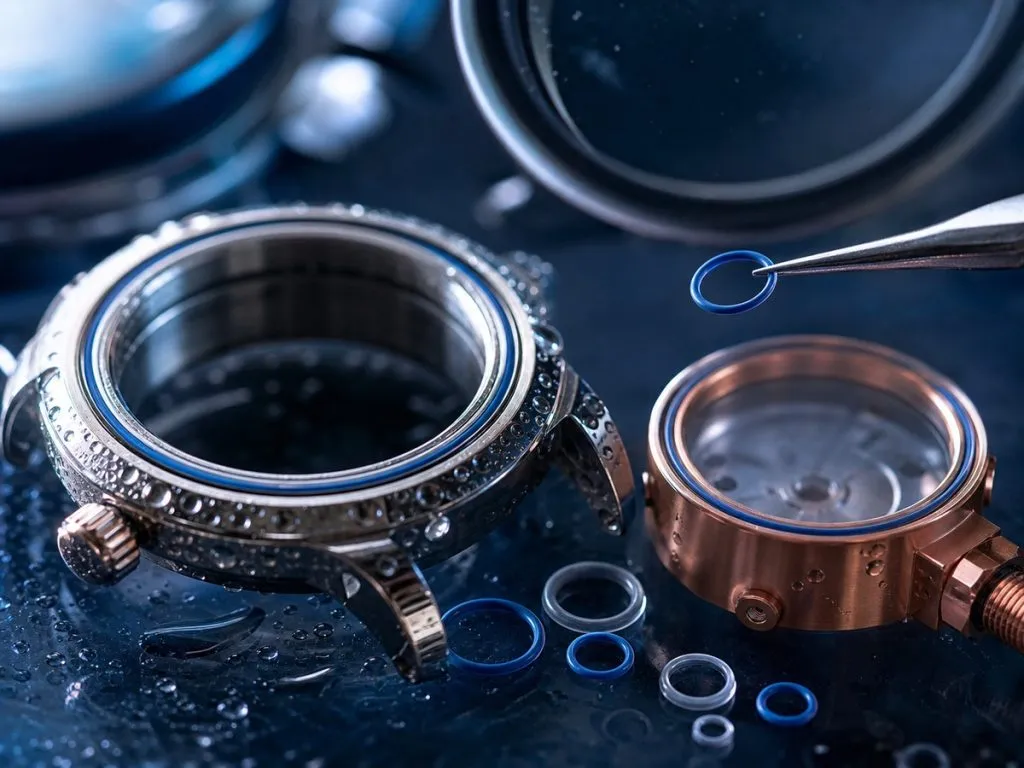
Waterproof rings for watches/instrumentation: characterized by "small size + high demands".
Common features of waterproof rings for precision watches and instruments:
- Smaller dimensions and thinner cross sections, more sensitive to tolerances
- Limited assembly space and insufficient lead-in corners make it more likely to scratch
- Clear requirements for waterproof rating and high demand for consistency
Common Application Locations
- Crown/Knob Perimeter
- Back cover/back cover end face
- Instrument housing mating surfaces
- Transparent cover perimeter
Selection points (practical version)
1) Dimensions and tolerances
- Key dimensions are recommended to be marked separately and test methods are agreed upon.
- Smaller parts are more susceptible to mold condition and process fluctuations
2) Hardness and Fit
- Need a better fit: medium hardness is more common
- Need for extrusion resistance: consider higher hardness at higher clearances or pressures
3) Surface quality
- Parting line, burr height directly affects sealing
- Defects in the vicinity of the sealing surface require even more stringent control
4) Assembly risk control
- Adequate lead-in corners/chamfers
- Use a compatible lubricant if necessary
- Avoid twisting and crimping
High frequency causes of leakage in these products: scratches + insufficient compression + dimensional fluctuations.
Suggested Validation Methods
- Dimensional consistency sampling (critical dimension CTQ)
- Assembly verification: for scratches and displacement
- Waterproof verification: do immersion/water pressure/airtightness according to target level (subject to customer standards)
- Temperature cycling: retesting after hot and cold cycles
FAQ
Q: Why do some of the same rings fit without leaking and some leak?
Usually caused by tolerance stacking leading to compression differences, or assembly scratches.
Q: Can I solve the leak by being "softer"?
Not necessarily. Softer may be a better fit, but it may also be more susceptible to scratching or extrusion, which needs to be verified along with the structure.