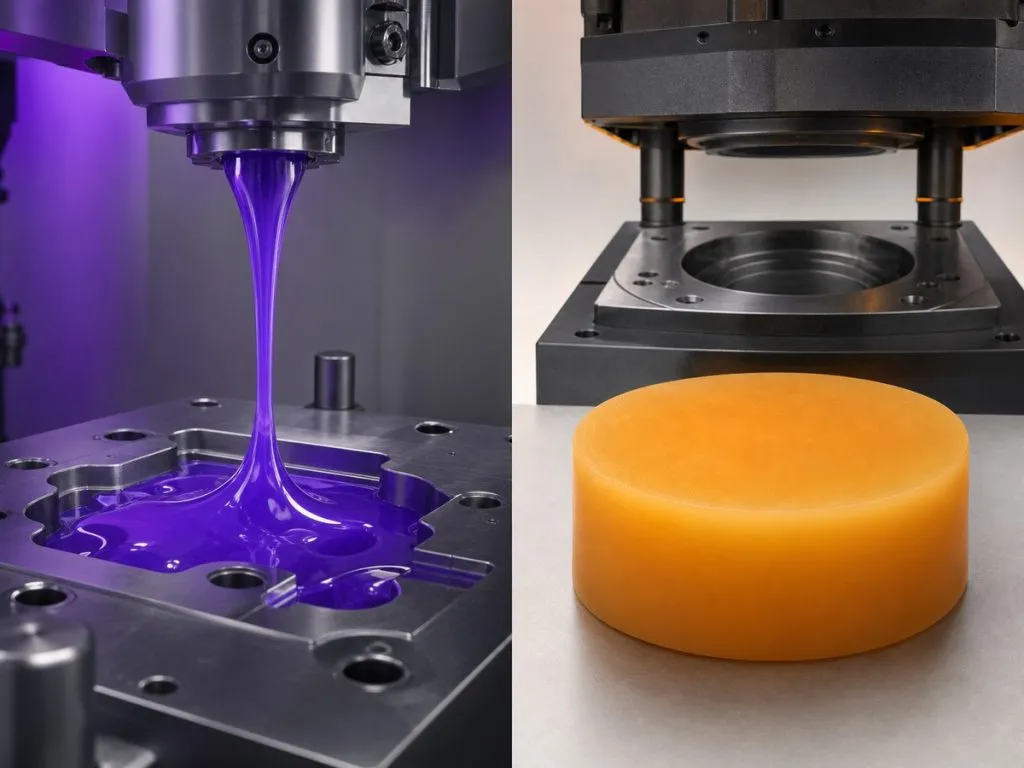
Liquid silicone rubber (LSR) and hot-cured silicone rubber (HCR) are not simply a matter of one being better than the other. Projects should select a stable and cost-effective molding process based on factors such as structure, production volume, precision, appearance, and certification requirements.
1. First, let’s look at the materials and forming methods
LSR is typically injection molded using a two-component metering system and offers good flow properties; HCR is most commonly produced via compression molding or injection molding, offering greater flexibility in formulation and processing.
- LSR is suitable for thin-walled, complex structures and automated continuous production
- HCR is suitable for multi-color applications, special hardness requirements, and flexible post-processing needs.
- The same product should be evaluated based on the actual rubber compound grade; it is not appropriate to make a judgment based solely on the material name.
2. Determine the process based on yield and accuracy
High-volume projects require greater attention to cycle time, labor, and consistency, while low-volume projects require control over mold investment and setup costs.
- When annual demand is stable and volumes are high, LSR automation should be evaluated as a priority.
- HCR dies offer good adaptability for situations involving multiple product varieties, small batches, or frequent changes.
- For critical dimensions, clearly define the measurement reference, shrinkage rate, and tolerance requirements.
3. Include subsequent processes in the evaluation
Surface coating, printing, laser engraving, bonding, and secondary vulcanization can all affect the final design.
- Confirm in advance whether overmolding, inserts, or clean packaging are required.
- For exterior parts, samples should first be checked for color variation, flash, and surface texture.
- Seals should be tested for leakage performance under actual assembly conditions.
4. Recommendations for the Prototyping Phase
By first completing prototype validation with a focus on functionality and assembly, and then finalizing the process window, rework during the mass production phase can be reduced.
- Provide 2D/3D drawings and key dimensional specifications
- Confirm material requirements such as hardness, color, flame retardancy, or food contact suitability
- Retain sample parts, first-article reports, and change records
FAQ
1. Is LSR always more expensive than HCR?
Not necessarily. While the initial investment in LSR molds and automation may be high, these can reduce labor and variable costs in high-volume production.
2. Can an assessment be made without drawings?
We can conduct a preliminary evaluation based on the sample, dimensions, and operating environment; however, we still recommend providing additional key dimensions and acceptance criteria before mass production.