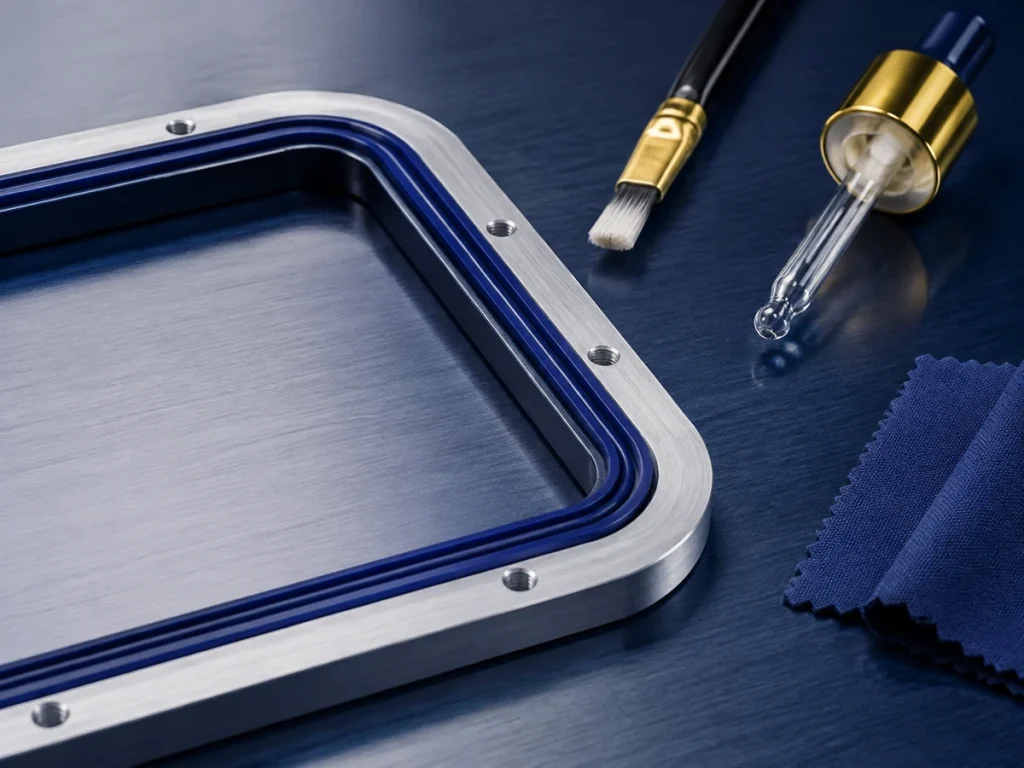
Short answer:Silicone adhesive primers must be compatible with the silicone system, the metal or plastic substrate, the adhesive, and the operating environment. Surface cleanliness, texturing or plasma treatment, coating thickness, flash-off time, and the curing window all contribute to the bond’s durability.
In what kinds of situations are these silicone parts suitable?
Clearly defining the actual application scenarios helps translate material, structural, and validation requirements into actionable technical specifications.
- Bonding of Silicone to a Metal Frame
- Bonding Silicone Sealing Frames to Plastic Housings
- Mounting Sensors, Controllers, and Assemblies
Parameters to Confirm Before Selecting a Model
We recommend providing the following information before requesting a quote or ordering a sample to minimize the need for repeated prototyping and misunderstandings regarding specifications.
- Specific grades and surface conditions of the silicone and substrate
- Temperature, Medium, Humidity and Heat, and Mode of Loading
- Process cycle time, curing conditions, and regulatory restrictions
Key Points in Structural Design
Structural dimensions, assembly relationships, and material elasticity must be evaluated together; simply increasing a single parameter generally does not directly improve reliability.
- Reasonable distribution of the bonded area and the direction of force
- Add fillets to corners to prevent stress concentration due to delamination
- The interface design takes into account positioning, glue overflow, and inspection
Production and Quality Control
Consistency in mass production results from the combined control of material batches, mold condition, molding windows, and inspection methods.
- Control the surface dwell time after degreasing and cleaning
- Apply the primer evenly and observe the drying and activation window.
- Controlling the amount of adhesive applied, clamping, and curing conditions
Recommended Verification Items
Validation should be conducted using actual or equivalent operating conditions whenever possible, and functionality should be reconfirmed after aging or cycling.
- Conduct peel, shear, and pull-off strength tests
- Bond Strength Tested After Exposure to Hot, Humid Media and Recirculation
- Failure modes should be documented for cohesive failures in interfaces or materials.
Frequently Asked Questions
Does a thicker coat of primer provide better adhesion?
If the coating is too thick or uneven, it may reduce the bond strength.
Is wiping the surface with alcohol before bonding sufficient?
The treatment plan must be determined based on the contamination of the substrate and its surface energy.
How do I provide information to suppliers?
Please provide 2D or 3D drawings, photos of samples, material and hardness specifications, operating environment, target quantity, acceptance criteria, and a list of compliance documents. Based on this information, Chengxin Silicone Rubber can evaluate the materials, molds, molding process, and validation plan.
Related Custom Products
Bring your application questions, communication materials, and process proposals
Please provide the product's intended use, 2D/3D drawings or samples, key dimensions, material requirements, and estimated quantity. Drawings may be sent as email attachments.
Send Your Inquiry Send the drawings via email
Materials, minimum order quantities, tooling costs, and lead times must be evaluated based on the specific drawings and quantities.