Separate specification and control limits
Specifications describe product requirements; control limits describe process behavior. Cpk measures capability relative to specifications and does not itself prove control. NIST capability guidance assumes an appropriate stable process. Resolve drift before interpreting an index.
Retain sampling labels
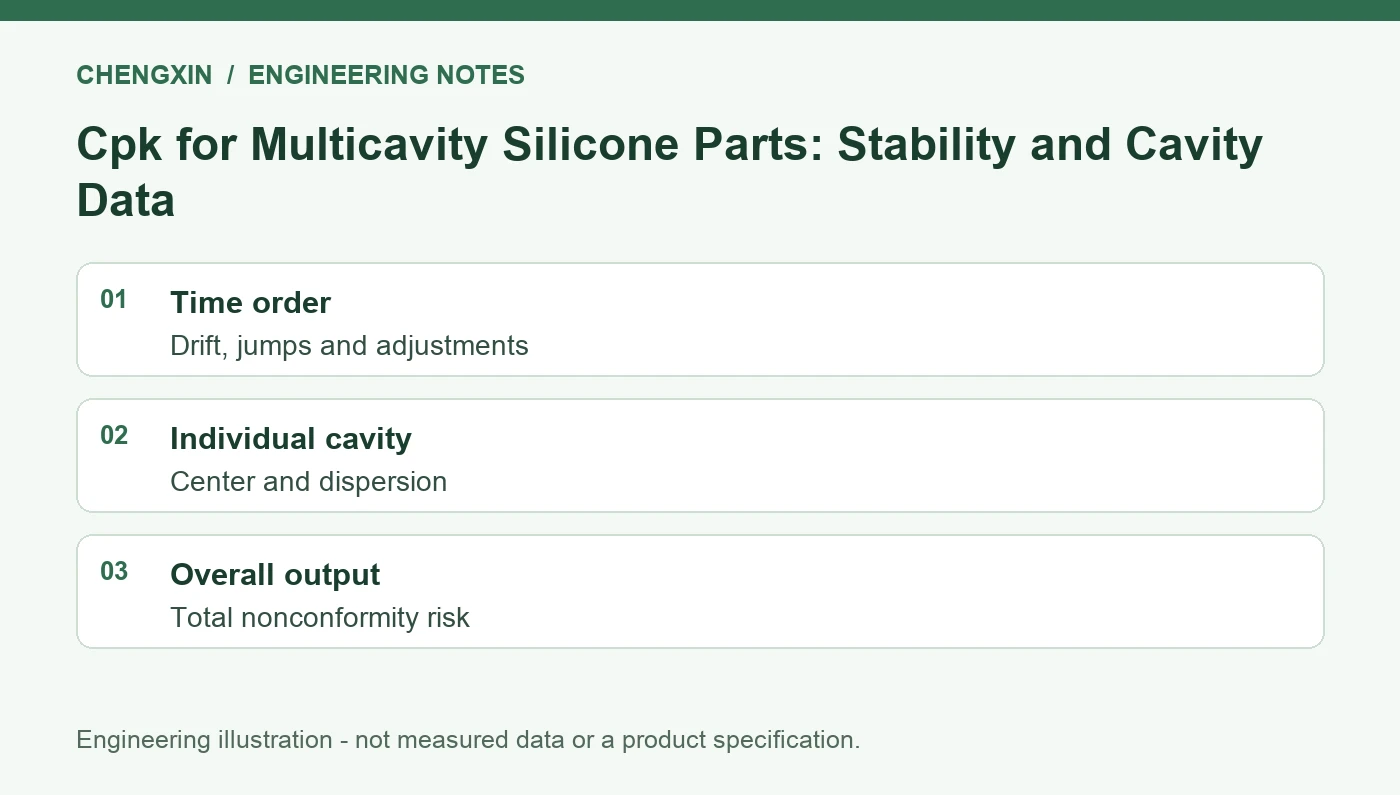
Keep cavity, production order, material lot, machine and adjustment events. Examine time trends, then cavity distributions and overall outgoing performance. Averages lose between-cavity information; deleting boundary specimens to improve an index misrepresents the process.
Turn results into evidence-based action
One shifted cavity suggests investigating local tooling, temperature or venting; simultaneous shifts suggest shared process or material factors. These are hypotheses requiring confirmation. Explain limited-sample uncertainty rather than announcing long-term capability from a few first-off parts.
Project review checklist
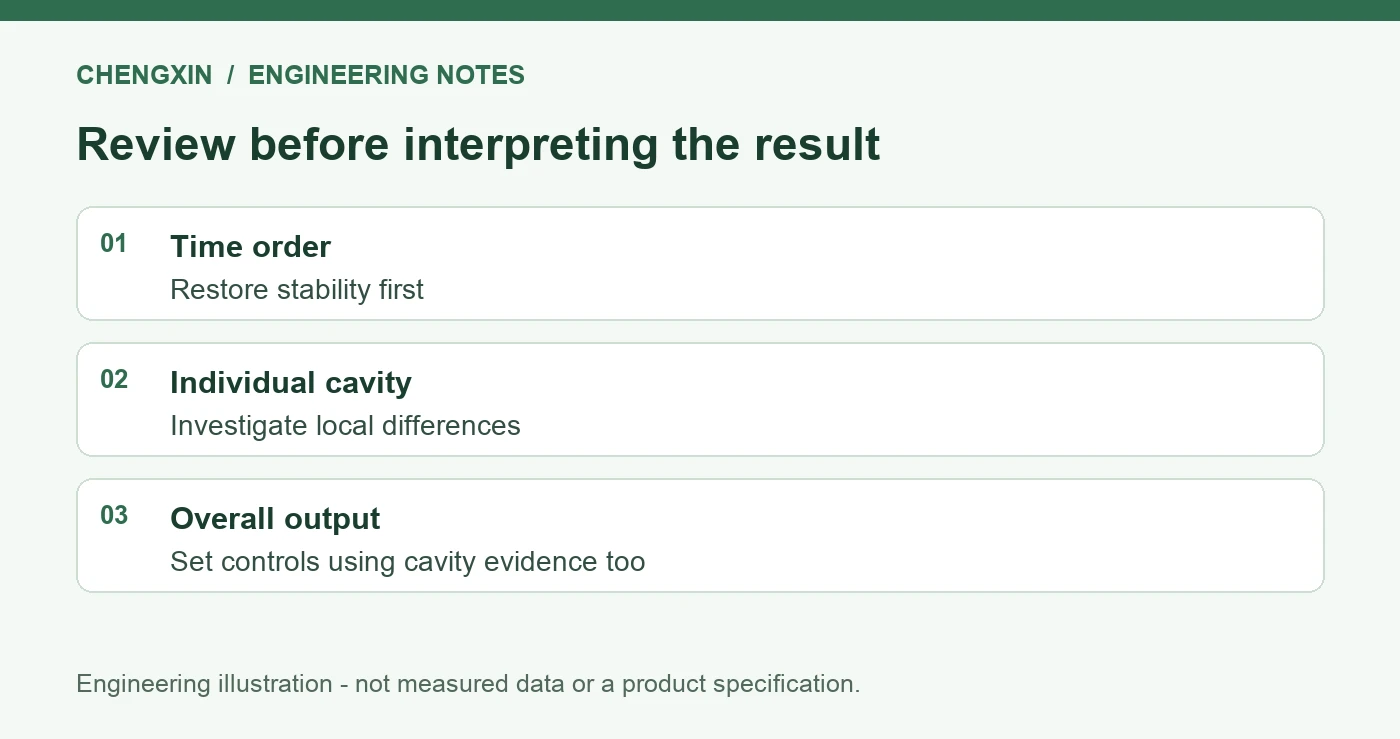
| Observation level | Review | Action |
|---|---|---|
| Time order | Drift, jumps and adjustments | Restore stability first |
| Individual cavity | Center and dispersion | Investigate local differences |
| Overall output | Total nonconformity risk | Set controls using cavity evidence too |
Illustrative project example
Two cavities can each have small variation but different means. Their broad pooled distribution is not the same issue as within-cavity random variation; retain cavity identity before deciding corrections.
Frequently asked questions
Does achieving a particular Cpk remove inspection?
Not automatically. Agreed controls, change management and functional risks still apply.
Can nonnormal data use the usual formula without review?
Understand the distribution and choose an appropriate method; do not transform or delete points merely to improve the number.
Technical references
References explain methods and terminology. They do not establish certification, acceptance limits or measured performance for a Chengxin product. Confirm the applicable edition and project-specific method with the responsible laboratory.
Related product and project inquiry
Precision Silicone O-Rings for Watches · When to Measure Silicone Rings After Stretching and Assembly
For a custom part review, send the drawing, application, material or performance needs, key dimensions, quantity and target test conditions. Material, tooling and acceptance requirements are confirmed for each project.