Scope and common interpretation errors
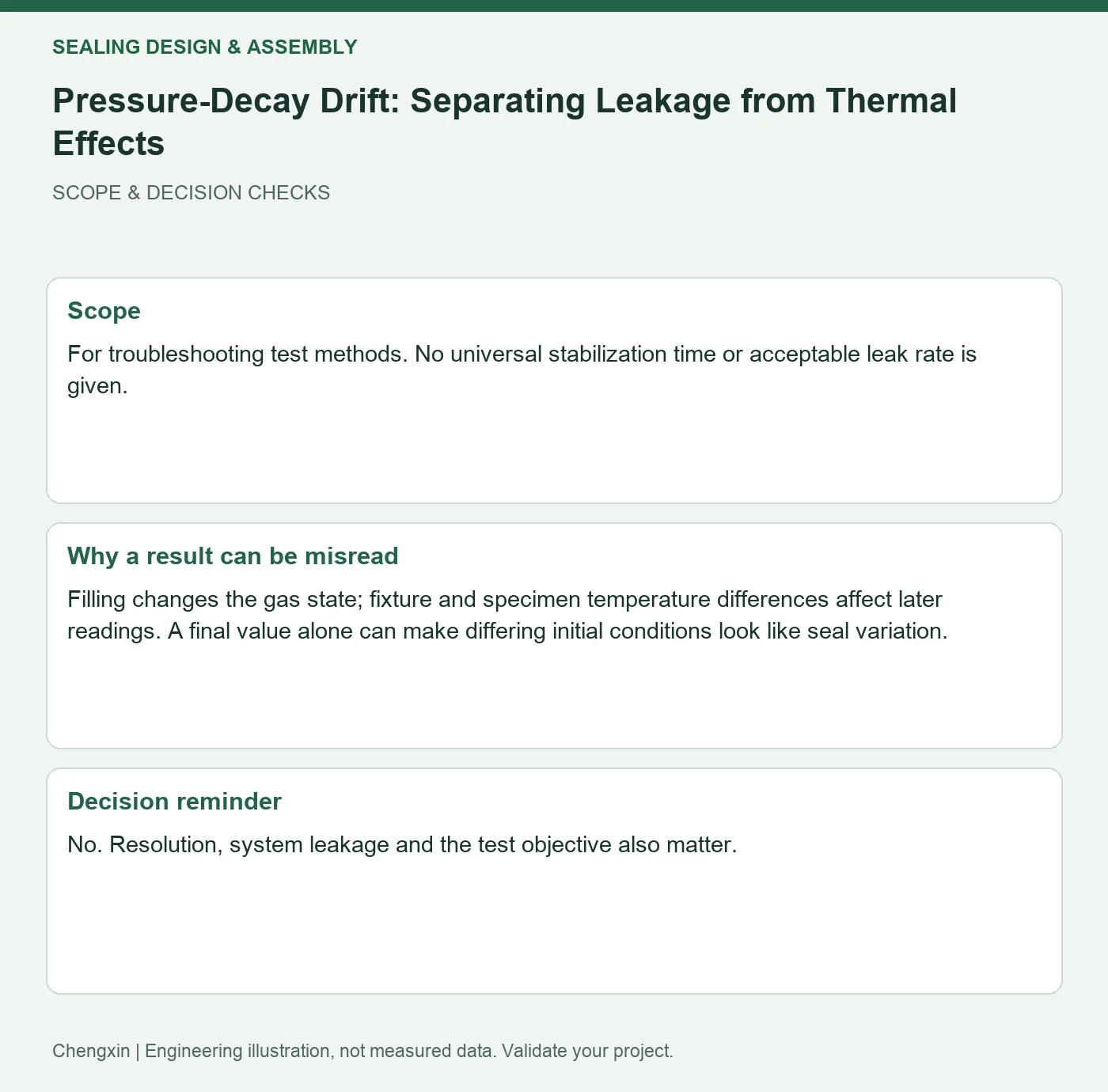
For troubleshooting test methods. No universal stabilization time or acceptable leak rate is given.
Filling changes the gas state; fixture and specimen temperature differences affect later readings. A final value alone can make differing initial conditions look like seal variation.
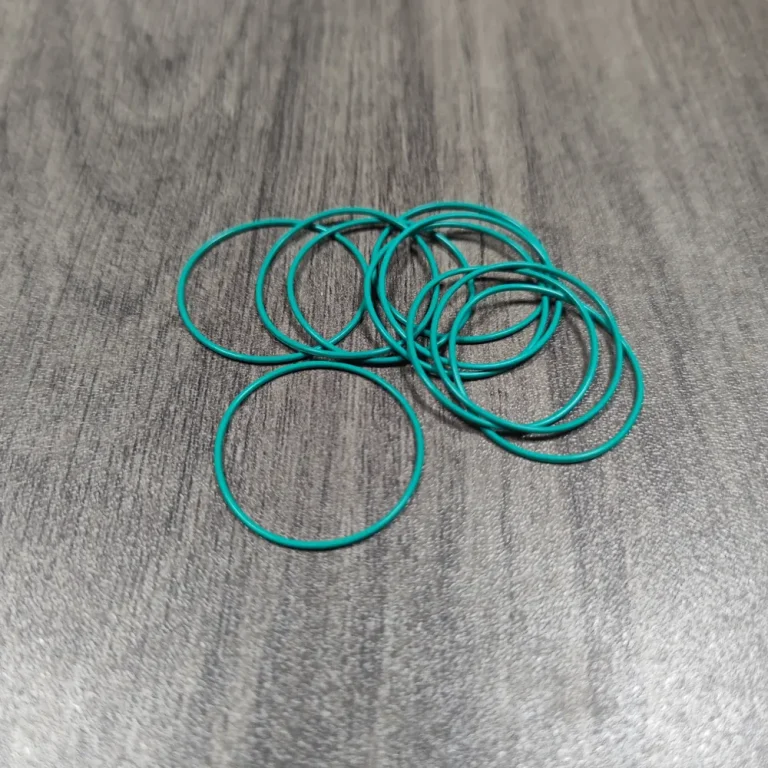
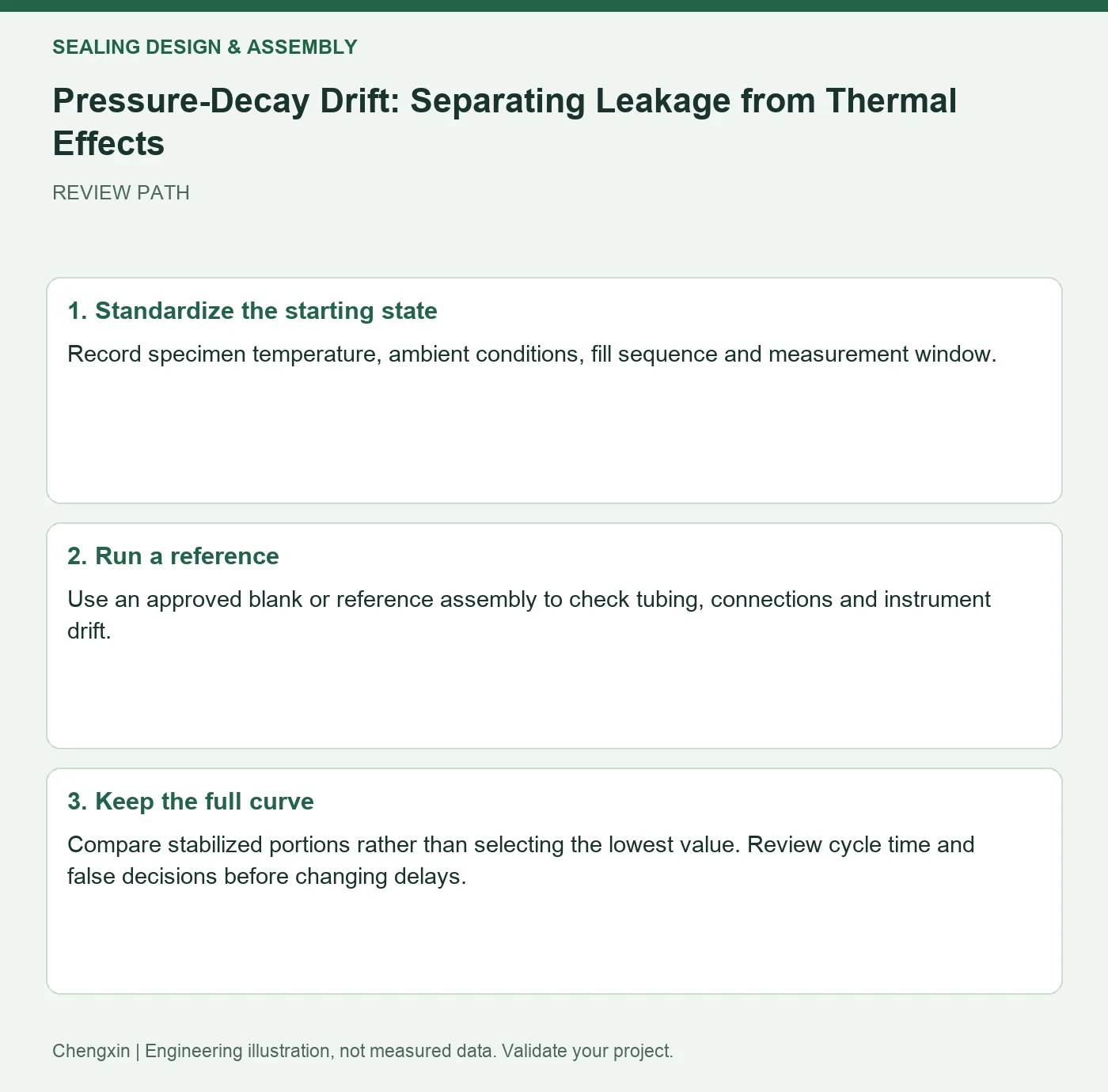
Turn the review into recorded checks
| Step | Action and evidence |
|---|---|
| 1 · Standardize the starting state | Record specimen temperature, ambient conditions, fill sequence and measurement window. |
| 2 · Run a reference | Use an approved blank or reference assembly to check tubing, connections and instrument drift. |
| 3 · Keep the full curve | Compare stabilized portions rather than selecting the lowest value. Review cycle time and false decisions before changing delays. |
A comparison to avoid misinterpretation
Compare the same specimen immediately after transfer and after temperature stabilization. If results track temperature, improve conditioning and records before changing the seal.
Frequently asked question
Does a longer stabilization time always improve accuracy?
No. Resolution, system leakage and the test objective also matter.
Background and further reading
This note addresses one specific question. For broader concepts, see the related background guide.
Related question: Water-Test Pass, Air-Test Fail: Understanding Seal Test Boundaries.
External references support the relevant concepts. The review steps and scenarios are independent engineering discussion guidance, not quotations from a standard or external organization. Use agreed methods, applicable document revisions and complete conditions.
Apply this to your custom part
Compare the structure with Rubber O-Rings for Cleaning-Equipment Water Circuits. Describe the application, geometry, operating conditions, quantity and problem to solve. Submit a custom-parts inquiry, or see how to send drawings and sample photographs by business email. Confirm material, dimensions, costs, testing and delivery requirements for the project.