Scope and common interpretation errors
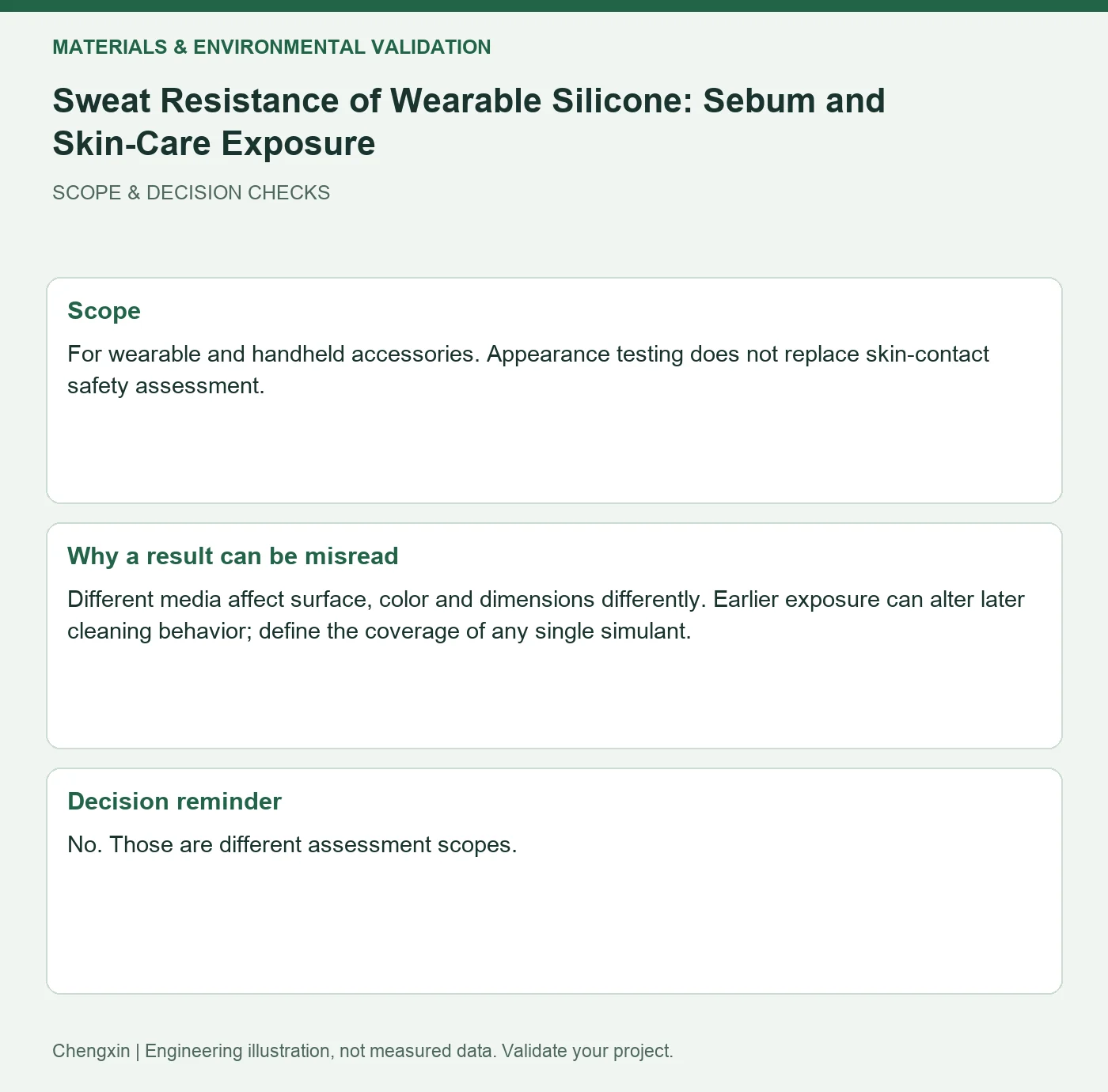
For wearable and handheld accessories. Appearance testing does not replace skin-contact safety assessment.
Different media affect surface, color and dimensions differently. Earlier exposure can alter later cleaning behavior; define the coverage of any single simulant.
Turn the review into recorded checks
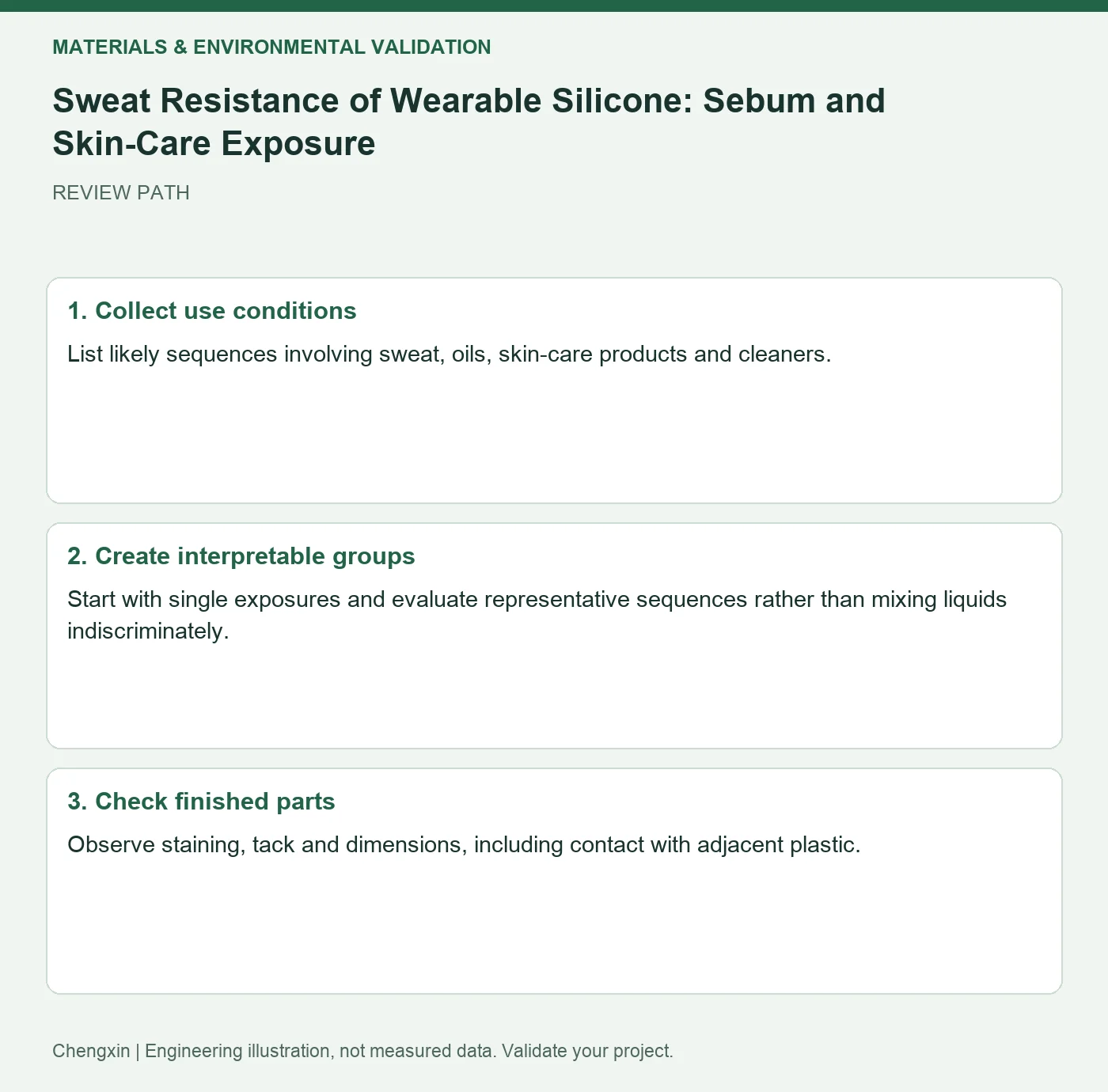
| Step | Action and evidence |
|---|---|
| 1 · Collect use conditions | List likely sequences involving sweat, oils, skin-care products and cleaners. |
| 2 · Create interpretable groups | Start with single exposures and evaluate representative sequences rather than mixing liquids indiscriminately. |
| 3 · Check finished parts | Observe staining, tack and dimensions, including contact with adjacent plastic. |
A comparison to avoid misinterpretation
A stable sweat group and a sticky skin-care-product group point to a specific exposure issue, not a blanket 'sweat failure' or 'complete oil resistance' claim.
Frequently asked question
Does a sweat test prove the part will not cause allergy?
No. Those are different assessment scopes.
Background and further reading
This note addresses one specific question. For broader concepts, see the related background guide.
Related question: Color Transfer from Dark Silicone to Light Plastic: Paired Tests.
External references support the relevant concepts. The review steps and scenarios are independent engineering discussion guidance, not quotations from a standard or external organization. Use agreed methods, applicable document revisions and complete conditions.
Apply this to your custom part
Compare the structure with Shaped Silicone Housing Gaskets for Wearable Devices. Describe the application, geometry, operating conditions, quantity and problem to solve. Submit a custom-parts inquiry, or see how to send drawings and sample photographs by business email. Confirm material, dimensions, costs, testing and delivery requirements for the project.