Scope and common interpretation errors
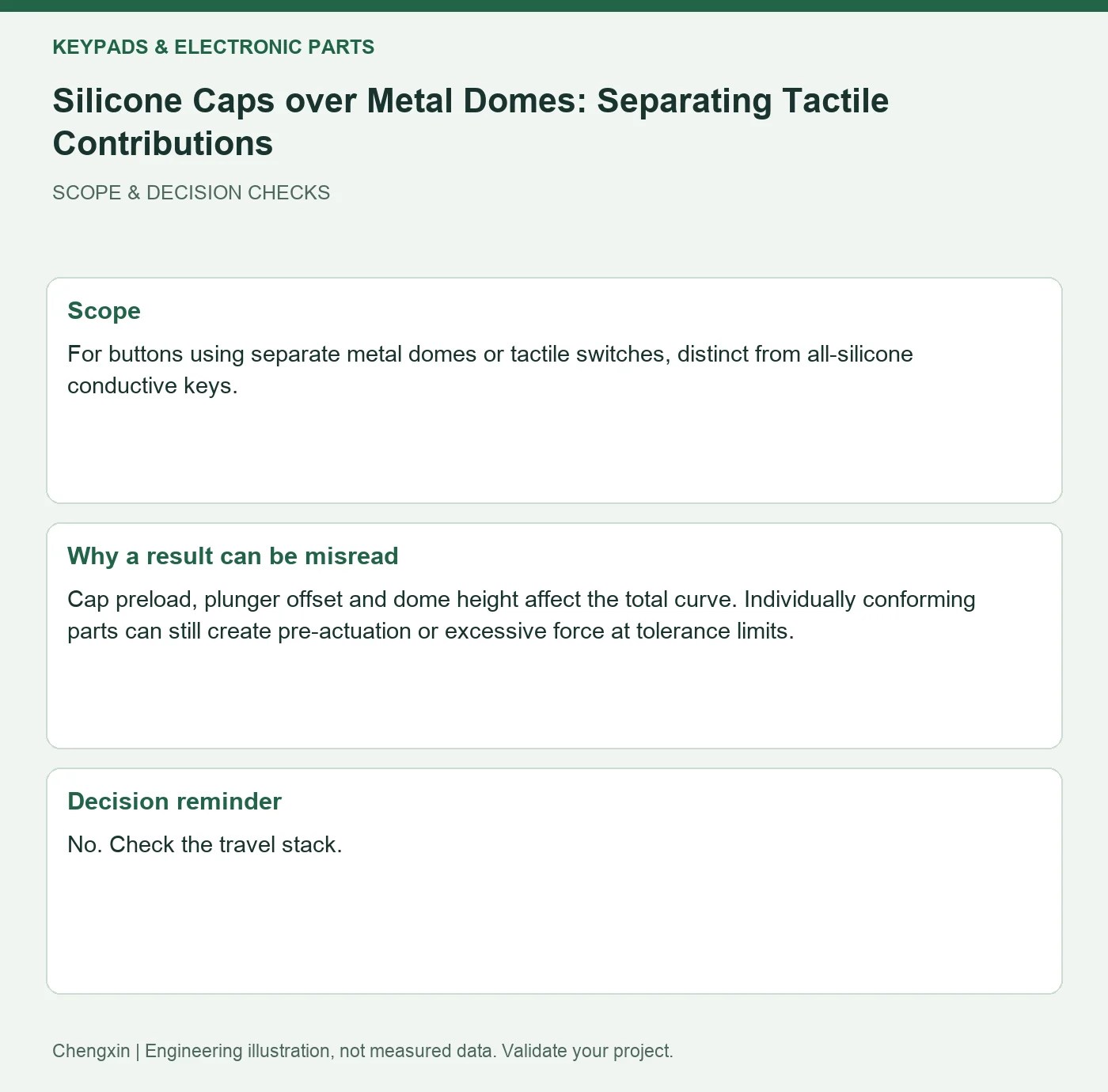
For buttons using separate metal domes or tactile switches, distinct from all-silicone conductive keys.
Cap preload, plunger offset and dome height affect the total curve. Individually conforming parts can still create pre-actuation or excessive force at tolerance limits.
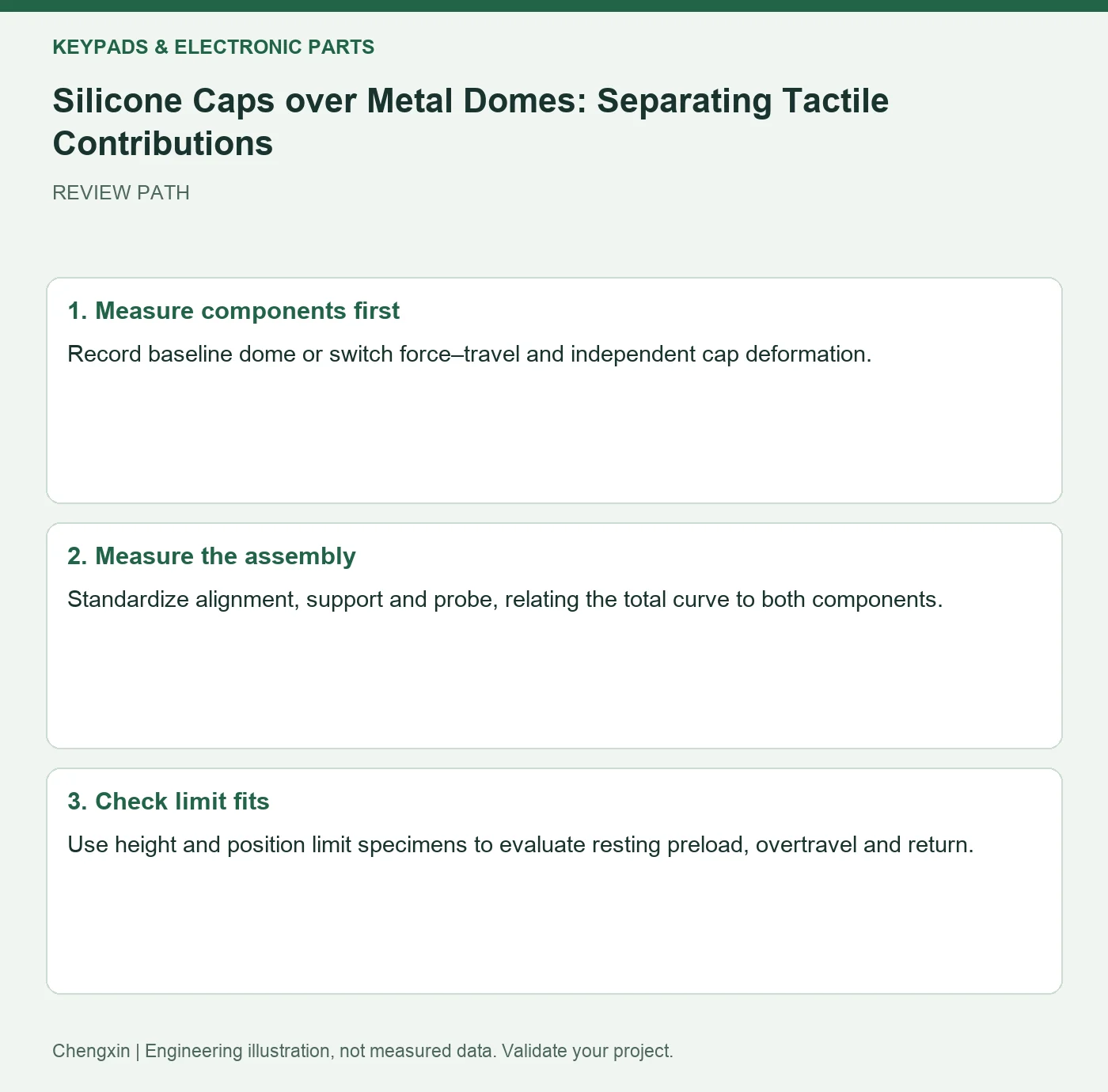
Turn the review into recorded checks
| Step | Action and evidence |
|---|---|
| 1 · Measure components first | Record baseline dome or switch force–travel and independent cap deformation. |
| 2 · Measure the assembly | Standardize alignment, support and probe, relating the total curve to both components. |
| 3 · Check limit fits | Use height and position limit specimens to evaluate resting preload, overtravel and return. |
A comparison to avoid misinterpretation
A stable dome-only curve with greater variation after fitting a cap justifies checking preload and eccentricity before declaring incoming domes uncontrolled.
Frequently asked question
Can an elastic cap accommodate any switch height?
No. Check the travel stack.
Background and further reading
This note addresses one specific question. For broader concepts, see the related background guide.
Related question: Neighbor-Key Movement in Silicone Keypads: Coupling and Support.
External references support the relevant concepts. The review steps and scenarios are independent engineering discussion guidance, not quotations from a standard or external organization. Use agreed methods, applicable document revisions and complete conditions.
Apply this to your custom part
Compare the structure with Custom Silicone Single-Key Button Caps. Describe the application, geometry, operating conditions, quantity and problem to solve. Submit a custom-parts inquiry, or see how to send drawings and sample photographs by business email. Confirm material, dimensions, costs, testing and delivery requirements for the project.