Scope and common interpretation errors
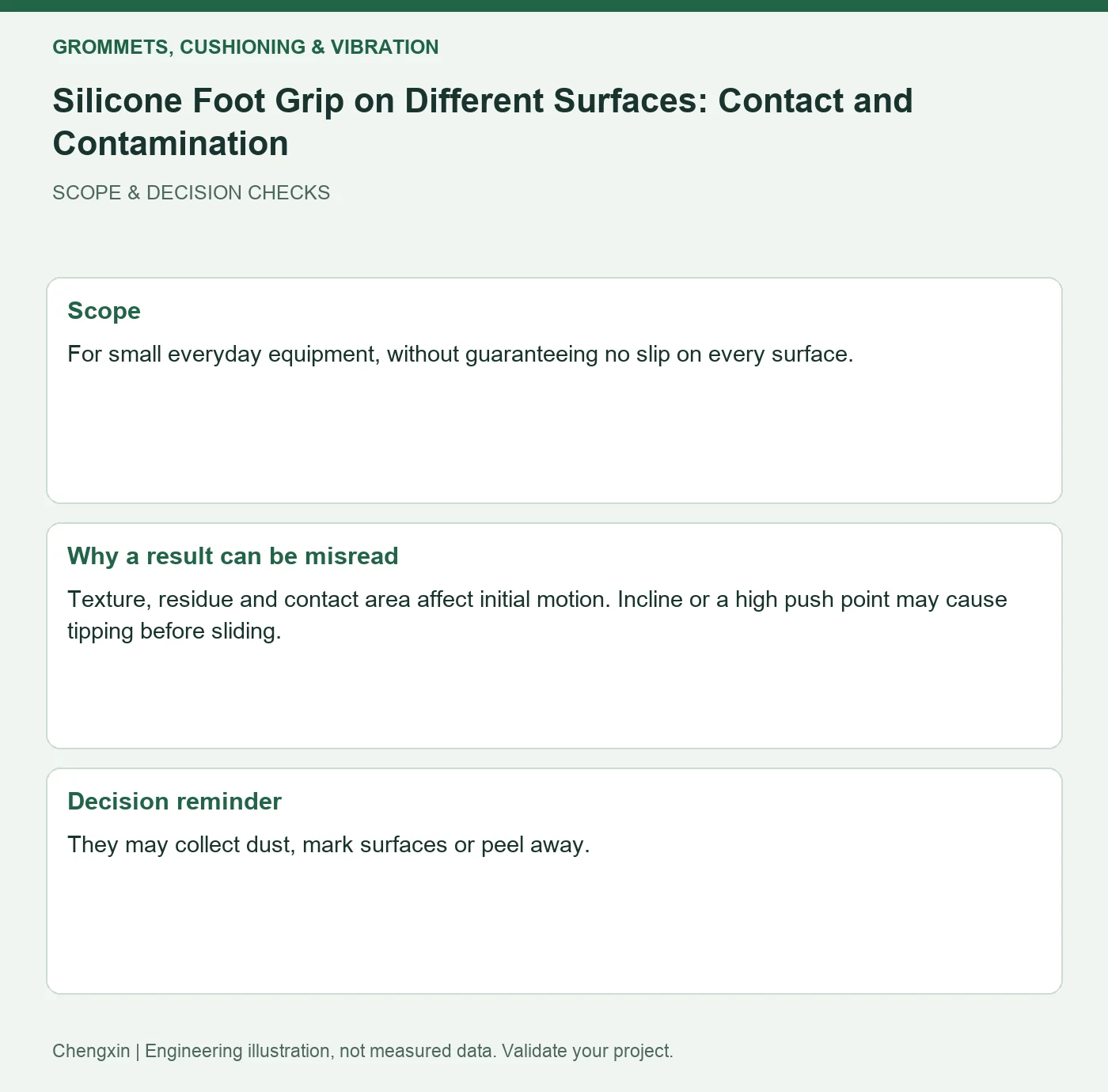
For small everyday equipment, without guaranteeing no slip on every surface.
Texture, residue and contact area affect initial motion. Incline or a high push point may cause tipping before sliding.
Turn the review into recorded checks
| Step | Action and evidence |
|---|---|
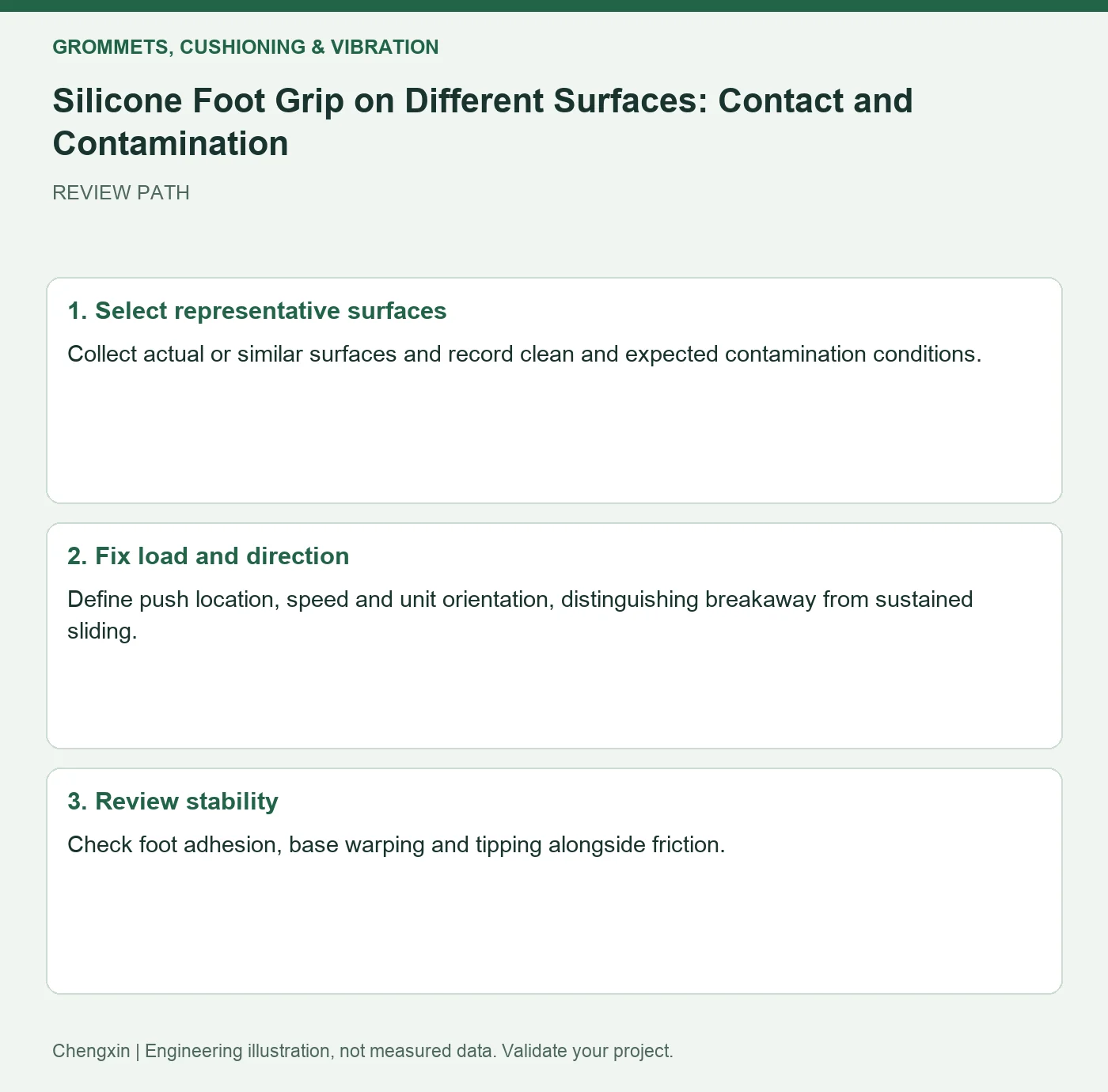
| 1 · Select representative surfaces | Collect actual or similar surfaces and record clean and expected contamination conditions. |
| 2 · Fix load and direction | Define push location, speed and unit orientation, distinguishing breakaway from sustained sliding. |
| 3 · Review stability | Check foot adhesion, base warping and tipping alongside friction. |
A comparison to avoid misinterpretation
Retain separate references for matte and glossy desks if behavior differs. The most favorable surface cannot establish suitability for all uses.
Frequently asked question
Are tackier feet always better for grip?
They may collect dust, mark surfaces or peel away.
Background and further reading
This note addresses one specific question. For broader concepts, see the related background guide.
Related question: Adhesive-Backed Silicone Feet Detaching: Failure Layer and Load.
External references support the relevant concepts. The review steps and scenarios are independent engineering discussion guidance, not quotations from a standard or external organization. Use agreed methods, applicable document revisions and complete conditions.
Apply this to your custom part
Compare the structure with Silicone Vibration-Isolation Feet for Small Equipment. Describe the application, geometry, operating conditions, quantity and problem to solve. Submit a custom-parts inquiry, or see how to send drawings and sample photographs by business email. Confirm material, dimensions, costs, testing and delivery requirements for the project.