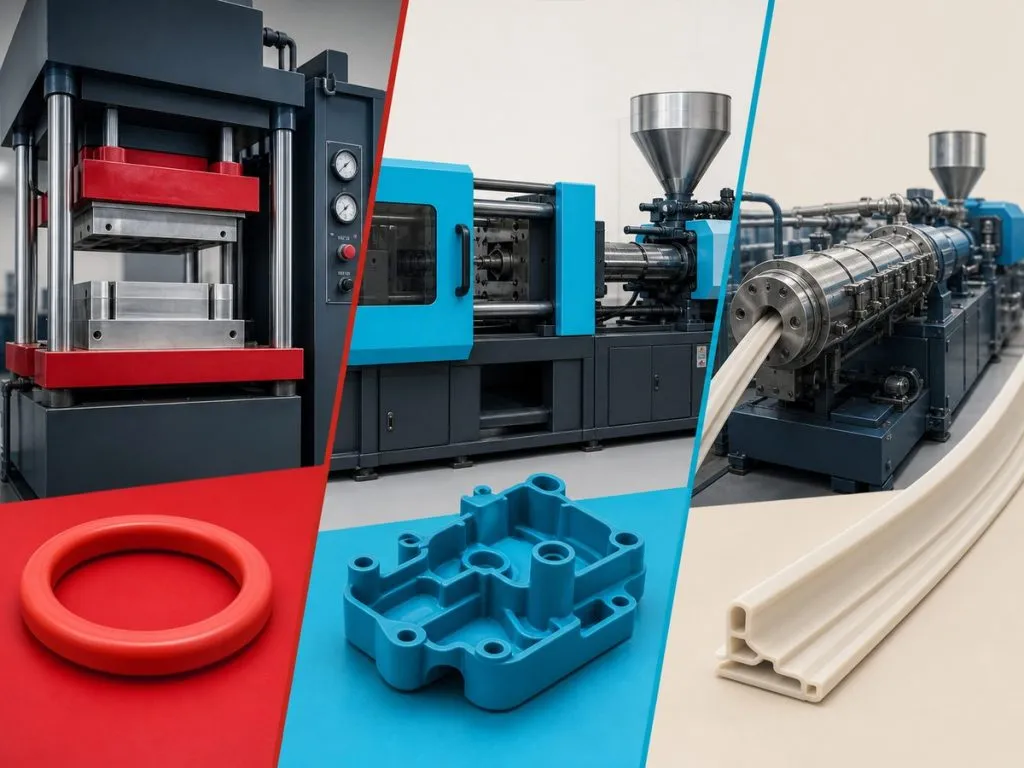
Three common silicone molding processes: compression molding, injection, extrusion
Different processes dictate that:
- What kind of shapes can you make?
- Upper limit of accuracy and consistency
- Unit price and mold cost structure
- Capacity and delivery
This article explains the "how to choose" approach, making it easy for customers to make quick decisions.
1) Compression Molding (Compression Molding)
Fit: Most conventional silicone parts, gaskets, shaped parts
- Advantages: mature technology, wide range of adaptability
- Focus: Burr control, efficiency and consistency depend on mold and process parameters
- Cost structure: relatively controllable mold costs, suitable for small and medium batches to mass production
2) Injection Molding (Injection Molding)
Fit: Projects with more complex structures, higher requirements for dimensional consistency, and higher production volumes
- Benefits: Higher efficiency, more automation, better consistency
- Concerns: Higher mold costs, more stringent design and exhaust requirements
- Cost structure: higher upfront investment, the larger the volume, the more obvious the advantages
3) Extrusion molding (Extrusion)
Fit: Long, tubular, continuous cross-section products
- Advantages: continuous production, high efficiency
- Concerns: can only make shapes with "no change in cross-section", which may require subsequent cutting/secondary processing.
A simple judgment:
- Complex shapes and large production volumes → Prioritize evaluation of injections
- Conventional shapes, flexible requirements → compression molding is very common
- Strip/Tubing → Extrusion is best </aside
How are costs and lead times usually affected?
- Mold complexity and number of cavities
- Whether secondary processes (oil spraying, printing, overmolding) are required
- Dimensional tolerances and inspection requirements
- Lot size and delivery cadence
Common Misconceptions
- Pursuing the "cheapest process" at the expense of consistency and yields
- Molding without complete drawings, resulting in repeated mold changes
- Mass production without small batch validation