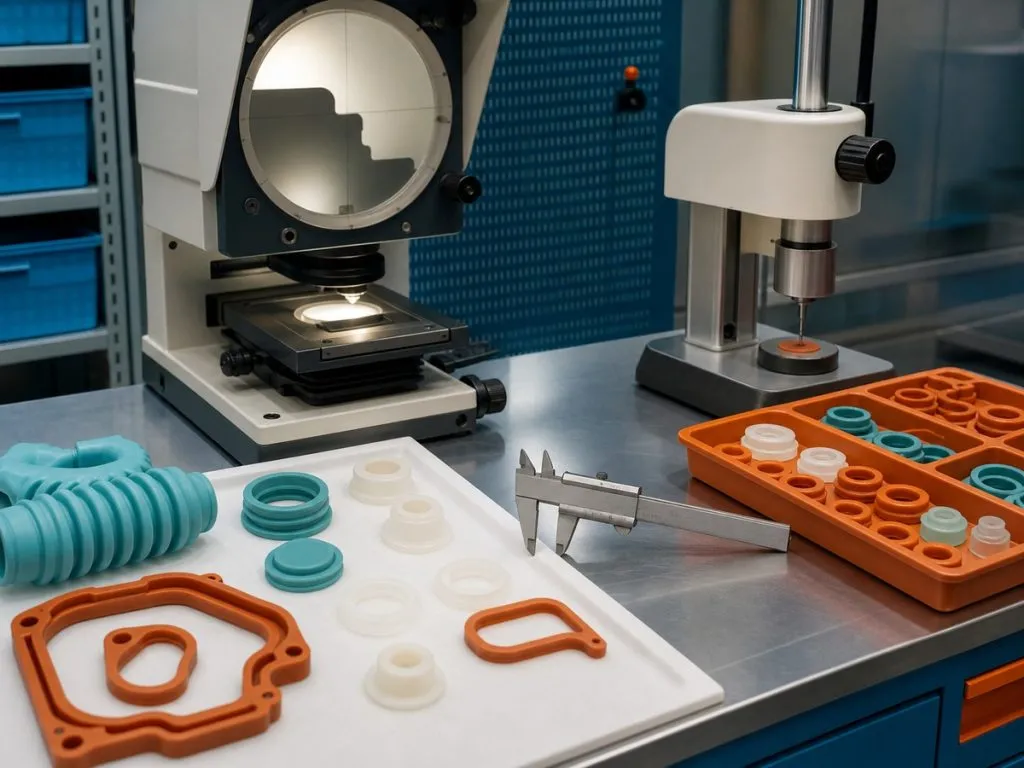
The stability of silicone seals often begins with incoming material inspection. Establishing reasonable IQC sampling standards can effectively reduce quality risks such as leakage, compression deformation, and dimensional abnormalities.
1. Establishment of a hierarchy: which items must be examined
- Category A (Critical): Seal line related dimensions, hardness, cosmetic defects (nicks/cuttings/brown edges)
- Class B (Important): General dimensions, color consistency, surface defects
- Category C (General): Packaging, labeling, quantity
2. Points for visual inspection
- Sealing surface area: burr height, nicks, bubbles, impurities
- Parting line and trim: whether or not it intrudes into the sealing line
- It is recommended that "standardized samples" and defect rating charts be established to reduce subjective differences.
3. Dimensional Inspection: Capturing Critical Dimensions and Methods
- Harmonization of gauges and measuring positions (large differences in results for different measurements of the same size)
- Suggests more frequent or full inspection of critical dimensions of the tolerance chain.
- CPK management can be used as an alternative to partial full inspection for bulk stabilization projects.
4. Hardness and resilience
- Hardness: it is recommended that each lot be sampled and trends recorded
- Rebound/compression set: sampling by risk or periodicity (e.g., quarterly/per change)
5. Sampling recommendations (may be adjusted by project)
- New suppliers/new molds: Tightened sampling (first 3 batches of key monitoring)
- Stabilized mass production: sampling by AQL or by risk classification
- Abnormalities occur: immediately upgrade sampling and initiate lot traceability
FAQ
- Is it enough to just check the size?
Insufficient. Seal failure is often associated with cosmetic chipping, burrs and hardness drift, and it is recommended that at least cosmetic and hardness be covered.
- What should I do if I pass the hardness test but still leak?
It may be a matter of structural compression or assembly consistency. Incoming inspection can only control the "incoming risk" and still requires system validation.
Related Custom Products and Inquiries
Please provide drawings, key dimensions, material specifications, operating conditions, and estimated quantities so we can discuss feasible prototyping and production plans.