
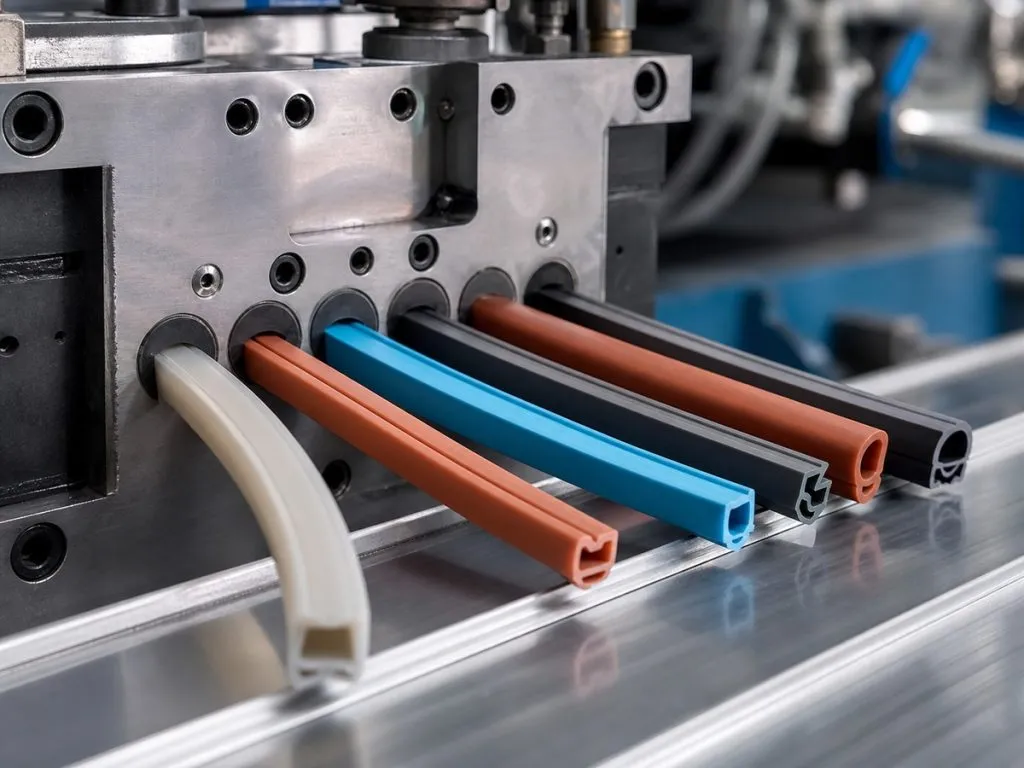
Extruded seals may seem simple, but the most common problems in mass production are "dimensional fluctuations" and "uncontrollable shrinkage". In this paper, a systematic solution is given from the design of die opening, process window to inspection control.
1. 4 main sources of dimensional fluctuations
- Poor mold opening design: uneven flow distribution leading to cross-section deformation
- Traction speed fluctuation: directly affects wire density and size
- Unstable temperature control: affects viscosity and shrinkage
- Formulation and batch variation: hardness, flow drift
2. Shrinkage: must be measured by the "actual process".
- The same material shrinks differently at different extrusion temperatures and haul-off speeds.
- Proposed empirical database: material lot × process window × shrinkage rate
3. Mold opening design recommendations
- Stabilizing segments in critical dimensional areas to reduce springback deformation
- Validation of runner balancing and test molding for complex cross sections
- Avoid burrs on sealing surfaces by planning the parting and trimming process in advance.
4. Process control: turning fluctuations into manageable indicators
- Key parameters: extrusion temperature, haul-off speed, cooling method
- On-line measurement: on-line monitoring/sampling cadence of critical cross-section dimensions
- CPK: Process capability management for sealing line related dimensions
5. Incoming materials and deliveries
- Definition of receiving inspection methods: gauges, measuring positions, determination criteria
- Packaging and storage: anti-pressure deformation and anti-pollution
FAQ
- Why is there so much difference in size between batches of the same mold opening?
It is usually the superimposed effect of material fluidity, temperature control and traction speed, and it is recommended that both batch sampling and process window control be established.
- What should I do if the extruded strip tends to spring back and deform after installation?
It can be optimized in terms of cross-section structure, hardness and assembly preloading method, and the post-assembly dimensional stability verification can be done.