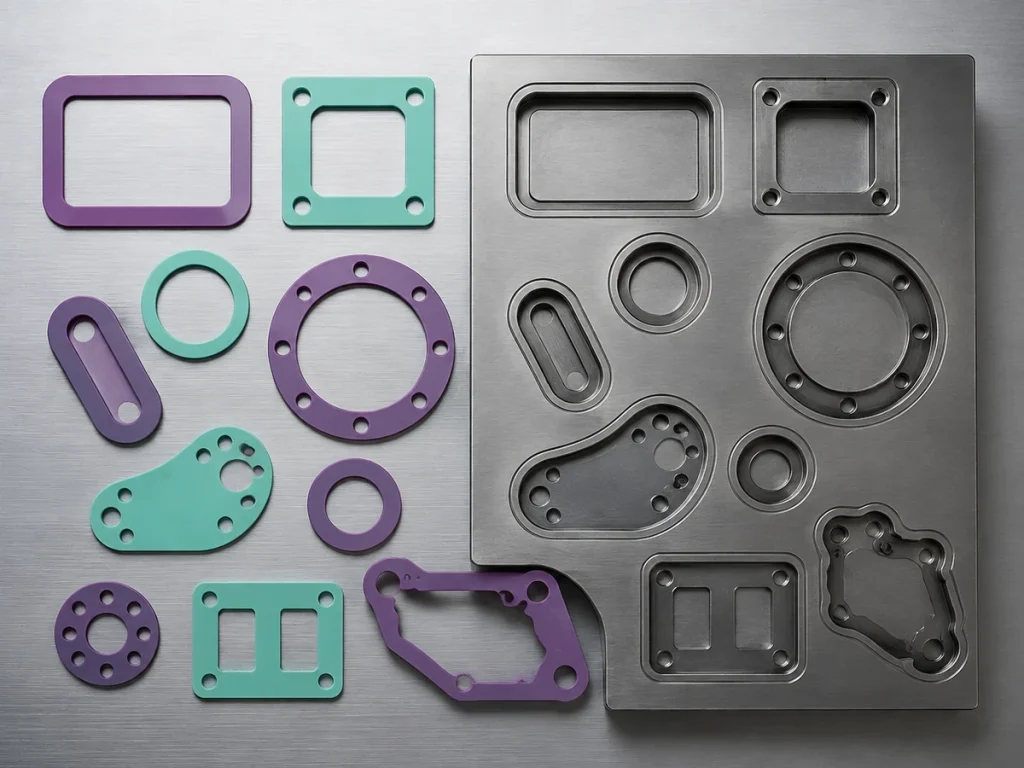
Short answer:The contour tolerances of die-cut silicone gaskets are affected by material thickness and hardness, die precision, cutting depth, layout orientation, and elastic recovery. Drawings should distinguish between critical hole locations, outer contours, and non-functional edges, and avoid applying the same strict tolerance to all dimensions.
In what kinds of situations are these silicone parts suitable?
Clearly defining the actual application scenarios helps translate material, structural, and validation requirements into actionable technical specifications.
- Electrical Insulation, Dust-Proof, and Shock-Absorbing Gaskets
- Flange Seats and Equipment Housing Gaskets
- Self-adhesive silicone sheets and complex-contour parts
Parameters to Confirm Before Selecting a Model
We recommend providing the following information before requesting a quote or ordering a sample to minimize the need for repeated prototyping and misunderstandings regarding specifications.
- Material thickness, hardness, and whether it is foamed
- Hole Spacing, Narrow Edges, and Minimum Fillet Radius
- Single-layer or multi-layer, with adhesive backing and release liner options
Key Points in Structural Design
Structural dimensions, assembly relationships, and material elasticity must be evaluated together; simply increasing a single parameter generally does not directly improve reliability.
- Key holes are set as appropriate locating references
- Avoid narrow bridges, sharp corners, and holes that are too small
- The width of the sealing edge should take into account material and assembly tolerances.
Production and Quality Control
Consistency in mass production results from the combined control of material batches, mold condition, molding windows, and inspection methods.
- Regularly check for die wear and cutting depth
- Control the tension, orientation, and retraction time of the material
- Prevent Stretching and Deformation During Waste Removal and Part Retrieval
Recommended Verification Items
Validation should be conducted using actual or equivalent operating conditions whenever possible, and functionality should be reconfirmed after aging or cycling.
- The first piece measured using imaging equipment to determine its contour
- Verification of Size Distribution by Location and Batch
- Re-testing Flatness and Assembly After Adhesive Backing and Aging
Frequently Asked Questions
Are the tolerances of laser cutting always better than those of die-cutting?
You also need to consider heat effects, materials, and batch efficiency.
Does a smaller tolerance on a drawing mean a better product?
Unnecessarily tight tolerances can increase costs and scrap rates.
How do I provide information to suppliers?
Please provide 2D or 3D drawings, photos of samples, material and hardness specifications, operating environment, target quantity, acceptance criteria, and a list of compliance documents. Based on this information, Chengxin Silicone Rubber can evaluate the materials, molds, molding process, and validation plan.