Scope and common interpretation errors
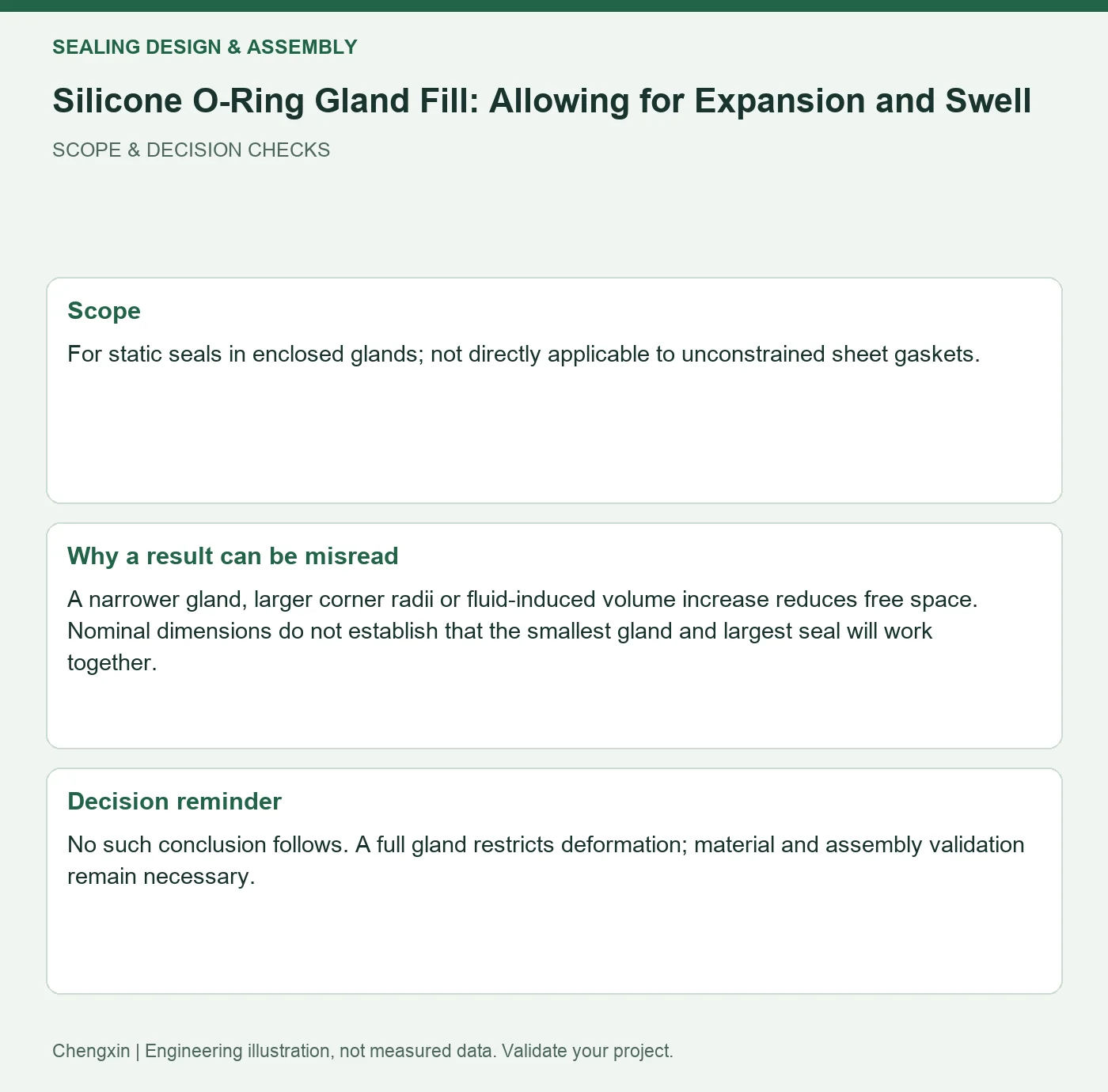
For static seals in enclosed glands; not directly applicable to unconstrained sheet gaskets.
A narrower gland, larger corner radii or fluid-induced volume increase reduces free space. Nominal dimensions do not establish that the smallest gland and largest seal will work together.

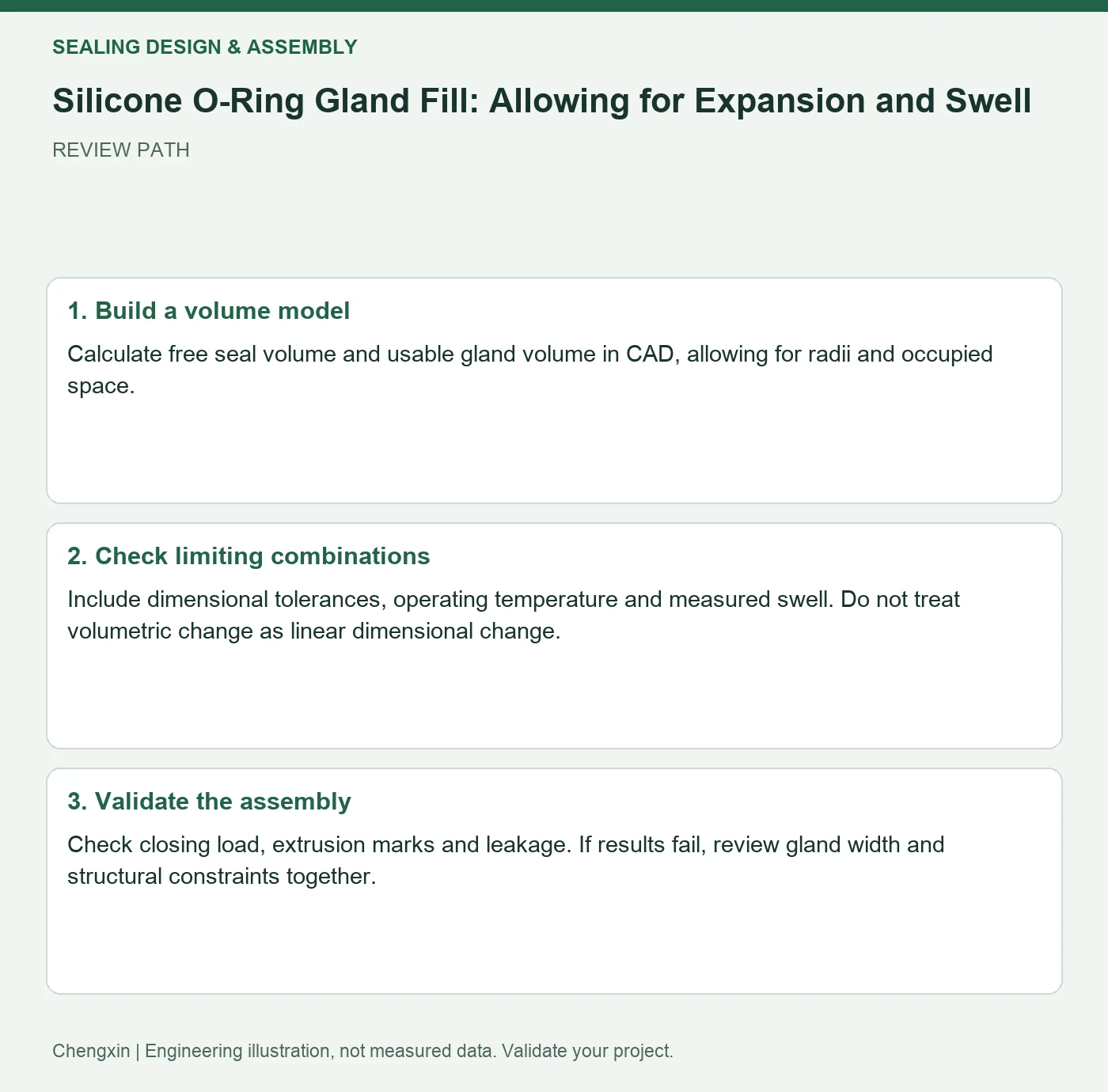
Turn the review into recorded checks
| Step | Action and evidence |
|---|---|
| 1 · Build a volume model | Calculate free seal volume and usable gland volume in CAD, allowing for radii and occupied space. |
| 2 · Check limiting combinations | Include dimensional tolerances, operating temperature and measured swell. Do not treat volumetric change as linear dimensional change. |
| 3 · Validate the assembly | Check closing load, extrusion marks and leakage. If results fail, review gland width and structural constraints together. |
A comparison to avoid misinterpretation
The same ring in two glands of equal depth but different width may have similar squeeze and different closing loads. This comparison separates compression depth from volume constraint; it provides no universal acceptance percentage.
Frequently asked question
Does filling the gland completely improve sealing?
No such conclusion follows. A full gland restricts deformation; material and assembly validation remain necessary.
Background and further reading
This note addresses one specific question. For broader concepts, see the related background guide.
Related question: O-Ring Installation Stretch: Checking Cross-Section Change.
External references support the relevant concepts. The review steps and scenarios are independent engineering discussion guidance, not quotations from a standard or external organization. Use agreed methods, applicable document revisions and complete conditions.
Apply this to your custom part
Compare the structure with Precision Silicone O-Rings for Watches. Describe the application, geometry, operating conditions, quantity and problem to solve. Submit a custom-parts inquiry, or see how to send drawings and sample photographs by business email. Confirm material, dimensions, costs, testing and delivery requirements for the project.