Define free thickness and the closed gap
Let free thickness be t and the space available after assembly be g. The simplified squeeze ratio is (t−g)/t. Derive g from the complete dimension chain: covers, steps, spacers and deformation after fastening can all affect it. An arbitrarily chosen gland depth is insufficient. This model does not replace analysis of a complex radial seal.
Calculate both limiting combinations
For hypothetical t = 2.00 ± 0.10 mm and g = 1.60 ± 0.05 mm, nominal squeeze is 20%. Minimum squeeze is (1.90−1.65)/1.90 ≈ 13.2%; maximum is (2.10−1.55)/2.10 ≈ 26.2%. These are illustrative dimensions, not a recommended squeeze range or Chengxin product parameters.
Identify the dimensions worth controlling
If a limit exceeds the project-validated window, compare seal, housing and assembly contributions before changing tolerances, geometry or material. Do not tighten every rubber dimension indiscriminately. Worst-case stacking checks boundaries; statistical stacking requires justified distributions and dependence assumptions and does not authorize relaxing functional requirements.
Project review checklist
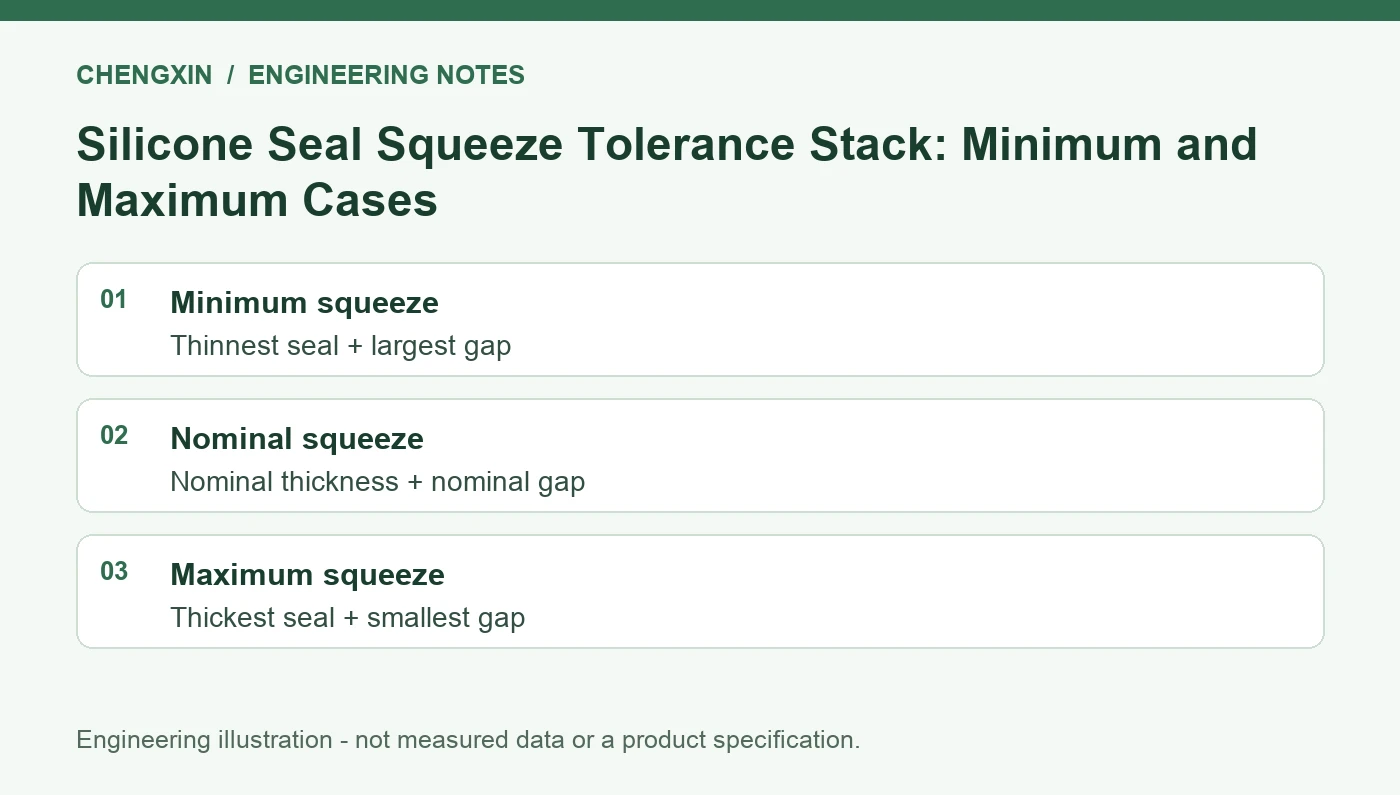
| Case | Dimension combination | Main concern |
|---|---|---|
| Minimum squeeze | Thinnest seal + largest gap | Contact and sealing reserve |
| Nominal squeeze | Nominal thickness + nominal gap | Design center |
| Maximum squeeze | Thickest seal + smallest gap | Load, extrusion and housing deformation |
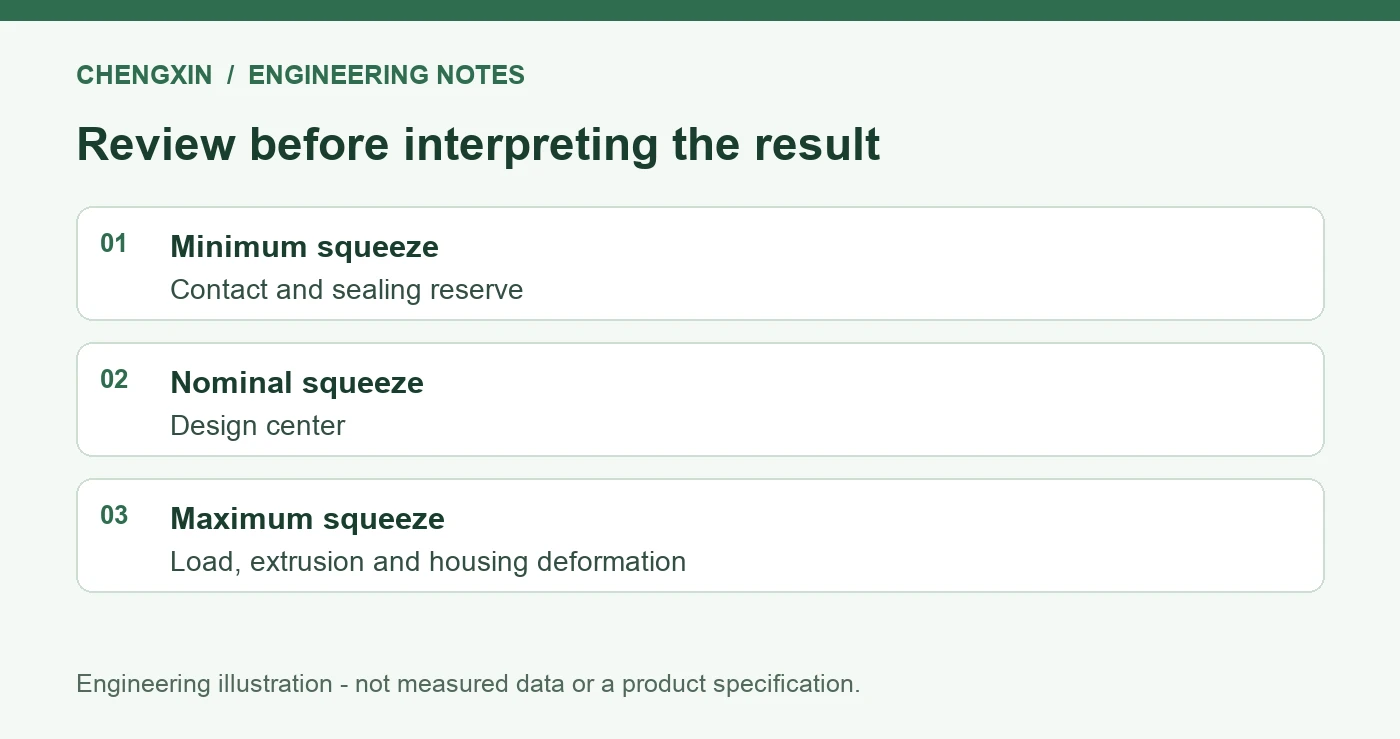
Illustrative project example
Use calculated limit combinations to organize assembly specimens and check leakage and closing loads. If the real housing warps under load, update the gap model. Attractive nominal values without boundary validation do not close the design review.
Frequently asked questions
What does a negative minimum squeeze mean?
In this simplified model there is clearance rather than the intended compressed contact. Recheck the dimension chain and assembly.
Does a passing calculation eliminate testing?
No. Material deformation, local surface defects, temperature and structural stiffness are not fully represented by the simple formula.
Technical references
References explain methods and terminology. They do not establish certification, acceptance limits or measured performance for a Chengxin product. Confirm the applicable edition and project-specific method with the responsible laboratory.
Related product and project inquiry
Precision Silicone O-Rings for Watches · Silicone O-Ring Gland Fill: Allowing for Expansion and Swell
For a custom part review, send the drawing, application, material or performance needs, key dimensions, quantity and target test conditions. Material, tooling and acceptance requirements are confirmed for each project.