Scope and common interpretation errors
For circular-section rings installed on shafts. Shaped frames, joined rings and reinforced parts need separate models.
Free and installed dimensions describe different states. Stretch-related section change combines with ring tolerances, gland diameter and waiting time; a passing inside diameter alone is insufficient.

Turn the review into recorded checks
| Step | Action and evidence |
|---|---|
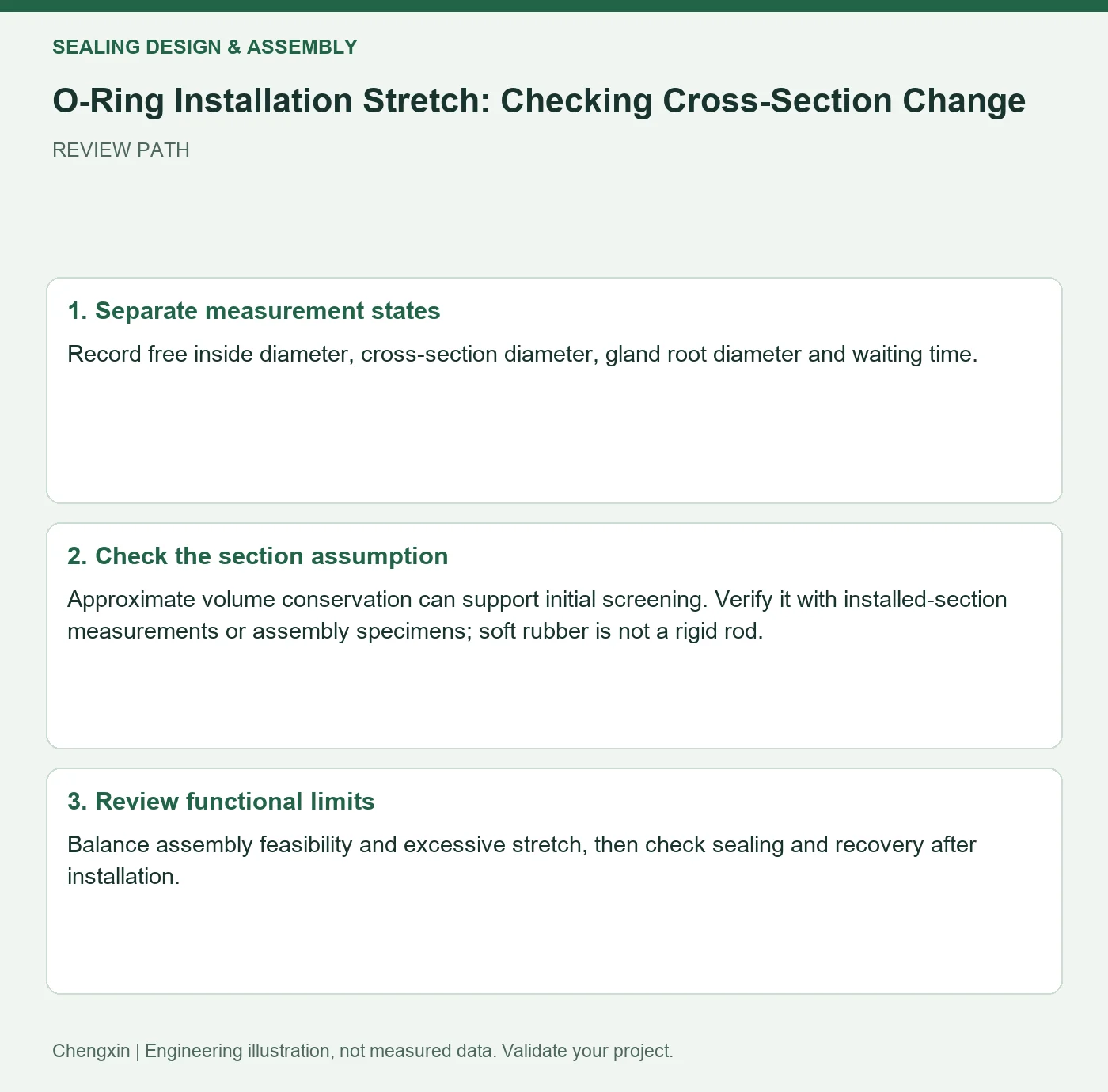
| 1 · Separate measurement states | Record free inside diameter, cross-section diameter, gland root diameter and waiting time. |
| 2 · Check the section assumption | Approximate volume conservation can support initial screening. Verify it with installed-section measurements or assembly specimens; soft rubber is not a rigid rod. |
| 3 · Review functional limits | Balance assembly feasibility and excessive stretch, then check sealing and recovery after installation. |
A comparison to avoid misinterpretation
Install rings with different free inside diameters but the same cross-section on one shaft. Compare assembly force and air-leak results rather than assuming the tighter ring is more reliable.
Frequently asked question
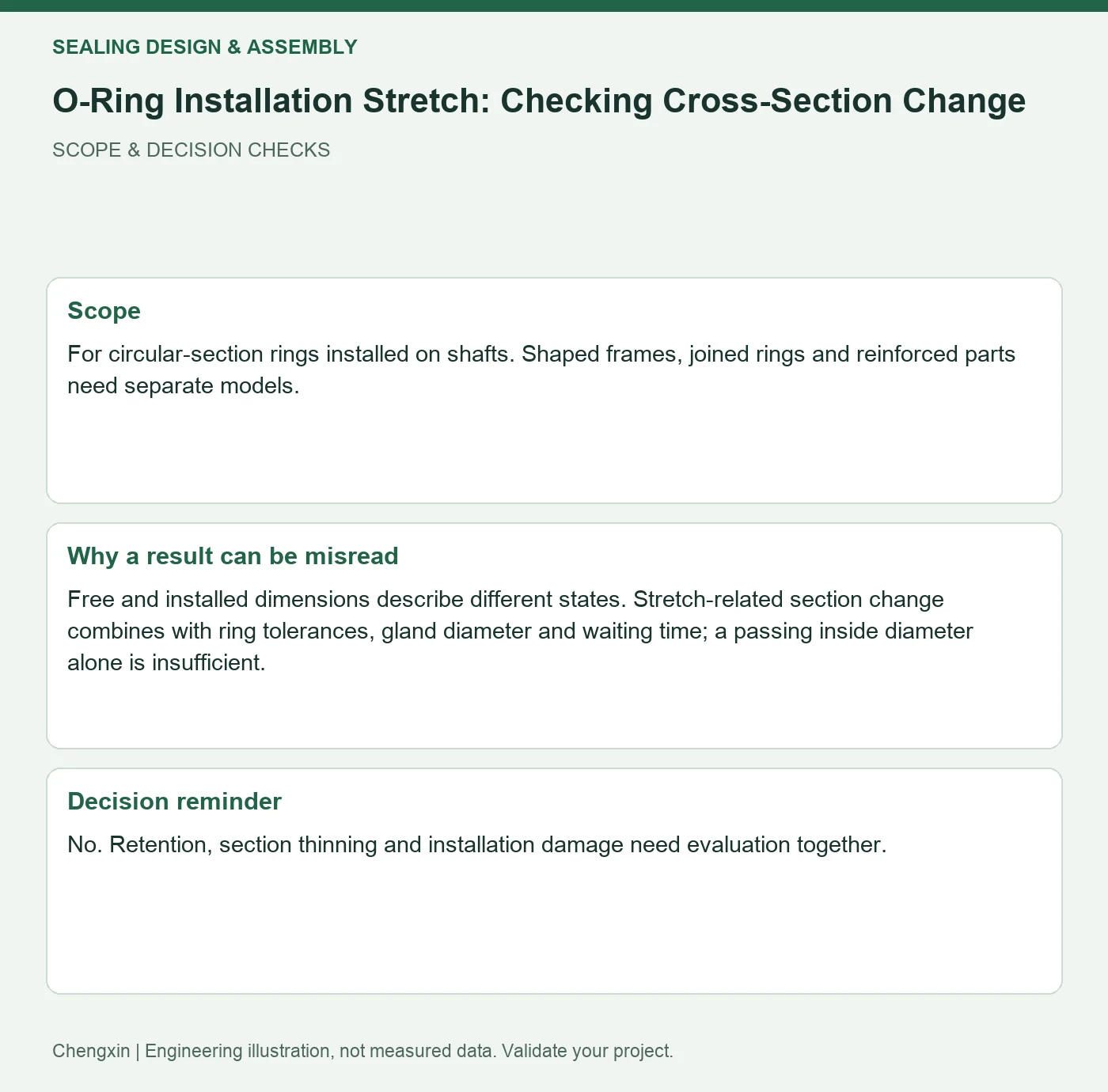
Does a smaller free inside diameter always prevent dislodging?
No. Retention, section thinning and installation damage need evaluation together.
Background and further reading
This note addresses one specific question. For broader concepts, see the related background guide.
Related question: Face-Seal O-Rings: Internal and External Pressure Direction.
External references support the relevant concepts. The review steps and scenarios are independent engineering discussion guidance, not quotations from a standard or external organization. Use agreed methods, applicable document revisions and complete conditions.
Apply this to your custom part
Compare the structure with Precision Silicone O-Rings for Watches. Describe the application, geometry, operating conditions, quantity and problem to solve. Submit a custom-parts inquiry, or see how to send drawings and sample photographs by business email. Confirm material, dimensions, costs, testing and delivery requirements for the project.