Scope and common interpretation errors
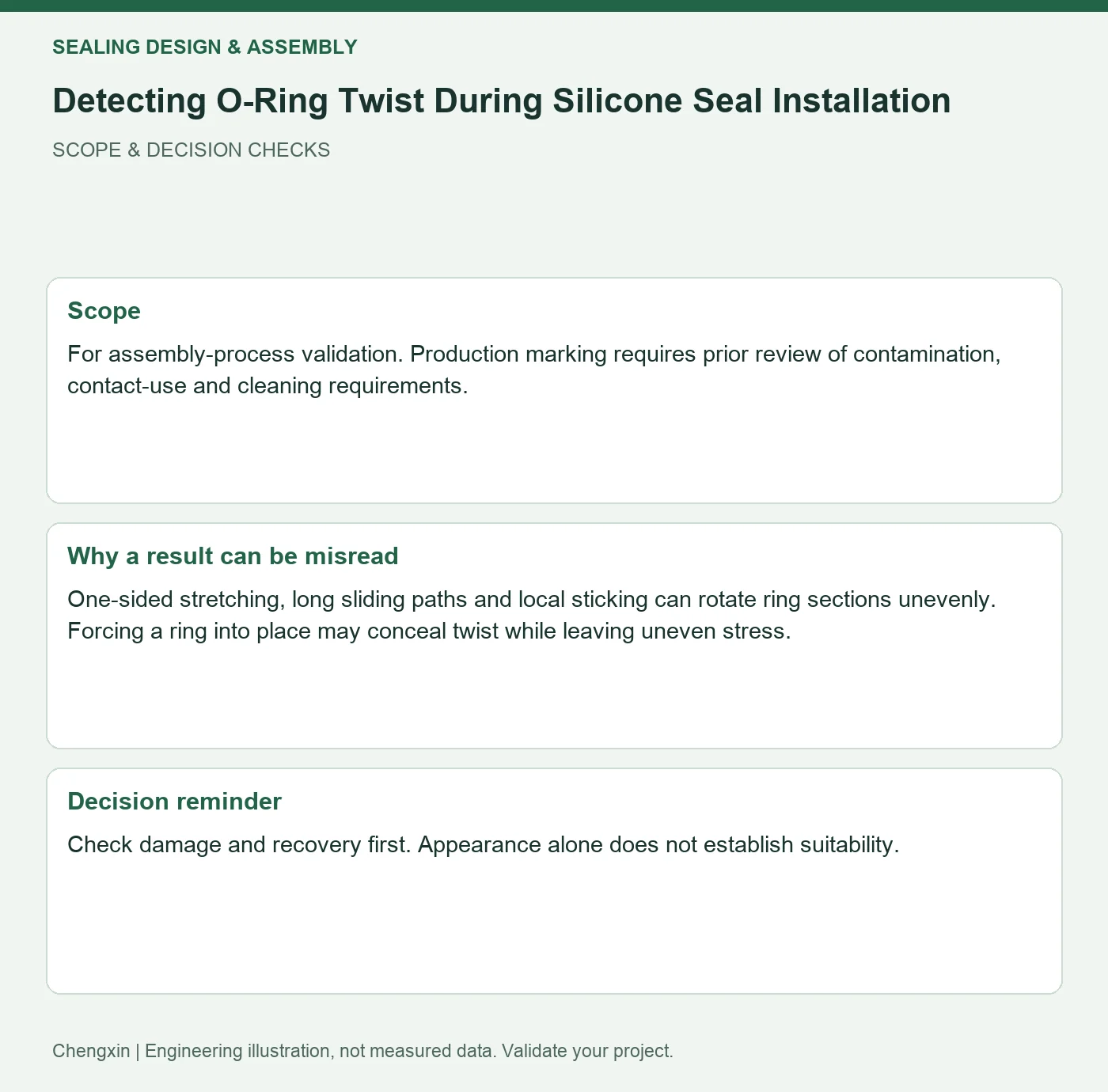
For assembly-process validation. Production marking requires prior review of contamination, contact-use and cleaning requirements.
One-sided stretching, long sliding paths and local sticking can rotate ring sections unevenly. Forcing a ring into place may conceal twist while leaving uneven stress.
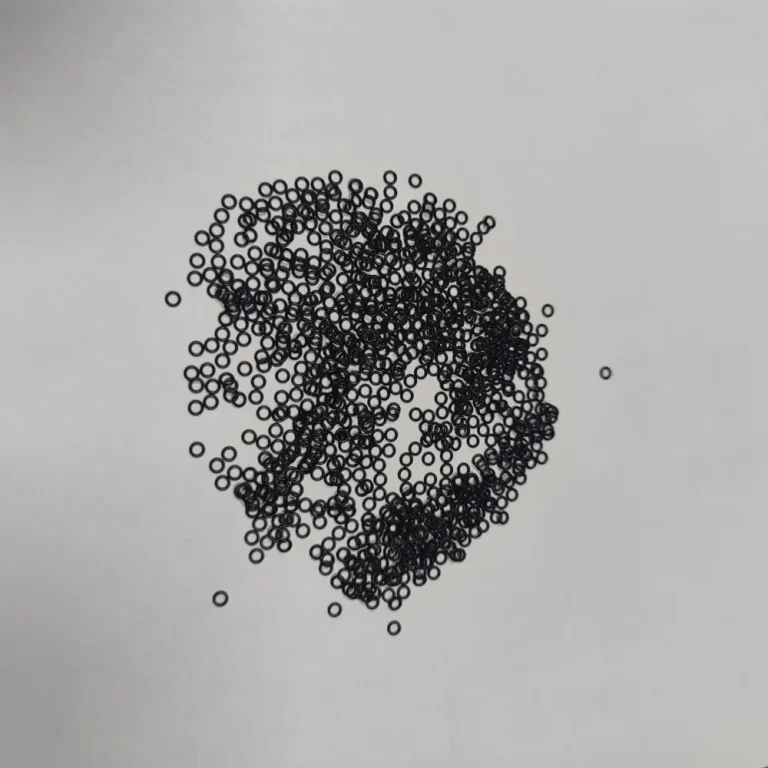
Turn the review into recorded checks
| Step | Action and evidence |
|---|---|
| 1 · Trace the assembly motion | Record the insertion start point, pushing direction and steps that the ring must cross. |
| 2 · Make orientation visible | Mark dedicated specimens and observe rotation in stages. Do not use an unevaluated permanent marker. |
| 3 · Change one factor | Compare twist and air leakage before and after changing lead-in tooling or lubrication. Standardize the motion only after confirming its effect. |
A comparison to avoid misinterpretation
Compare one-sided pulling with even, staged insertion using witness lines and the shape after removal. This diagnoses a process issue; it does not establish one universal installation method.
Frequently asked question
Can a twisted ring simply be smoothed and installed?
Check damage and recovery first. Appearance alone does not establish suitability.
Background and further reading
This note addresses one specific question. For broader concepts, see the related background guide.
Related question: Protecting Seals from Threads and Cross-Holes During Assembly.
External references support the relevant concepts. The review steps and scenarios are independent engineering discussion guidance, not quotations from a standard or external organization. Use agreed methods, applicable document revisions and complete conditions.
Apply this to your custom part
Compare the structure with Precision Silicone O-Rings for Watches. Describe the application, geometry, operating conditions, quantity and problem to solve. Submit a custom-parts inquiry, or see how to send drawings and sample photographs by business email. Confirm material, dimensions, costs, testing and delivery requirements for the project.