Scope and common interpretation errors
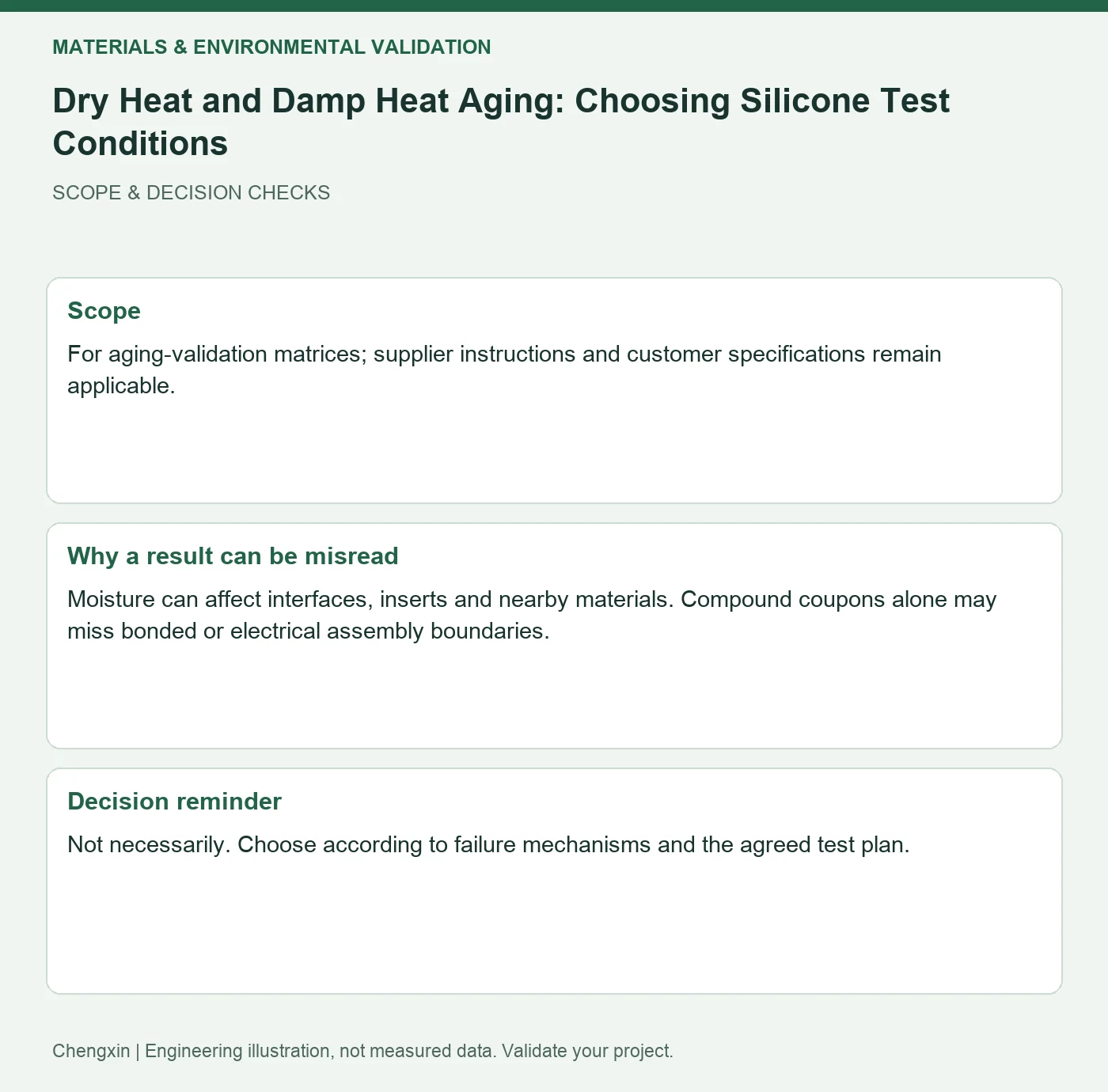
For aging-validation matrices; supplier instructions and customer specifications remain applicable.
Moisture can affect interfaces, inserts and nearby materials. Compound coupons alone may miss bonded or electrical assembly boundaries.
Turn the review into recorded checks
| Step | Action and evidence |
|---|---|
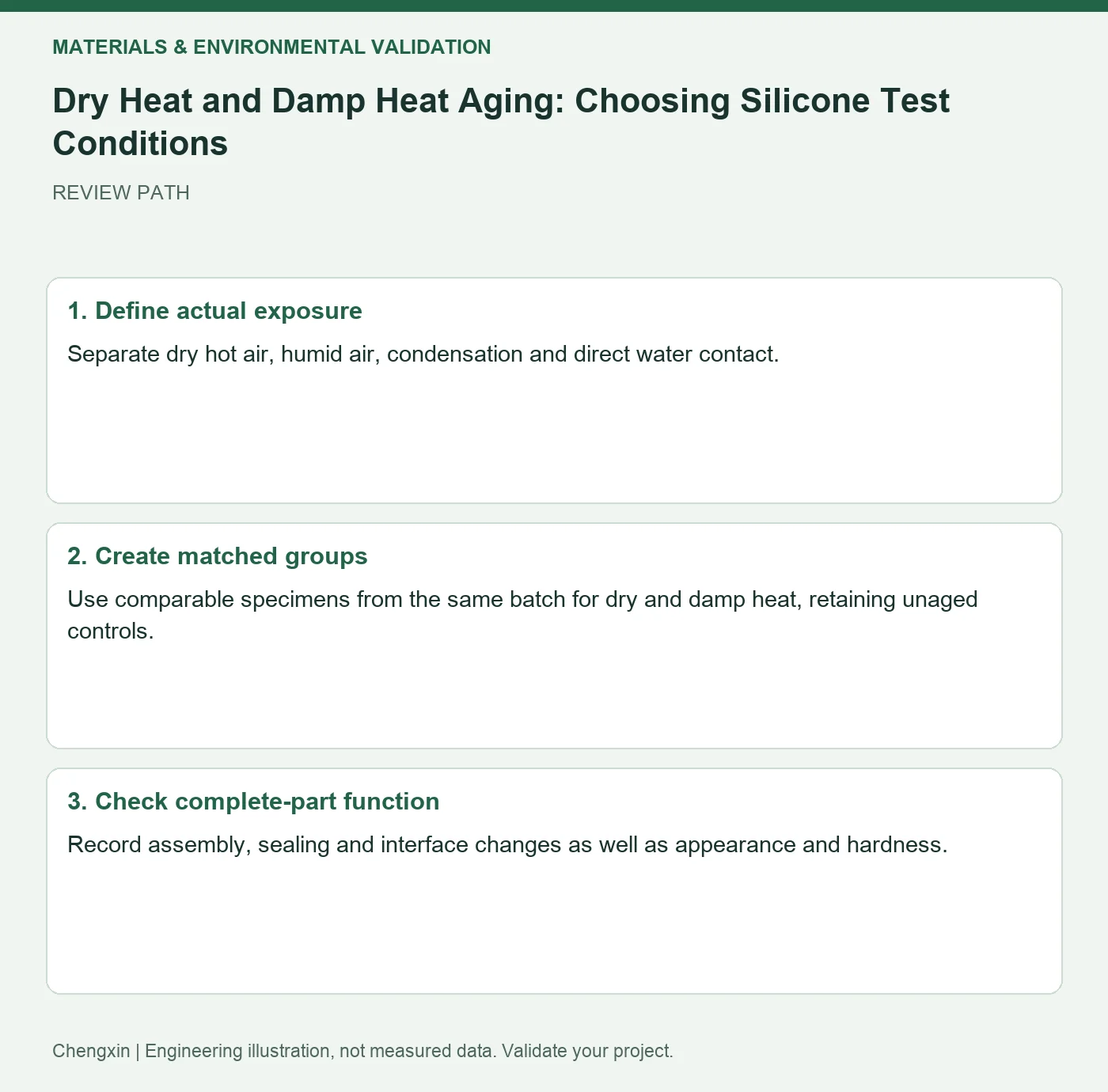
| 1 · Define actual exposure | Separate dry hot air, humid air, condensation and direct water contact. |
| 2 · Create matched groups | Use comparable specimens from the same batch for dry and damp heat, retaining unaged controls. |
| 3 · Check complete-part function | Record assembly, sealing and interface changes as well as appearance and hardness. |
A comparison to avoid misinterpretation
If rubber remains intact after dry heat but an insert interface fails after damp heat, investigate the interface instead of attributing everything to inadequate silicone heat resistance.
Frequently asked question
Can damp heat replace dry heat because it is harsher?
Not necessarily. Choose according to failure mechanisms and the agreed test plan.
Background and further reading
This note addresses one specific question. For broader concepts, see the related background guide.
Related question: Ozone Testing of Rubber Parts: Why Specimen Strain Matters.
External references support the relevant concepts. The review steps and scenarios are independent engineering discussion guidance, not quotations from a standard or external organization. Use agreed methods, applicable document revisions and complete conditions.
Apply this to your custom part
Compare the structure with Shaped Silicone Housing Gaskets for Wearable Devices. Describe the application, geometry, operating conditions, quantity and problem to solve. Submit a custom-parts inquiry, or see how to send drawings and sample photographs by business email. Confirm material, dimensions, costs, testing and delivery requirements for the project.