Scope and common interpretation errors
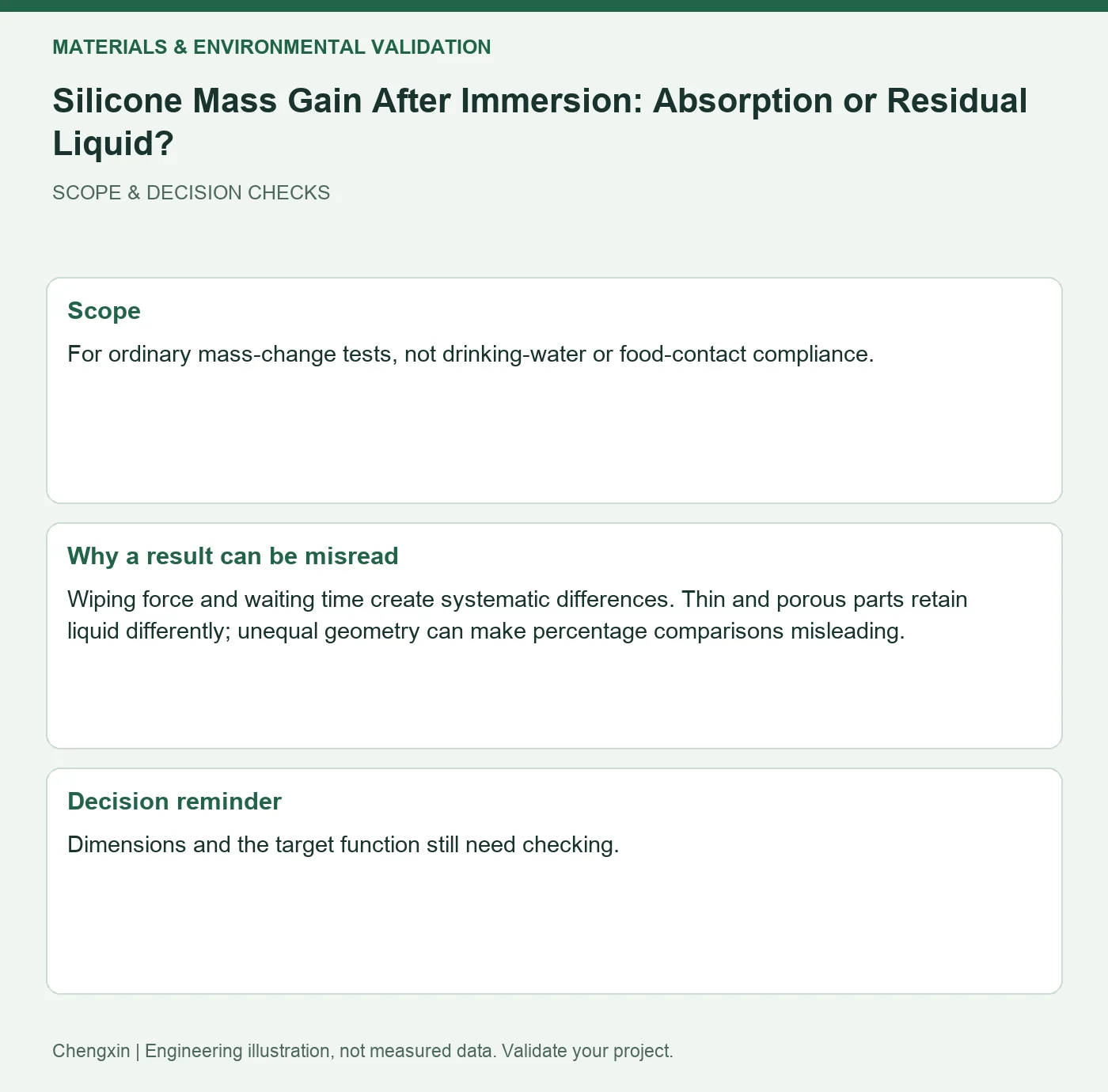
For ordinary mass-change tests, not drinking-water or food-contact compliance.
Wiping force and waiting time create systematic differences. Thin and porous parts retain liquid differently; unequal geometry can make percentage comparisons misleading.
Turn the review into recorded checks
| Step | Action and evidence |
|---|---|
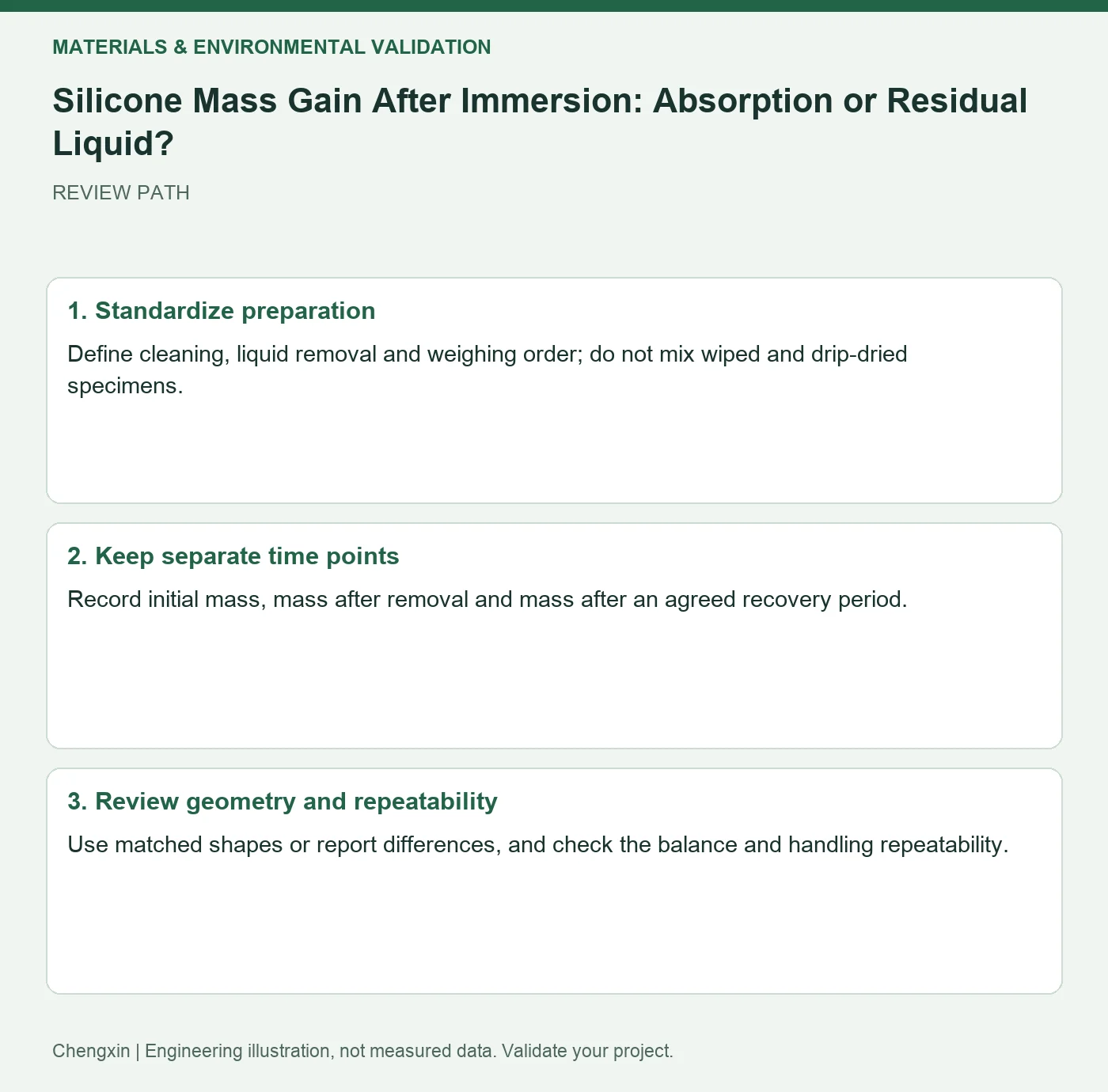
| 1 · Standardize preparation | Define cleaning, liquid removal and weighing order; do not mix wiped and drip-dried specimens. |
| 2 · Keep separate time points | Record initial mass, mass after removal and mass after an agreed recovery period. |
| 3 · Review geometry and repeatability | Use matched shapes or report differences, and check the balance and handling repeatability. |
A comparison to avoid misinterpretation
If mass drops substantially after several minutes, investigate residual liquid and evaporation before concluding long-term absorption.
Frequently asked question
Does returning to initial mass prove full recovery?
Dimensions and the target function still need checking.
Background and further reading
This note addresses one specific question. For broader concepts, see the related background guide.
Related question: Loose Silicone-to-Metal Overmolded Inserts After Thermal Cycling.
External references support the relevant concepts. The review steps and scenarios are independent engineering discussion guidance, not quotations from a standard or external organization. Use agreed methods, applicable document revisions and complete conditions.
Apply this to your custom part
Compare the structure with Rubber O-Rings for Cleaning-Equipment Water Circuits. Describe the application, geometry, operating conditions, quantity and problem to solve. Submit a custom-parts inquiry, or see how to send drawings and sample photographs by business email. Confirm material, dimensions, costs, testing and delivery requirements for the project.