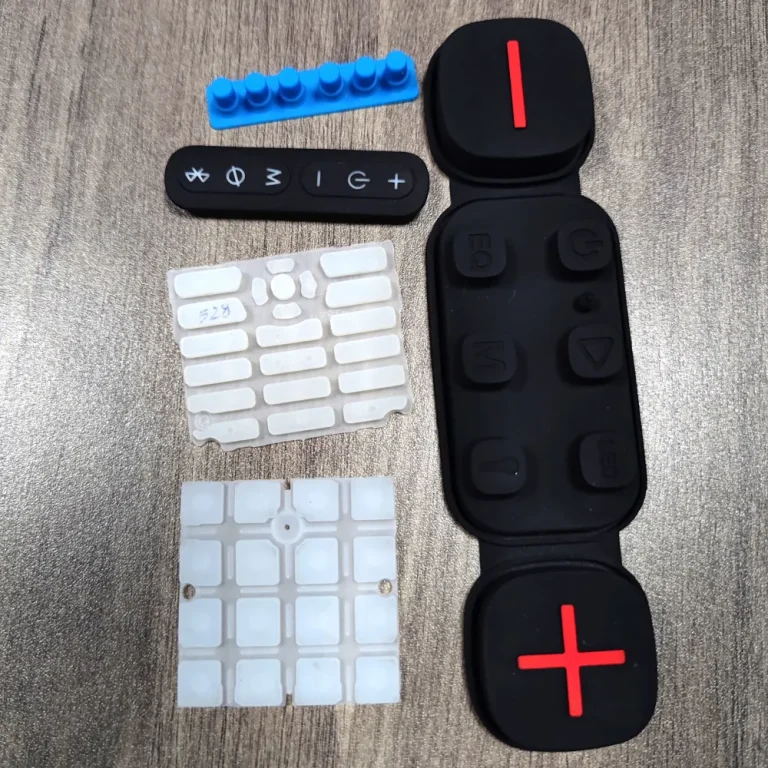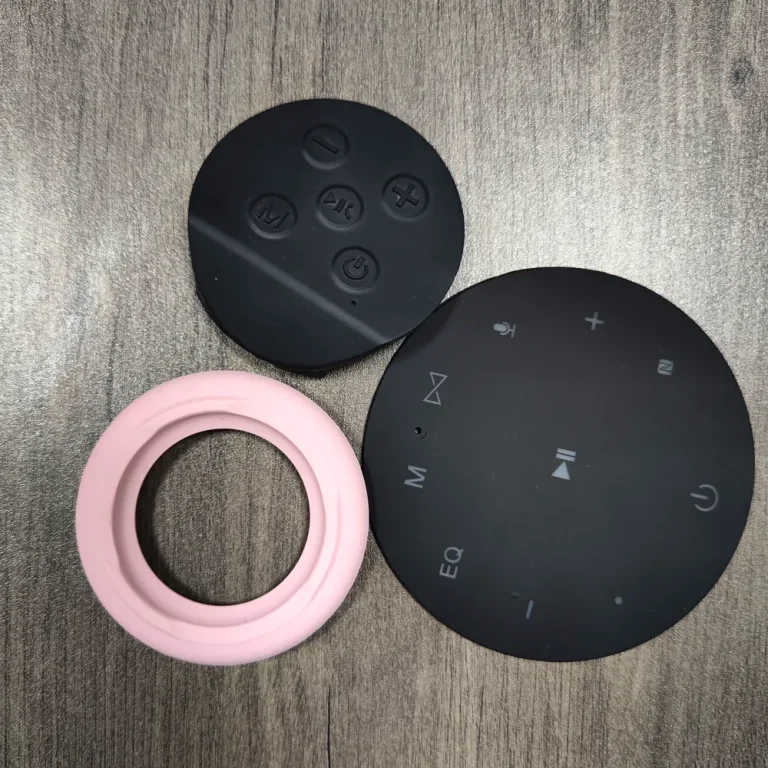
Scope and common interpretation errors
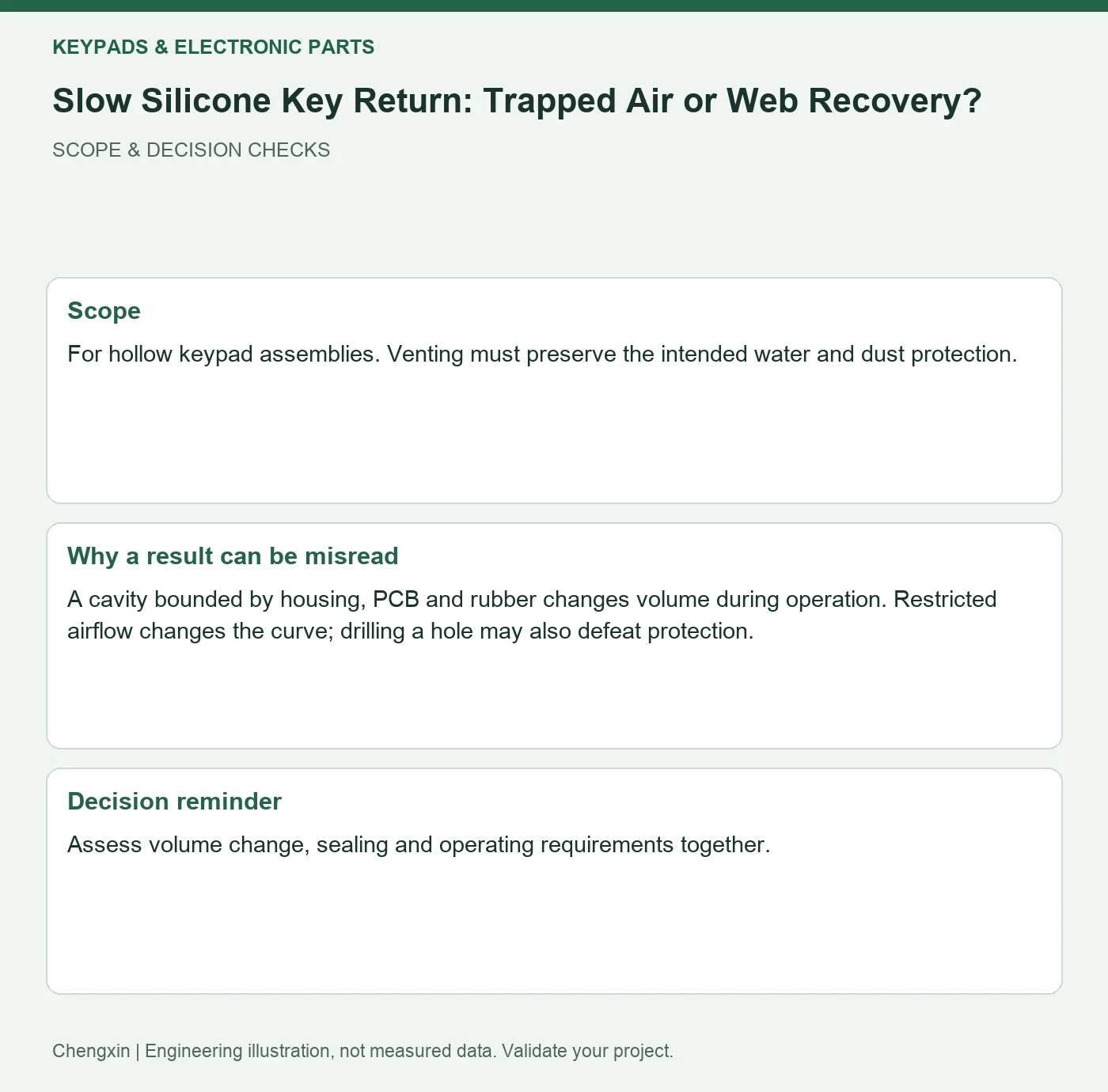
For hollow keypad assemblies. Venting must preserve the intended water and dust protection.
A cavity bounded by housing, PCB and rubber changes volume during operation. Restricted airflow changes the curve; drilling a hole may also defeat protection.
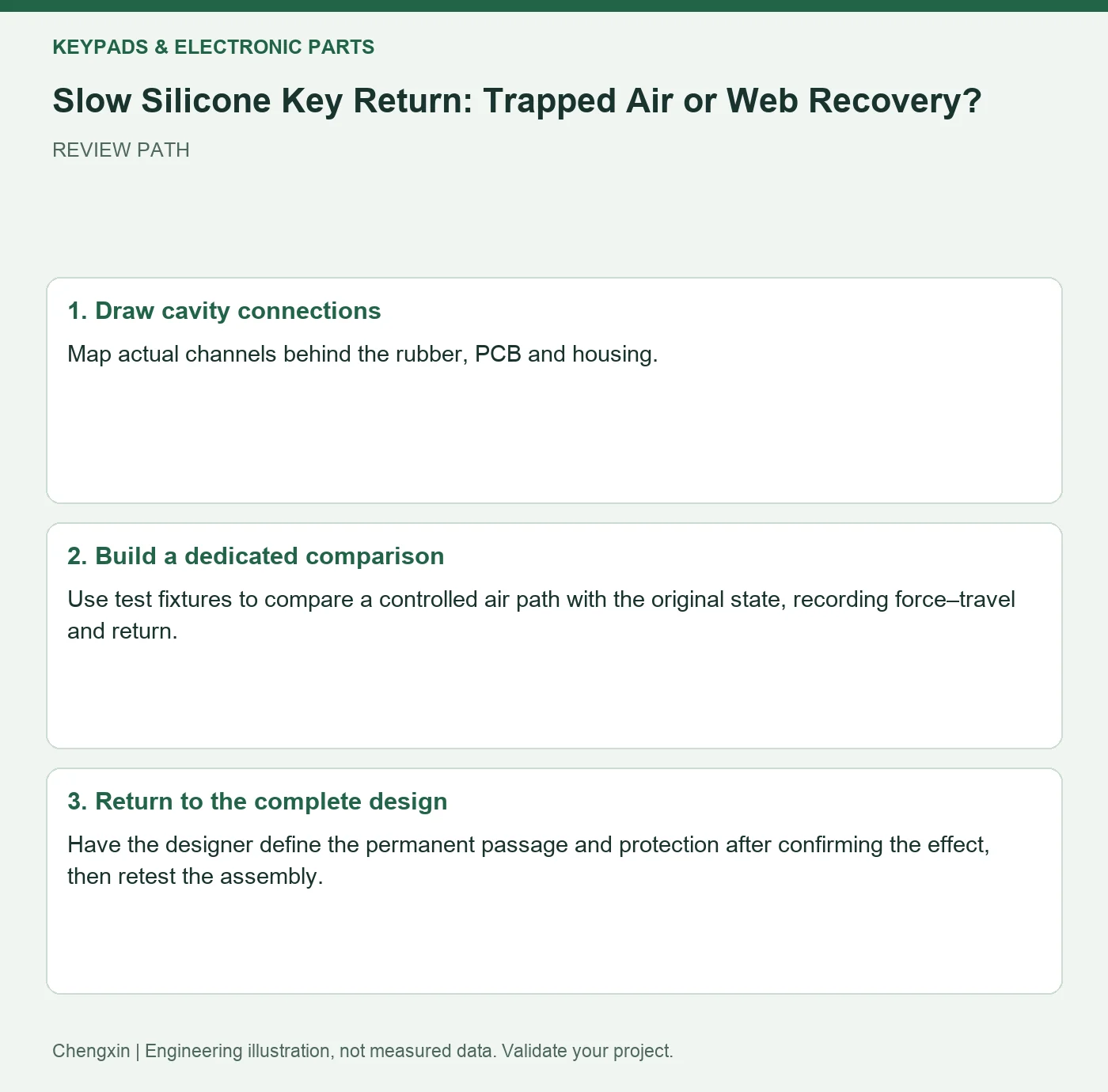
Turn the review into recorded checks
| Step | Action and evidence |
|---|---|
| 1 · Draw cavity connections | Map actual channels behind the rubber, PCB and housing. |
| 2 · Build a dedicated comparison | Use test fixtures to compare a controlled air path with the original state, recording force–travel and return. |
| 3 · Return to the complete design | Have the designer define the permanent passage and protection after confirming the effect, then retest the assembly. |
A comparison to avoid misinterpretation
Improved return with a temporary test channel identifies airflow as a variable. It does not qualify the drilled specimen as a final waterproof design.
Frequently asked question
Does every air-filled key need venting?
Assess volume change, sealing and operating requirements together.
Background and further reading
This note addresses one specific question. For broader concepts, see the related background guide.
Related question: Silicone Keypad Snap Ratio: Aligning Peak and Valley Definitions.
External references support the relevant concepts. The review steps and scenarios are independent engineering discussion guidance, not quotations from a standard or external organization. Use agreed methods, applicable document revisions and complete conditions.
Apply this to your custom part
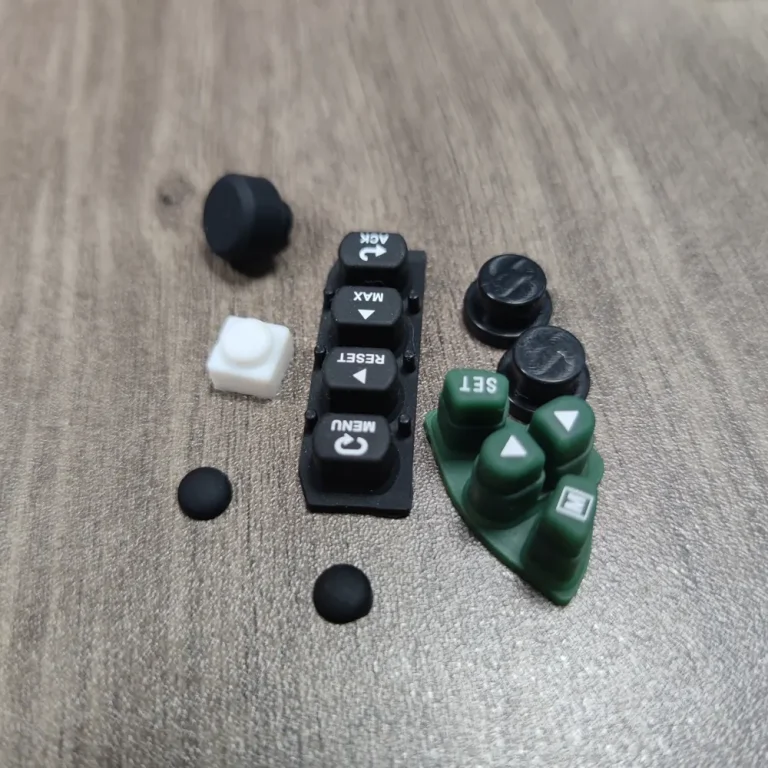
Compare the structure with Custom Silicone Single-Key Button Caps. Describe the application, geometry, operating conditions, quantity and problem to solve. Submit a custom-parts inquiry, or see how to send drawings and sample photographs by business email. Confirm material, dimensions, costs, testing and delivery requirements for the project.