Scope and common interpretation errors
For material-document interpretation, alongside grade-specific supplier recommendations and finished-part validation.
Brief exposure, long compression and repeated flexing have different demands. Remaining elastic does not prove retained sealing force or bond strength.
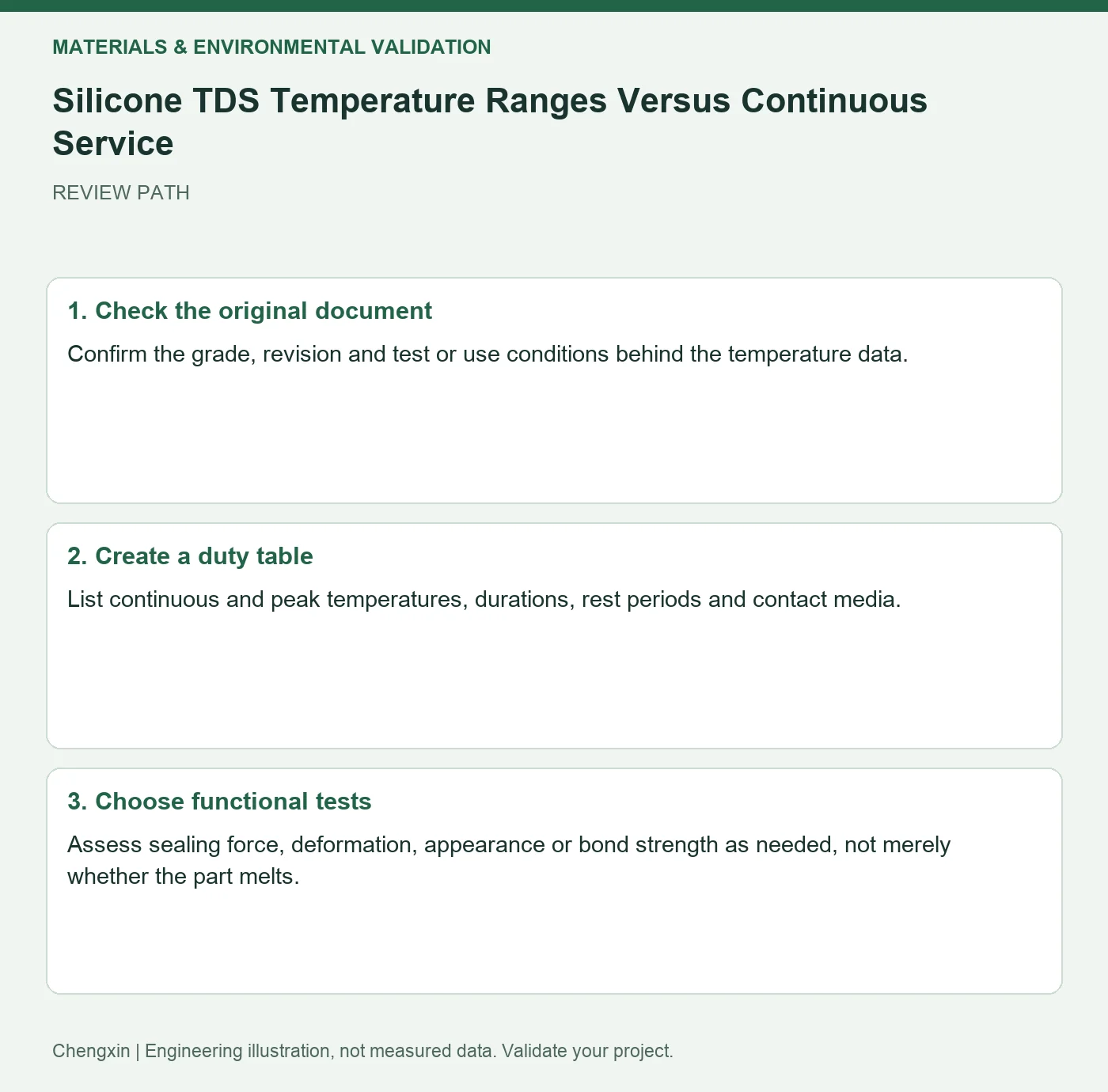
Turn the review into recorded checks
| Step | Action and evidence |
|---|---|
| 1 · Check the original document | Confirm the grade, revision and test or use conditions behind the temperature data. |
| 2 · Create a duty table | List continuous and peak temperatures, durations, rest periods and contact media. |
| 3 · Choose functional tests | Assess sealing force, deformation, appearance or bond strength as needed, not merely whether the part melts. |
A comparison to avoid misinterpretation
A short hot stage within a cooler duty cycle calls for tests reflecting the real cycle and worst state, not treating the peak as an all-day continuous temperature.
Frequently asked question
Does a supplier's 'heat resistant' description remove aging tests?
No. Finished geometry and service conditions still need confirmation.
Background and further reading
This note addresses one specific question. For broader concepts, see the related background guide.
Related question: Dry Heat and Damp Heat Aging: Choosing Silicone Test Conditions.
External references support the relevant concepts. The review steps and scenarios are independent engineering discussion guidance, not quotations from a standard or external organization. Use agreed methods, applicable document revisions and complete conditions.
Apply this to your custom part
Compare the structure with Shaped Silicone Housing Gaskets for Wearable Devices. Describe the application, geometry, operating conditions, quantity and problem to solve. Submit a custom-parts inquiry, or see how to send drawings and sample photographs by business email. Confirm material, dimensions, costs, testing and delivery requirements for the project.