Scope and common interpretation errors
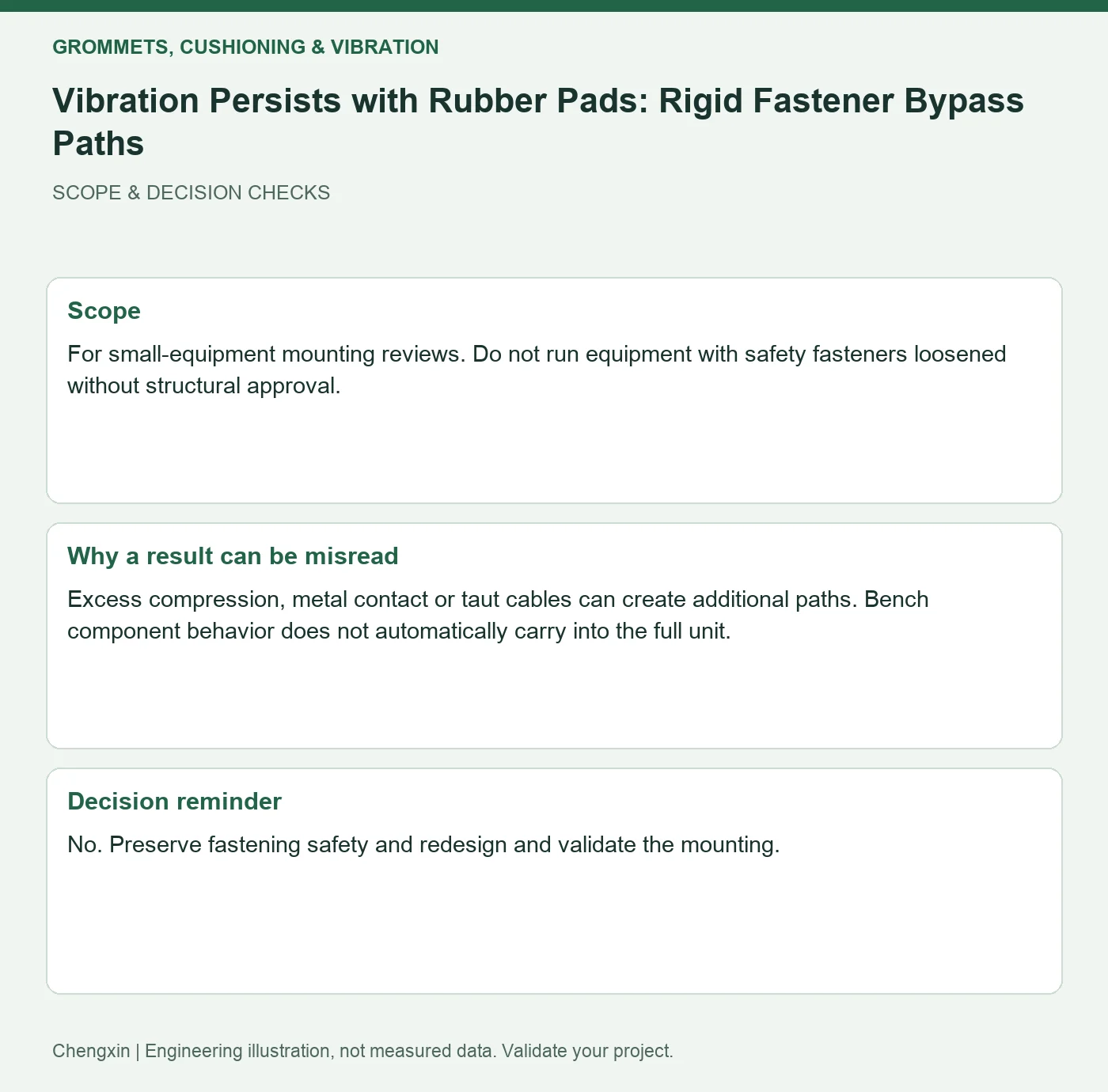
For small-equipment mounting reviews. Do not run equipment with safety fasteners loosened without structural approval.
Excess compression, metal contact or taut cables can create additional paths. Bench component behavior does not automatically carry into the full unit.
Turn the review into recorded checks
| Step | Action and evidence |
|---|---|
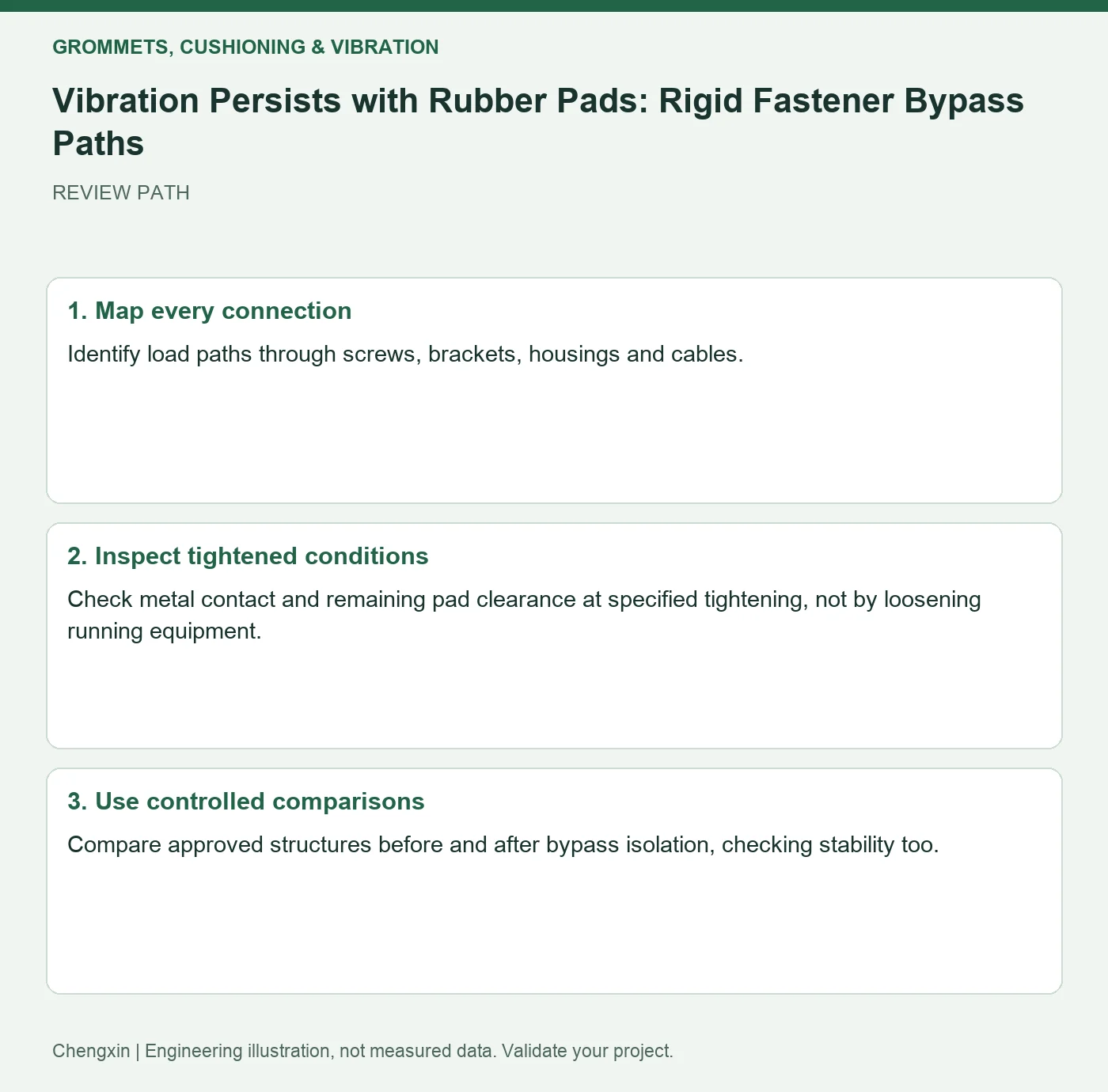
| 1 · Map every connection | Identify load paths through screws, brackets, housings and cables. |
| 2 · Inspect tightened conditions | Check metal contact and remaining pad clearance at specified tightening, not by loosening running equipment. |
| 3 · Use controlled comparisons | Compare approved structures before and after bypass isolation, checking stability too. |
A comparison to avoid misinterpretation
A sleeve bridging both pad faces may be an intentional stop and a vibration bypass. Review its design role before changing it.
Frequently asked question
Can an assembly be delivered with loose screws because vibration improves?
No. Preserve fastening safety and redesign and validate the mounting.
Background and further reading
This note addresses one specific question. For broader concepts, see the related background guide.
Related question: Measuring Silicone Vibration Isolation: Input, Output and Frequency.
External references support the relevant concepts. The review steps and scenarios are independent engineering discussion guidance, not quotations from a standard or external organization. Use agreed methods, applicable document revisions and complete conditions.
Apply this to your custom part
Compare the structure with Silicone Vibration-Isolation Feet for Small Equipment. Describe the application, geometry, operating conditions, quantity and problem to solve. Submit a custom-parts inquiry, or see how to send drawings and sample photographs by business email. Confirm material, dimensions, costs, testing and delivery requirements for the project.