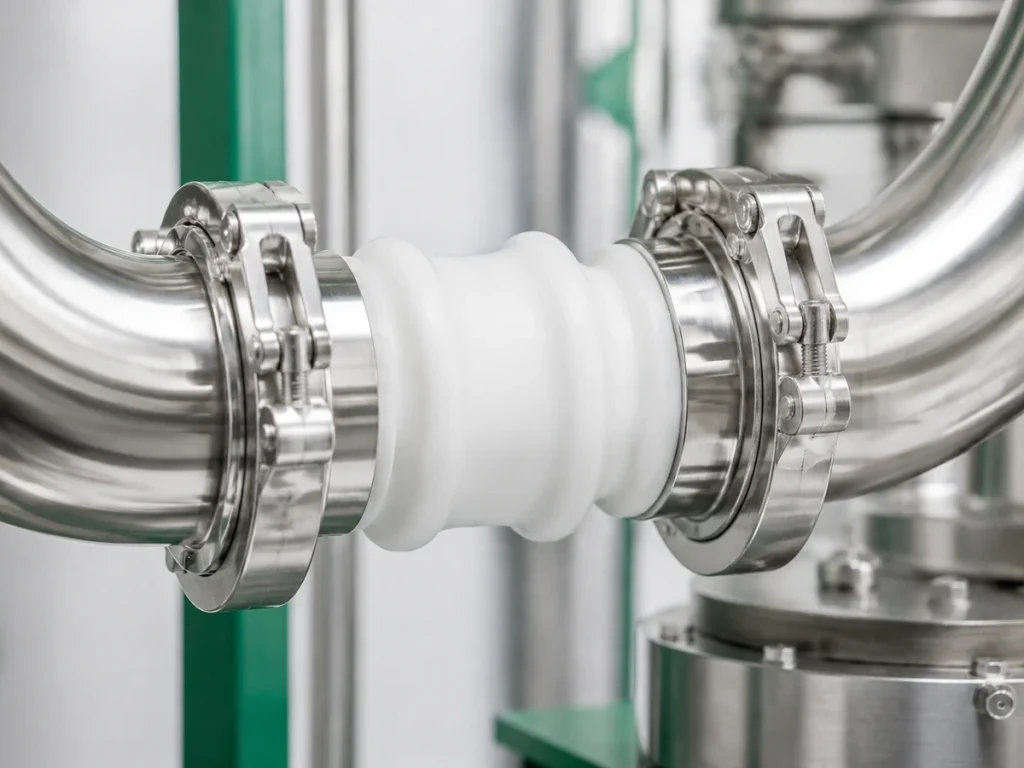
Short answer:Silicone flexible connectors for powder processing equipment must absorb vibrations and accommodate installation misalignments while preventing powder leakage, material buildup, and fatigue cracking. Their service life is determined by a combination of factors, including the corrugation profile, wall thickness, flange clamping, positive and negative pressure, and powder abrasion.
In what kinds of situations are these silicone parts suitable?
Clearly defining the actual application scenarios helps translate material, structural, and validation requirements into actionable technical specifications.
- Flexible Connections Between the Screening Machine, Hopper, and Conveyor Pipe
- Food, Chemical, and Pharmaceutical Powder Processing Equipment
- Pipe joints subject to vibration or displacement
Parameters to Confirm Before Selecting a Model
We recommend providing the following information before requesting a quote or ordering a sample to minimize the need for repeated prototyping and misunderstandings regarding specifications.
- Pipe Diameter, Pressure Range, and Allowable Displacement
- Particle Size, Abrasiveness, and Temperature of Powders
- Food Sanitation Compliance and Cleaning Methods
Key Points in Structural Design
Structural dimensions, assembly relationships, and material elasticity must be evaluated together; simply increasing a single parameter generally does not directly improve reliability.
- The waveform and length accommodate axial and lateral compensation
- Preventing Slip and Stress Concentration in the Flange Clamping Area
- Smooth inner walls reduce material buildup and cross-contamination
Production and Quality Control
Consistency in mass production results from the combined control of material batches, mold condition, molding windows, and inspection methods.
- Controlling Wall Thickness, Seam Strength, and Flange Joint Strength
- The surface must be free of pinholes and localized thin spots.
- Package and protect the sealed edges in accordance with cleanliness requirements
Recommended Verification Items
Validation should be conducted using actual or equivalent operating conditions whenever possible, and functionality should be reconfirmed after aging or cycling.
- Testing for Leaks and Deformation Under Positive and Negative Pressure
- Inspect for Cracks and Delamination After Displacement-Vibration Cycles
- Assessment of Material Buildup After Powder Handling and Cleaning
Frequently Asked Questions
Does a longer flexible connection result in greater compensation?
If it is too long, it may collapse and cause material to accumulate; therefore, pressure and support must be used in combination.
Is a leak test alone sufficient?
Validation for displacement, vibration, erosion, and cleaning is still required.
How do I provide information to suppliers?
Please provide 2D or 3D drawings, photos of samples, material and hardness specifications, operating environment, target quantity, acceptance criteria, and a list of compliance documents. Based on this information, Chengxin Silicone Rubber can evaluate the materials, molds, molding process, and validation plan.