Understand why the numbers differ
ASTM D1329 covers low-temperature retraction; TR10 identifies the temperature at a prescribed retraction proportion. ASTM E1356 addresses glass-transition assignment by DSC. One observes recovery after specified deformation, the other a thermal-analysis response. Different histories and interpretation can produce different values without either report being wrong.
Align report conditions
Check grade, cure, post-treatment, specimen source and standard revision. For DSC, record the assigned point and heating/cooling program; for retraction, record conditioning and test conditions. Fluid exposure and long compression may change the state, so new-coupon data does not automatically represent a used part.
Validate the most demanding cold action
After adequate cold stabilization, check seals at the target pressure and valves or keys for initial movement and return. No static leakage does not establish no leakage after the first cold movement. Inspection after warming supplements rather than replaces cold-state function.
Project review checklist
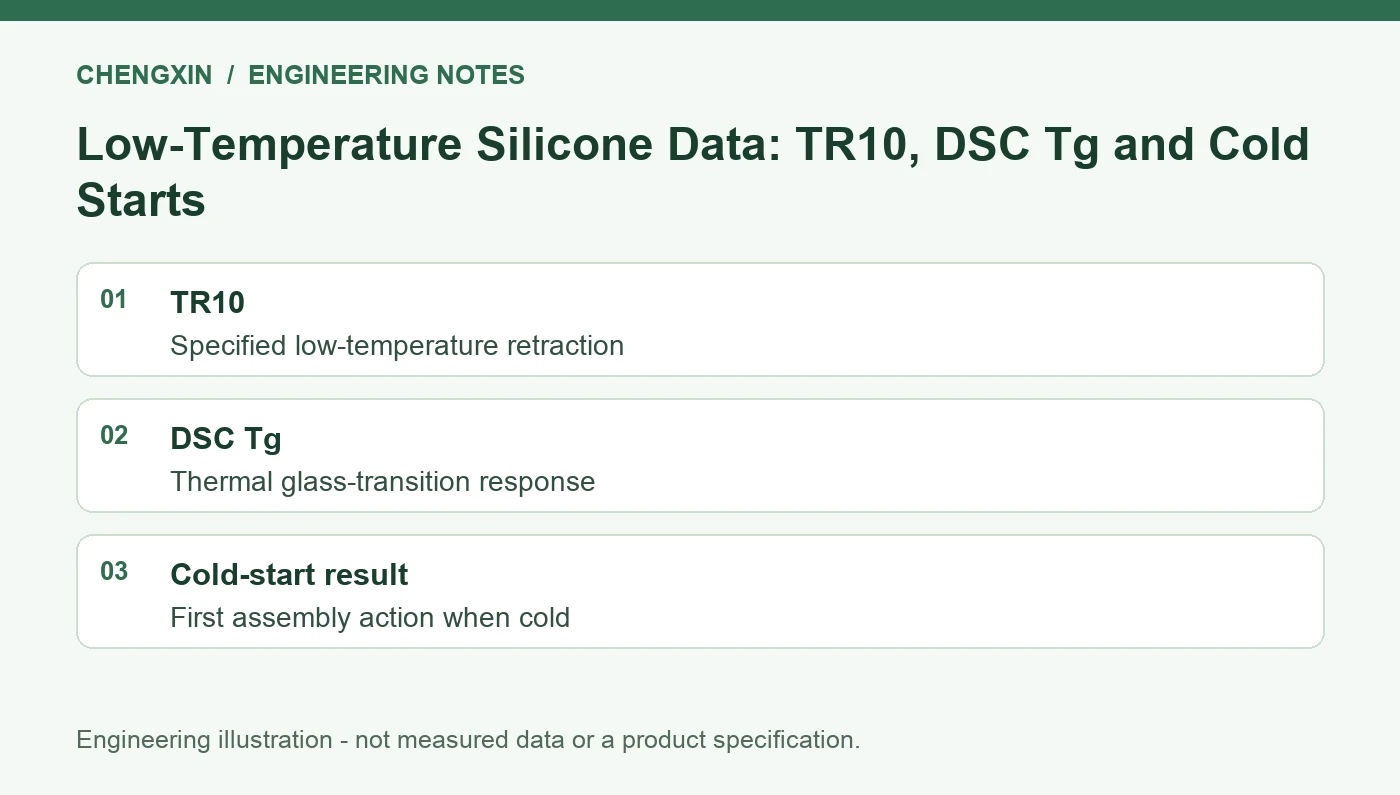
| Data | Main observation | Additional evidence |
|---|---|---|
| TR10 | Specified low-temperature retraction | Actual motion and sealing |
| DSC Tg | Thermal glass-transition response | Finished-part cold function |
| Cold-start result | First assembly action when cold | Repeated cycles and recovery |
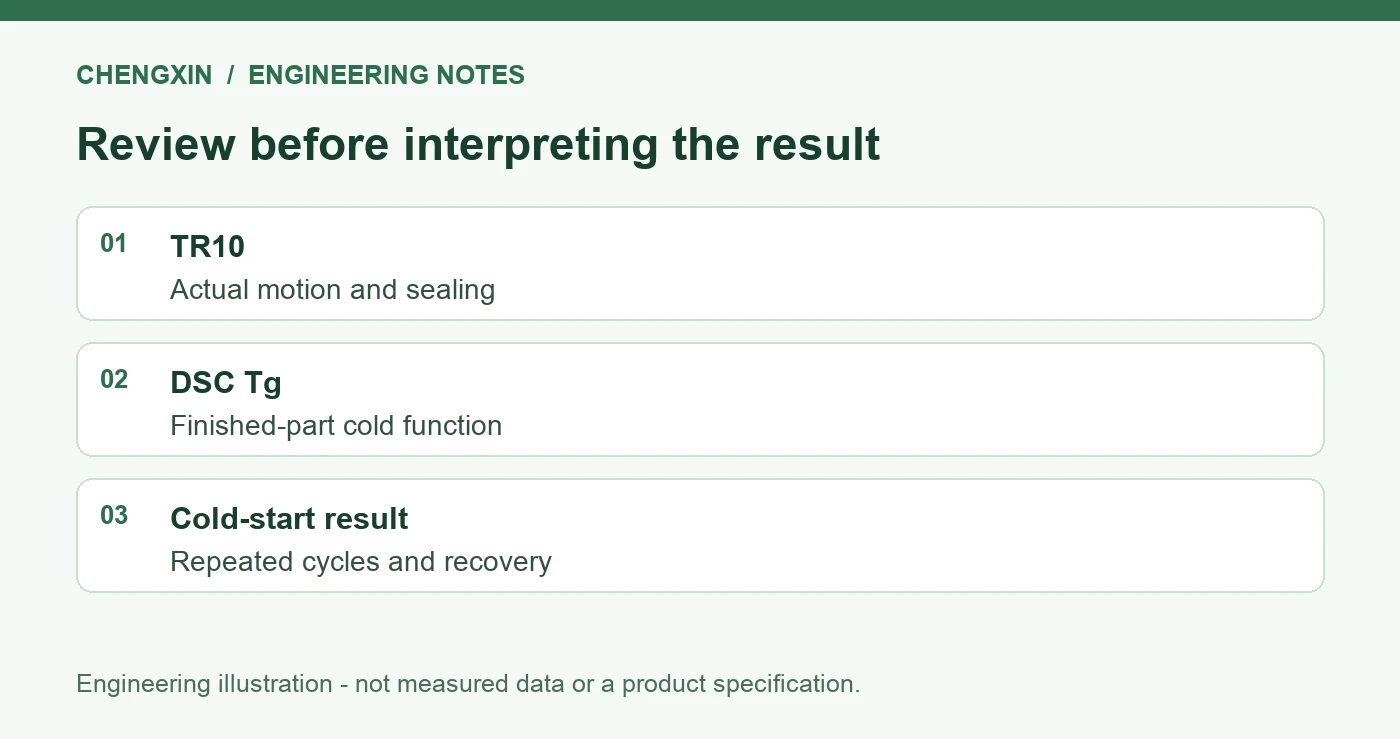
Illustrative project example
A low-Tg compound may still bind at cold startup. Check clearances, lubrication and mating-part contraction rather than clearing the structure on Tg alone. This is not a temperature promise for any grade.
Frequently asked questions
Does a lower TR10 always mean a better cold-service choice?
It helps compare specified retraction behavior; media, loads and geometry still have to suit the application.
Does normal operation after warming count as a cold pass?
No. Complete the specified function at the required cold state.
Technical references
References explain methods and terminology. They do not establish certification, acceptance limits or measured performance for a Chengxin product. Confirm the applicable edition and project-specific method with the responsible laboratory.
Related product and project inquiry
Shaped Silicone Housing Gaskets for Wearable Devices · Gasket Compression Stops: Separating Closure from Screw Torque
For a custom part review, send the drawing, application, material or performance needs, key dimensions, quantity and target test conditions. Material, tooling and acceptance requirements are confirmed for each project.