Scope and common interpretation errors
For ordinary incoming or outgoing inspection discussions, alongside customer-specified sampling standards.
For representative independent identically distributed Bernoulli trials, zero-defect probability is (1−p)^n. The model cannot fix biased top-of-box sampling, missed defects or mixed batches.
Turn the review into recorded checks
| Step | Action and evidence |
|---|---|
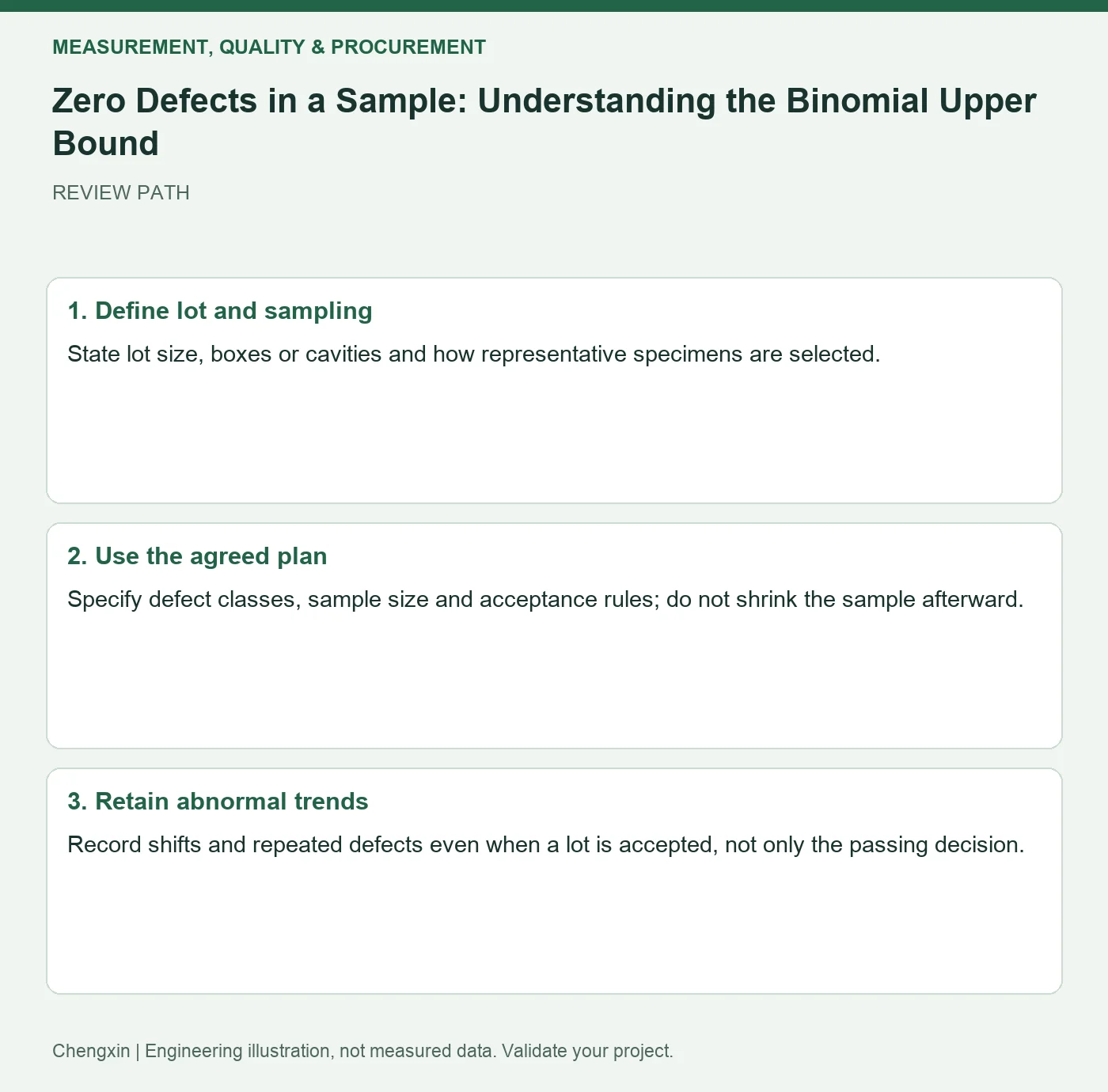
| 1 · Define lot and sampling | State lot size, boxes or cavities and how representative specimens are selected. |
| 2 · Use the agreed plan | Specify defect classes, sample size and acceptance rules; do not shrink the sample afterward. |
| 3 · Retain abnormal trends | Record shifts and repeated defects even when a lot is accepted, not only the passing decision. |
A comparison to avoid misinterpretation
Hypothetically, inspect 60 random parts with zero defects under a valid binomial model. Solving (1−p)^60 = 0.05 gives a one-sided 95% upper confidence bound of about 4.87%. This is neither the actual defect rate nor measured data from this batch. Finite-lot sampling without replacement may require a different model.
Frequently asked question
Can the probability bound replace AQL acceptance rules?
No. Upper-bound estimation, lot acceptance and contractual defect requirements answer different questions.
Background and further reading
This note addresses one specific question. For broader concepts, see the related background guide.
Related question: Passing Overall Means but Assembly Failures: Separate Mold Cavities.
External references support the relevant concepts. The review steps and scenarios are independent engineering discussion guidance, not quotations from a standard or external organization. Use agreed methods, applicable document revisions and complete conditions.
Apply this to your custom part
Compare the structure with Custom Shaped Silicone Parts. Describe the application, geometry, operating conditions, quantity and problem to solve. Submit a custom-parts inquiry, or see how to send drawings and sample photographs by business email. Confirm material, dimensions, costs, testing and delivery requirements for the project.