Develop separate path hypotheses
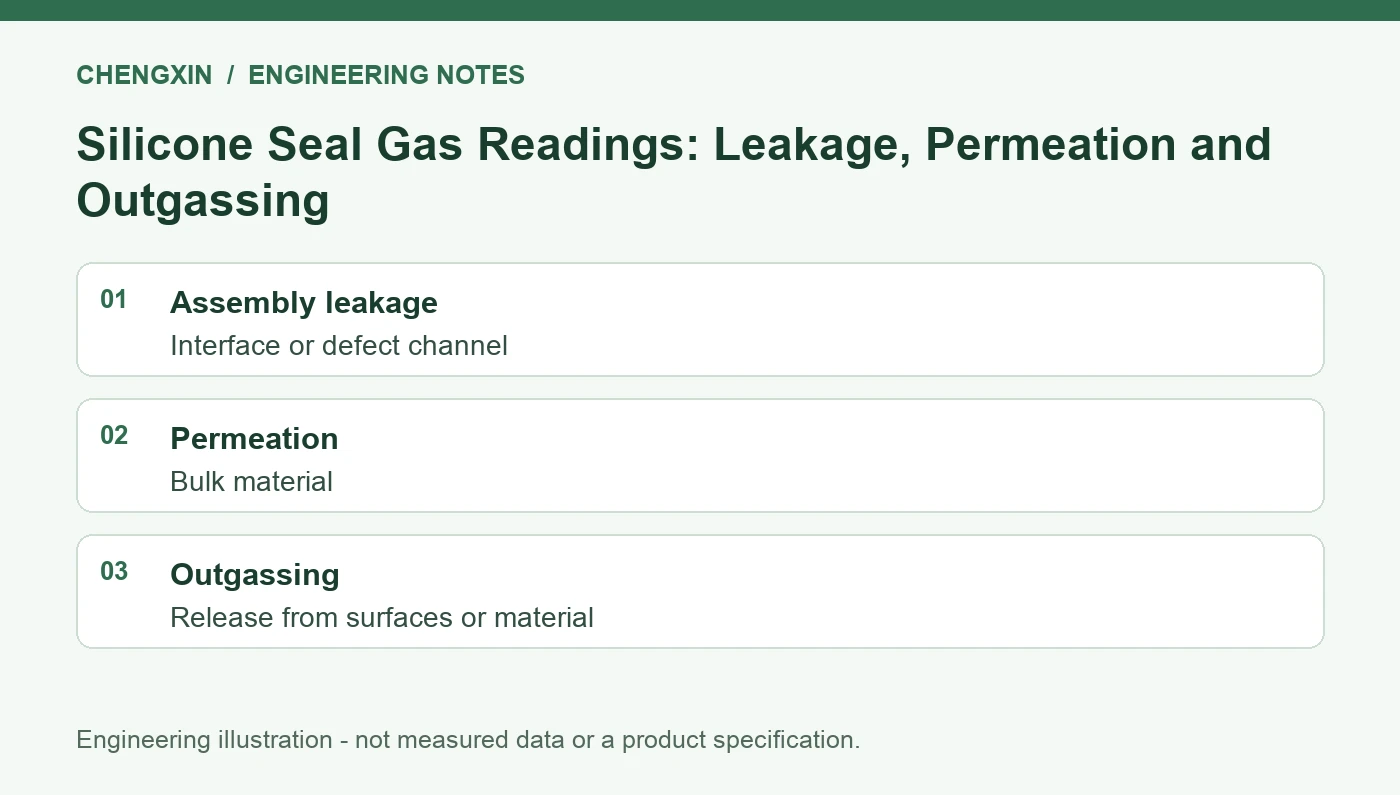
The Parker O-Ring Handbook discusses permeation and gas sealing. Treat interface leakage, transport through the material and system outgassing as separate hypotheses. A reading changing after tightening is useful evidence, but temperature and test-connection changes must still be excluded.

Make comparisons reproducible
Fix gas, pressure differential, temperature, stabilization time and test volume, and verify the fixture first. Retain the full time trend. Depending on the objective and equipment, compare exposure durations, known-state assemblies and appropriate material specimens.
Target the identified path
For assembly leakage, investigate scratches, insufficient squeeze and interfaces. If permeation dominates, reassess compound, effective path and allowed gas loss. For outgassing, investigate cleaning and conditioning. Increasing squeeze repeatedly does not address every gas signal.
Project review checklist
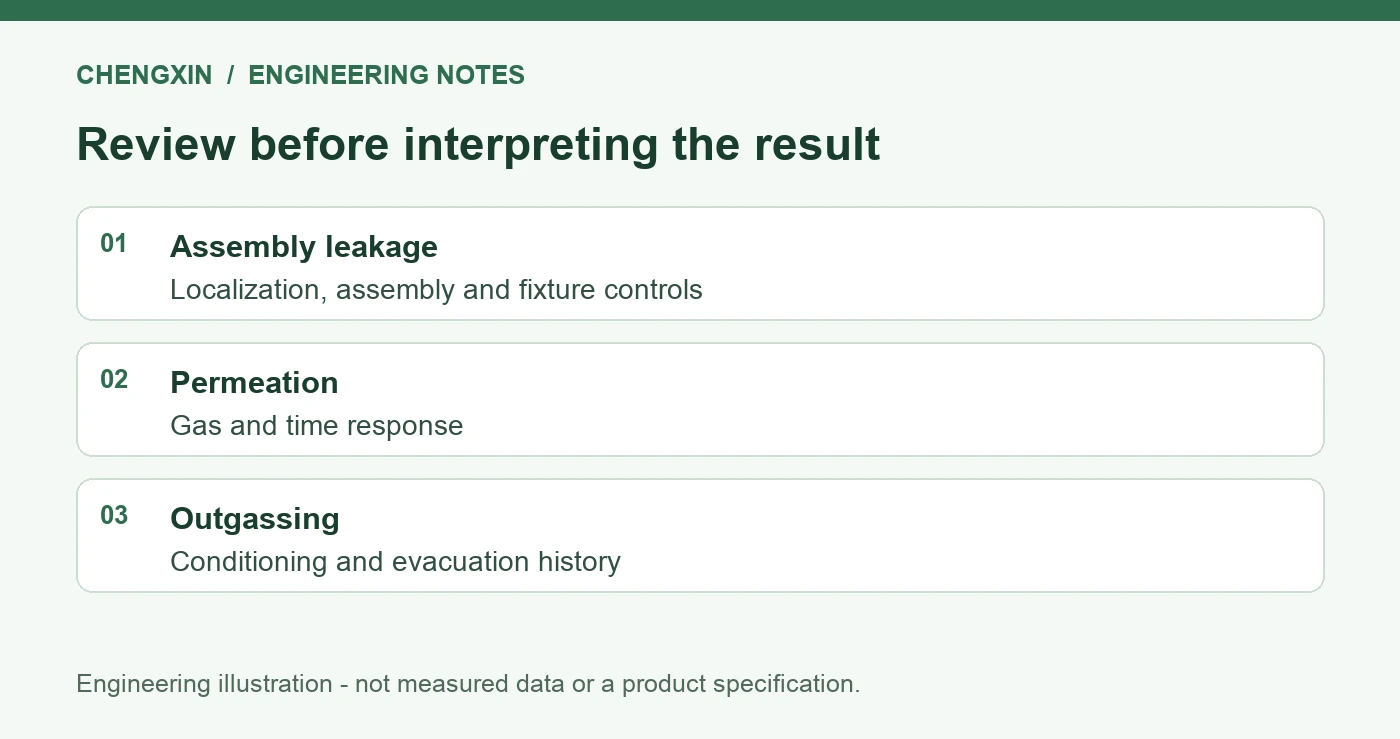
| Phenomenon | Main path | Evidence to retain |
|---|---|---|
| Assembly leakage | Interface or defect channel | Localization, assembly and fixture controls |
| Permeation | Bulk material | Gas and time response |
| Outgassing | Release from surfaces or material | Conditioning and evacuation history |
Illustrative project example
No improvement after repeated tightening does not prove permeation. Exclude test interfaces, instrument background and insufficient stabilization first. Establish repeatability before choosing further comparisons.
Frequently asked questions
Does a waterproof pass prove gas impermeability?
No. Liquid and gas transport and acceptance conditions differ.
Will harder rubber solve permeation?
Hardness alone does not establish gas-barrier performance; validate the specific compound and conditions.
Technical references
References explain methods and terminology. They do not establish certification, acceptance limits or measured performance for a Chengxin product. Confirm the applicable edition and project-specific method with the responsible laboratory.
Related product and project inquiry
Precision Silicone O-Rings for Watches · Silicone O-Ring Gland Fill: Allowing for Expansion and Swell
For a custom part review, send the drawing, application, material or performance needs, key dimensions, quantity and target test conditions. Material, tooling and acceptance requirements are confirmed for each project.